Key findings:
Backlogs balloon with noise.
Teams running five or more AppSec tools regularly end up with backlogs in the thousands — most of it duplicate, unreachable, or long since irrelevant.
An audit is the only source of truth.
It’s the only way to know whether your backlog reflects your actual risk, or just how many tools you have running.
A repeatable framework gets you through 1,000+ findings.
Seven ordered steps, from consolidation to re-filing, turn an unworkable pile into a real backlog.
Cadence keeps it from ballooning again.
Continuous and event-driven is the target; short of that, a full audit quarterly and a lightweight one every sprint.
If your backlog grows faster than your team can work through it, this cheat sheet is for you.
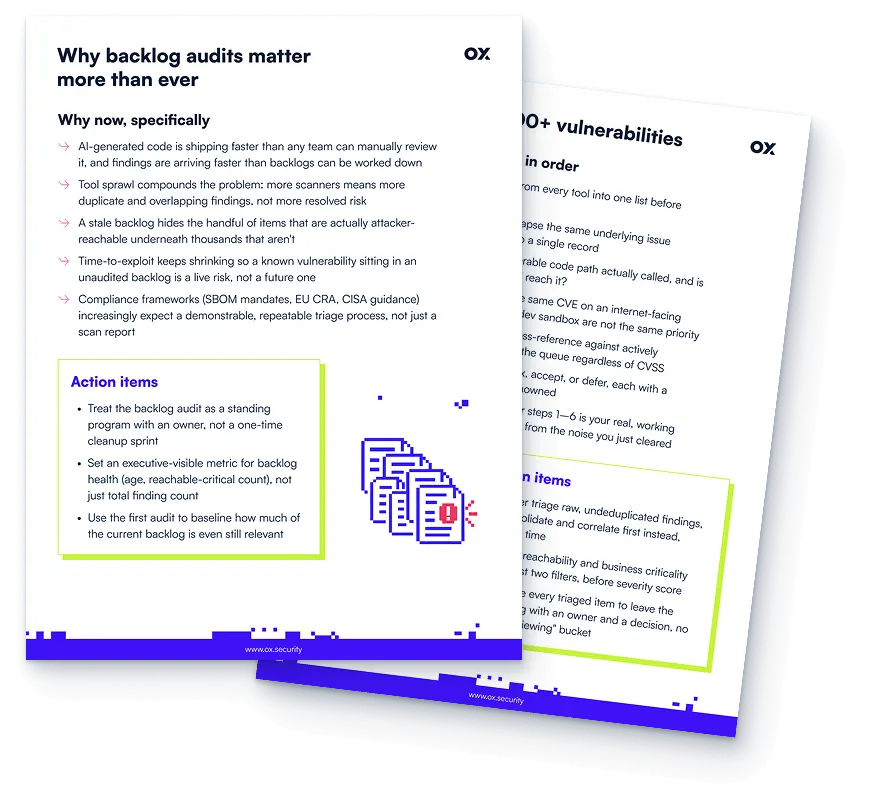
Whole days disappear into triage meetings, jumping between dashboards, chasing false positives, and re-litigating the same finding across tools that all flagged it differently. Tool sprawl compounds the problem — more scanners means more duplicate and overlapping findings, not more resolved risk. A stale backlog hides the handful of items that are actually attacker-reachable underneath thousands that aren’t, and with time-to-exploit shrinking, a known vulnerability sitting in an unaudited backlog is a live risk, not a future one.
Inside the cheat sheet: the 7-step triage framework
- Consolidate. Pull every finding from every tool into one list before triaging anything.
- Deduplicate and correlate. Collapse the same underlying issue reported by multiple scanners into a single record.
- Filter by reachability. Is the vulnerable code path actually called, and exposed to something that could reach it?
- Weight by business criticality. The same CVE on an internet-facing production service and an internal dev sandbox are not the same priority.
- Flag known-exploited activity. Cross-reference against actively exploited / KEV-type lists — these jump the queue regardless of CVSS.
- Assign an owner and a decision. Fix, accept, or defer — each with a name and a date attached, not left unowned.
- Re-file what’s left. What remains after steps 1–6 is your real, working backlog — track it separately from the noise you just cleared.
By the numbers:
- 5+ AppSec tools is enough to push a backlog into the thousands — mostly duplicate, unreachable, or irrelevant.
- 1,000+ findings is the scale a modern audit has to get through.
- 7 ordered steps in the repeatable triage framework.
- Quarterly full audit minimum, with a lightweight audit every sprint — until continuous, event-driven becomes the norm.