

From an innocent-looking SQL import to startup-folder persistence: Understanding the risk in patched IBM App Connect Enterprise Toolkits
Overview
OX Research found and disclosed a SQL injection vulnerability in the IBM App Connect Enterprise and IBM Integration Bus for z/OS Toolkit.
The SQL injection vulnerability allows the attacker to create arbitrary files on the victim’s machine without the victim’s knowledge. Successful exploitation of this vulnerability requires user interaction, so a remote attacker would need to use social engineering techniques to trick the user into performing actions that trigger the vulnerability.
In the proof of concept shared with and responsibly disclosed to IBM, this capability was leveraged to achieve remote command execution on a victim’s machine, ultimately resulting in a complete system compromise.
The issue was published as CVE-2026-3602 inside IBM’s official advisory.
Vulnerability Details
CVE: CVE-2026-3602
Description: IBM App Connect Enterprise is vulnerable to SQL injection. A remote attacker could socially engineer a user into accidentally creating files they may not be aware of.
CWE: CWE-73: External Control of File Name or Path
CVSS Source: IBM
CVSS Base score: 4.7
CVSS Vector: (CVSS:3.1/AV:L/AC:H/PR:N/UI:R/S:U/C:N/I:H/A:N)
About IBM App Connect Enterprise and IBM Integration Bus for z/OS toolkit
IBM App Connect Enterprise (ACE) and IBM Integration Bus (IIB) for z/OS are enterprise integration platforms that enable organizations to connect applications, services, and data across different environments. The associated Toolkit provides developers and administrators with tools to design, configure, test, and manage integration flows and related resources.
These platforms are widely adopted by large enterprises and organizations that rely on IBM middleware solutions to support critical business processes and integrate complex IT environments. Due to their use in enterprise-scale deployments, vulnerabilities affecting these products may have a significant impact on organizations that depend on them for application and data connectivity.
Responsible Disclosure Timeline
- February 26, 2026 – Initial disclosure
- February 26, 2026 – IBM acknowledges the vulnerability
- June 29, 2026 – CVE-2026-3602 is assigned and the issue is made public
- July 15, 2026 – IBM updates us that the vulnerability was patched
Technical Details
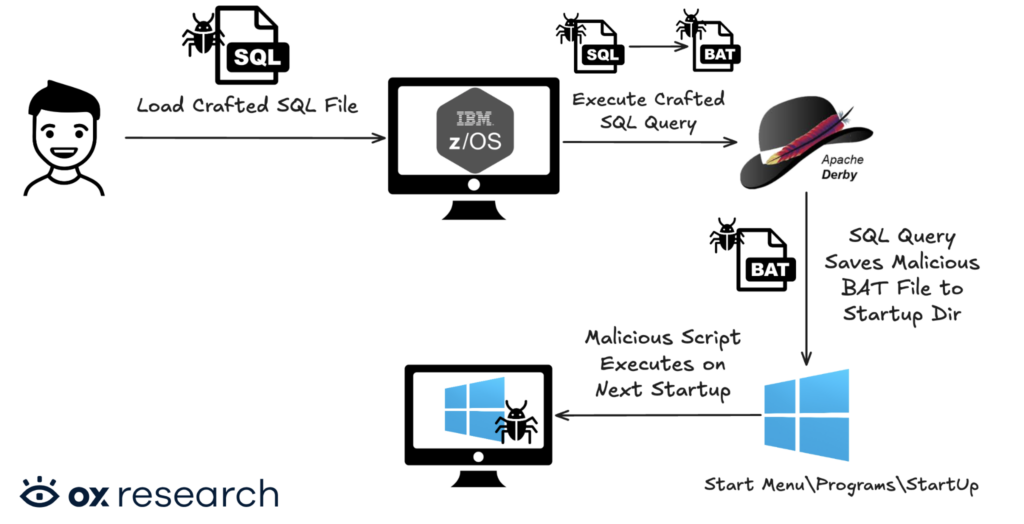
The application provides functionality for opening SQL files. We created a specially crafted SQL file that, when loaded by the application, exploits the SQL injection vulnerability that allows the creation of a file anywhere on the targeted system, by leveraging this vulnerability, an attacker can create arbitrary files inside sensitive directories such as the startup folder in order for the file to be executed next time the machine starts.
The application allows the user to select a connection profile. In our proof of concept, we created a Derby connection profile that can be abused to trigger the vulnerable code path and exploit the SQL injection vulnerability.
An attack scenario should look something like this: A threat actor generates a .sql file which contains both legitimate data, and the SQL injection attack inside with a malicious script inside. The victim receives the innocent looking .sql file, and imports it to IBM App Connect Enterprise in order to use the data inside. Once the victim loads the malicious .sql file, everything continues to work normally, but in the background the SQL database was tricked to write a script in the startup directory, which will launch the next time the computer boots up.
By exploiting the vulnerability, we were able to write arbitrary files to the victim’s local machine, which were subsequently leveraged to achieve arbitrary command execution, ultimately resulting in a complete system compromise.
Proof of Concept Diagram
Video:
Affected Products and Versions
| Affected Product(s) | Version(s) |
| IBM App Connect Enterprise | 13.0.1.0 – 13.0.7.2 |
| IBM App Connect Enterprise | 12.0.1.0 – 12.0.12.26 |
| IBM Integration Bus for z/OS | 10.1.0.0 – 10.1.0.7 |
Remediation
Addressing the vulnerability is possible by applying the appropriate fix to IBM App Connect Enterprise and IBM Integration Bus for z/OS:
| Product | Fixes |
| IBM App Connect Enterprise | Fix Pack Release 13.0.8.0 |
| IBM App Connect Enterprise | Fix Pack Release 12.0.12.27 |
| IBM Integration Bus for z/OS | Interim Fix is available to apply to 10.1.0.7 from IBM Fix Central |