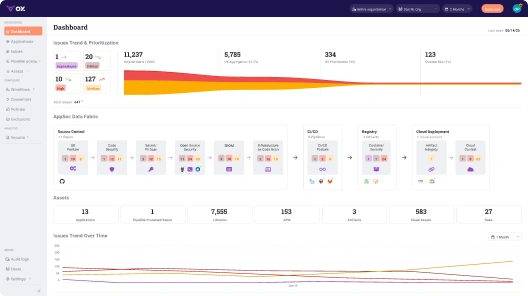

Why Your AppSec Remediation Needs a Serious Upgrade
By now, you’ve heard it all before: “AI-powered,” “LLM-enhanced,” “next-gen machine learning.” Every security vendor says the same things—often in the same words (complicating the buying and using processes). It’s the AI arms race, and everyone’s calling out buzzword bingo at the same time. But here’s the problem: Most of those promised AI features? They’re generic. They generate boilerplate advice, cookie-cutter recommendations, and one-size-fits-nobody fixes.
In AppSec, that kind of genericism doesn’t just slow teams down. It makes security worse. It floods developers with irrelevant tasks and unsuitable suggestions. And it costs time and money while developers try to retrofit blanket remediation advice into their code, in their environment, and with their dependencies, workflows, and all kinds of particulars.
We think it’s time to raise the bar.
At OX Security, we’re not interested in AI for the headline. We’re interested in AI that eliminates the generic—AI that understands your environment, your stack, and your codebase. That’s why we’re rolling out a major upgrade to the OX Platform: “Agent OX,” an AI-powered remediation and context-aware detections that work with your repos, pipelines, and IDEs to help you fix what matters.
This is AppSec tuned to your world. And it starts with killing the copy/paste provided by run-of-the-mill AI outputs from run-of-the-mill security vendors.
We’re Done with Generic — And You Should Be Too
In today’s software development lifecycle, vulnerabilities are created faster than ever, but here’s a secret: only a tiny fraction of them are actually reachable, exploitable, and truly relevant to your environment. Unfortunately, most security recommendations often fall flat. They’re like that one-size-fits-all t-shirt that fits no one quite right. They’re:
- Generic as can be: “Sanitize inputs” or “use a secure function” —sound familiar? These vague suggestions ignore your language, framework, and unique codebase. A Python project gets the same advice as a JavaScript microservice. That shouldn’t happen…
- Lacking real code context: They don’t analyze your specific codebase or usage patterns.
- Disconnected from your tech stack: They ignore your organization‘s individual architecture, the libraries you trust, or the deployment model(s) your team has adopted.
And the result? Always the same:
- Wasted development cycles chasing low-risk or irrelevant issues.
- Pushback from developers who see the suggestions as noise, not insight.
- Security fixes that are never merged because they break functionality, introduce regressions, or have little perceived value.
When teams spend time fixing generic issues that don’t impact real risk, they create a false sense of security while leaving truly dangerous vulnerabilities in place. This creates security theater—lots of activity but no meaningful risk reduction. This, in turn, leads to developer frustration, insecure workarounds, skipped vulnerability remediation, and eroded trust with security teams.
This is why business-specific, context-aware remediation is essential. It ensures that the time your developers spend on security is time well spent—solving problems that are real, urgent, and tailored to your environment. Developers don’t need another list of arbitrary tasks. They need intelligent, actionable help—rooted in how they work, and focused on what impacts the security of the software they build.
Could the AppSec and ASPM tools vendors have offered tailored remediation without AI? Yes, and some of them have. But it’s resource-intensive, which leads to high costs, and is the reason (until now) most security software vendors could only offer generic remediation guidance.
Generic is better than nothing. But fortunately we have the ability to move beyond that now.
What’s New in the OX Platform
With Agent OX, we’re introducing a complete AI remediation experience that provides contextual recommendations tailored to your code—not a random codebase or some other company’s SDLC.
Key highlights include:
Code-specific fixes inside your developers’ flows
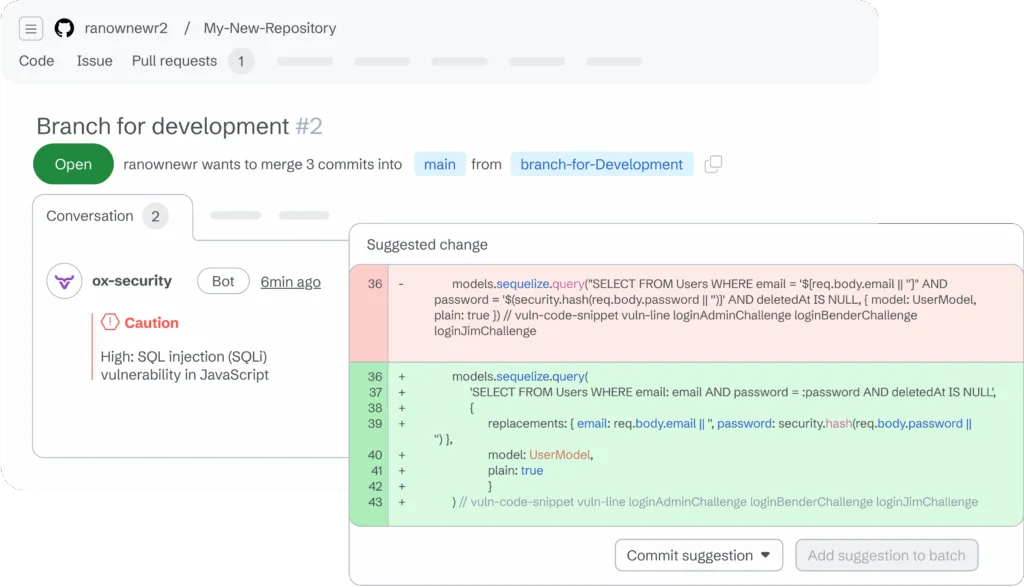
Get targeted remediation suggestions delivered directly to the PR, tailored to the exact line of code and repo configuration—eliminating the need to dig through tickets or dashboards.
AI-assisted remediation based on environmental context
The Agent OX remediation engine analyzes your actual stack and environment to generate fixes that are deployable, relevant, and tested—no more generic suggestions that create more noise than value.
Fix in flow across IDEs, CI/CD, and PRs
Developers can act immediately within the tools they already use. OX integrates across the full SDLC to ensure remediation happens in the moment, not after the fact.

One-click remediation aligned to your codebase
Fix vulnerabilities instantly with AI-generated patches tailored to your specific code and app architecture. One click in the IDE or PR view applies the right code—no guesswork required.

Support for Your Stack
Initial rollout supports Python and JavaScript, with Java and other languages on the roadmap.
| Feature | Traditional SAST | OX Security |
|---|---|---|
| Custom Fix for Your Codebase | ❌ | ✅ |
| Generic Recommendations | ✅ | ❌ |
| Inline Fix Suggestions (MR) | ❌ | ✅ |
| CI/CD + IDE Integration | ❌ | ✅ |
| Code Reachability Awareness | ❌ | ✅ (Code Projection) |
| False Positive Reduction | ❌ | ✅ (95%↓) |
How Agent OX Works Its Magic
- Accurate detection: OX identifies vulnerabilities through native scanning or third-party integrations—code, dependencies, containers, or runtime issues.
- Code Projection: OX’s proprietary code projection determines if the issue is reachable, exploitable, and impactful in your actual environment—cutting out noise and false positives.
- Context-aware AI analysis: OX’s AI analyzes the surrounding code, architecture, and runtime context to generate tailored, secure fixes—not boilerplate suggestions.
- Faster fix in one click: Developers receive precise, code-specific remediation recommendations directly in their IDE or PR. Most fixes can be applied instantly with one click, minimizing disruptions to flow.
- Enhanced delivery and control: Fixes are surfaced contextually—where developers work. They can review, customize, approve, or reject suggested changes without triggering re-scans or risking branch conflicts.
Who Benefits From Agent OX?
All of you, actually! The fact is, all cybersecurity efforts—application/software security, or network, endpoint, and more—need to start with a solid foundation. That is, starting at the most fundamental element, which is often visibility. You can fix what you can’t see, after all. But visibility with the ability to act is simply knowledge, nothing more, and certainly nothing that will improve an organization’s security posture and reduce its cyber attack surface.
AppSec teams today want more than visibility; they need accurate, easy-to-follow instructions that can substantively improve their risk posture and allow the business to quickly and reliably deploy secure applications.
Some of the common themes we’ve heard from customers and prospects include:
“We want the platform to tell us what to fix, and how to fix it — not just throw alerts at us.”
“We like the concept of copilot-style suggestions on PRs. We’re already using that with other tools, and we want the same in OX.”
“Improve the quality of the SAST recommendations — they’re too generic today.”
Helping AppSec and DevOps Teams Work Smarter
With this new AI-assisted feature, OX customers can now:
- Customize severity and PR gating rules
- Include/exclude AI fixes in SLA policies
- Adjust CI/CD feedback flows for in-pipeline recommendations
- Enable IDE integrations for real-time development guidance
OX works with your organization’s individual development styles—whether that’s monorepos, microservices, or something in between.
Final Thoughts
We built this feature not because AI is trendy, but because it solves a real problem: Security tools shouldn’t just point out flaws. They should help fix vulnerabilities and do it in a way that makes sense for modern software development and developer workflows.
OX’s AI remediation capability is a force multiplier for DevOps and AppSec teams, providing the context and definitive guidance to fix the most critical flaws in software as they arise. By integrating AI functionality into the OX Security platform, we’re taking advantage of all the positives AI can offer: speed, flexibility, customization, and greater accuracy.
Stop fixing the wrong things. OX now delivers AI-generated remediation tailored to your environment—so your teams can focus on what matters. Generic AppSec suggestions waste time. OX’s new Agent OX AI-assisted remediation gives your developers context-aware fixes they can trust and merge.