
Because security isn’t about finding everything — it’s about finding what matters.
Malicious dependencies aren’t bugs. They’re backdoors. They’re stealthy packages uploaded to public registries like npm, PyPI, and Maven Central by cyber criminals with the explicit intent to steal credentials, exfiltrate data, or sabotage systems.
Many traditional AppSec or general-purpose security tools won’t catch them. And that’s a problem. It gives attackers an advantage; at OX, we’re not OK with that.
To help businesses improve their AppSec programs and deliver secure software with confidence, OX is announcing our newly enhanced malicious dependency detection — a major upgrade to our platform’s native Software Composition Analysis (SCA) that identifies packages specifically designed to harm the business.
Why Malicious Dependencies Matter
The modern software supply chain depends on open source and third-party packages — which makes it a massive attack surface. Malicious packages in software are becoming increasingly common and deeply problematic because they:
- Are intentionally built by threat actors to cause harm
- Masquerade as legitimate dependencies
- Often go undetected by traditional / common SCA detection tools
Standard tools miss the mark. They flag outdated versions or missing patches — not intentionally harmful code.
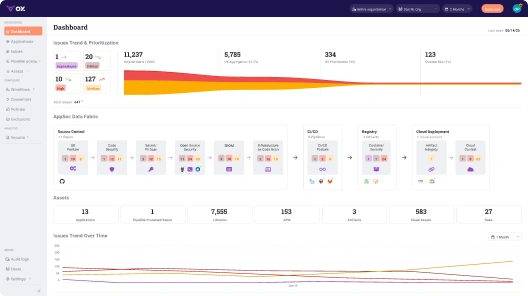
That’s why OX built real-time, curated detection backed by our Code Projection and runtime-aware context. It doesn’t just identify whether a package has an issue — it shows AppSec teams whether the package vulnerability is reachable, exploitable, and poses a threat.
What Are Malicious Dependencies?
In short, a malicious dependency is a software package purposely crafted to execute harmful or unauthorized actions.
These actions may include stealing credentials, executing remote code, exfiltrating data, sabotaging systems, or introducing backdoors.
Unlike traditional vulnerabilities (e.g., CVEs), these threats are deliberate (rather than a coding error, for instance) and often evade standard vulnerability scanners.
Examples of malicious dependencies include:
| Type | Example | Impact |
| Typosquatting | urllib3-secure | Mimicked urllib3, included code to exfiltrate system information |
| Protestware | es5-ext | Included a payload that added political messages in logs |
| Hijacked Dependencies | ua-parser-js | Credential stealer and cryptominer injected via hijacked maintainer account |
| Install-Time Attacks | noblox.js fork | Malicious fork exfiltrated tokens on install |
| Credential Theft | crypto-random | Sent .npmrc credentials and ENV secrets to attacker-controlled server |
| Dependency Confusion | amzn-core | Posed as internal AWS dependency, captured traffic |
Detecting the 5% of Malicious Dependencies That Matter
At OX, we’ve always said: 95% of AppSec alerts don’t matter. That’s truer than ever in the world of SCA. Most security tools bombard AppSec and DevOps teams with outdated CVEs or version mismatches. OX allows teams to eliminate the noise and focus on software risks that present business risk.
Our newly enhanced malicious package detection engine goes beyond public CVE and generic findings to identify:
- Known malicious packages across 30,000+ curated entries
- Behavior patterns that indicate credential theft, exfiltration, or sabotage
- Intentionally placed backdoors in code that may allow remote code execution
- All affected repos or branches
Once a malicious dependency is identified, the OX platform automatically analyzes the finding to determine if the package is referenced and/or used and whether the malicious package is reachable, executable, and impactful (in that specific environment and with deployed controls). OX then provides detailed recommendations for remediation. This process allows for accurate, contextualized, and reliable prioritization of issues, reducing the ever-present problem of false positives and alert fatigue.
With this new functionality, OX customers gain advanced detection capabilities above and beyond “regular” SCA detection, allowing teams to see and understand known and wild malicious dependencies. OX’s major competitive advantage with this functionality is that our platform provides deep context and reduces the noise of traditional malicious dependency detection, while many other commercial ASPM and AppSec tools will tag most (if not all) findings as “critical” without analyzing whether the finding is exploitable.
Policy-Backed, SBOM-Ready
Once a malicious package is detected, customers will see a “Malicious Dependency in Code” issue appear in the “SBOM Policies” section of the platform.
From there, users will get:
- Full visibility of dependencies in SBOM and Issue dashboards
- Branch- and repo-specific tracking
- Auto-assigned severity (“Critical” or “Apocalypse”)
- Remediation guidance based on usage
- OSINT references for every threat
This data helps security and development teams learn about real risks faster, remediate with precision, and demonstrate true risk reduction throughout the software development lifecycle (SDLC).
Visual Comparison: Why Prioritization Beats Detection Alone
| Feature | OX Security | Snyk | GitHub | JFrog | Nexus |
|---|---|---|---|---|---|
| Detects known malicious packages | ✅ Yes | ✅ | ✅ | ✅ | ✅ |
| Context-aware prioritization | ✅ Yes | ❌ | ❌ | ❌ | ❌ |
| Code reachability via Code Projection | ✅ Yes | ❌ | ❌ | ❌ | ❌ |
| False positive reduction | ✅ 95%↓ | ❌ | ❌ | ❌ | ❌ |
| SBOM + branch-level tracking | ✅ Yes | ❌ | ❌ | ❌ | ❌ |
A Real Example: node-ipc in Your Environment
Let’s say node-ipc is flagged. In most tools, that means AppSec teams:
- Receive a “critical” issue alert
- Can’t identify if the issue executed
- Can’t see which (if any) branches are affected
- Lack the context to determine whether to fix or ignore the issue
OX provides the granular insights that give teams the concrete evidence they need to make prioritized decisions. The OX platform shows:
- Whether the dependency is used in runtime
- If it exists in a dev-only branch
- The originating repo
- Remediation recommendations and the ability to automate workflows to prevent issues from propagating
Built for Modern DevOps
Malicious dependency detection is enabled by default for all customers. Users may customize:
- Trigger severity
- PR gate enforcement
- Notifications and escalations
- Reporting inclusion/exclusion
- SLA rules and remediation workflows
Whether teams manage one monorepo or 100 microservices, malicious dependency coverage scales with the organization — and stays relevant.
Final Thoughts
Malicious dependencies represent a fast-moving, high-impact threat vector — and until now, they’ve slipped past most AppSec tooling undetected or unprioritized.
With OX Security, AppSec and DevOps teams don’t just find risky dependencies; they fix what matters. The OX ASPM platform provides relevant, evidence-based context awareness per environment and per your deployed controls. This isn’t generic vulnerability detection; OX helps you cut through the noise of low-risk software vulnerabilities to implement actionable remediation recommendations.
This new capability brings malicious package detection into the same unified AppSec platform trusted by hundreds of engineering teams. And just like our approach to CI/CD security, SBOM, and multi-branch scanning, it’s built to prioritize signal, not noise.
Securing your software supply chain isn’t about reacting to every alert. It’s about knowing which ones are real.