Understanding Software Composition Analysis for Secure Development
In modern application development, open source components are everywhere. They power innovation, speed up development, and enable teams to build complex software at scale. But with great power comes hidden risk. The more open source code developers use, the more important it becomes to understand exactly what’s inside your application — and whether any of those components could introduce security or compliance issues.
This is where Software Composition Analysis (SCA) scans come into play. SCA scanning is an essential part of a mature application security program. It helps security and development teams identify and manage the open source components that make up their software, and to do it continuously, accurately, and at scale.
Let’s walk through what an SCA scan is, why it matters, and how organizations can use it to secure modern software development.
What is Software Composition Analysis (SCA) Scanning?
SCA scanning is the automated process of analyzing source code and software artifacts to identify open source components, third-party libraries, and their associated metadata, including licenses, known security vulnerabilities, and versioning information.
SCA scanners work by comparing your codebase against vast databases of known open source projects and vulnerabilities (like the National Vulnerability Database, or NVD). The result is a detailed Software Bill of Materials (SBOM), which inventories the software components in use, tracks their origin, and flags any known issues.
Why Software Composition Analysis Is Important
Open source software accelerates development, but it also introduces significant risks. Vulnerabilities in open source libraries — especially if those libraries are deeply embedded or rarely updated — can have a serious impact on application security.
Consider well-known cases like Log4Shell, a critical vulnerability in the popular Log4j library. Organizations using Log4j needed a fast, reliable way to understand where it was being used in their applications, whether the vulnerable versions were present, and how to remediate them. SCA scanning made that possible.
SCA doesn’t just help detect vulnerabilities; it helps AppSec teams:
- Ensure license compliance across projects
- Manage dependency sprawl and version drift
- Enable traceability for audits and risk assessments
- Support regulatory compliance
- Improve collaboration between development and security teams
Open Source Component Identification in SCA
At its core, SCA scanning helps organizations answer a fundamental question: What’s in my software?
To truly understand what comprises software, you must be able to identify every open source and third-party component, whether explicitly imported or bundled as a transitive dependency. An effective SCA scan detects these components even if they’re deeply nested or obscured within package managers and build artifacts.
Most tools also provide metadata about each component, including:
- Version number and release history
- License type (e.g., MIT, GPL, Apache)
- Known vulnerabilities and CVEs
- Usage prevalence and community maintenance status
Vulnerability Detection in SCA
A key outcome of any SCA scan is the identification of security vulnerabilities.
Once a scan maps your codebase to known components, it checks those against public vulnerability databases. When a match is found, it alerts the team to potential security risks, often with links to CVEs, remediation advice, and severity scores.
More advanced SCA tools go further. They evaluate:
- Whether a vulnerable component is loaded at runtime
- Whether the vulnerable function is reachable from your code
- Whether safe version upgrades are available
This allows AppSec and DevOps teams to focus on both present and exploitable vulnerabilities rather than wading through hundreds of theoretical risks.
Continuous Monitoring and the Role of SBOMs
Modern SCA solutions don’t just perform one-time scans; they support continuous monitoring, tracking changes to the software supply chain in real time.
As developers commit new code, update packages, or change build processes, the SCA platform updates the SBOM accordingly. This dynamic, always-current SBOM can then be used for ongoing vulnerability detection, license management, and compliance reporting.
SCA also plays an important role in incident response. If a new vulnerability is disclosed (say, another Log4Shell-class event), security teams can quickly determine which applications are affected and prioritize mitigation.
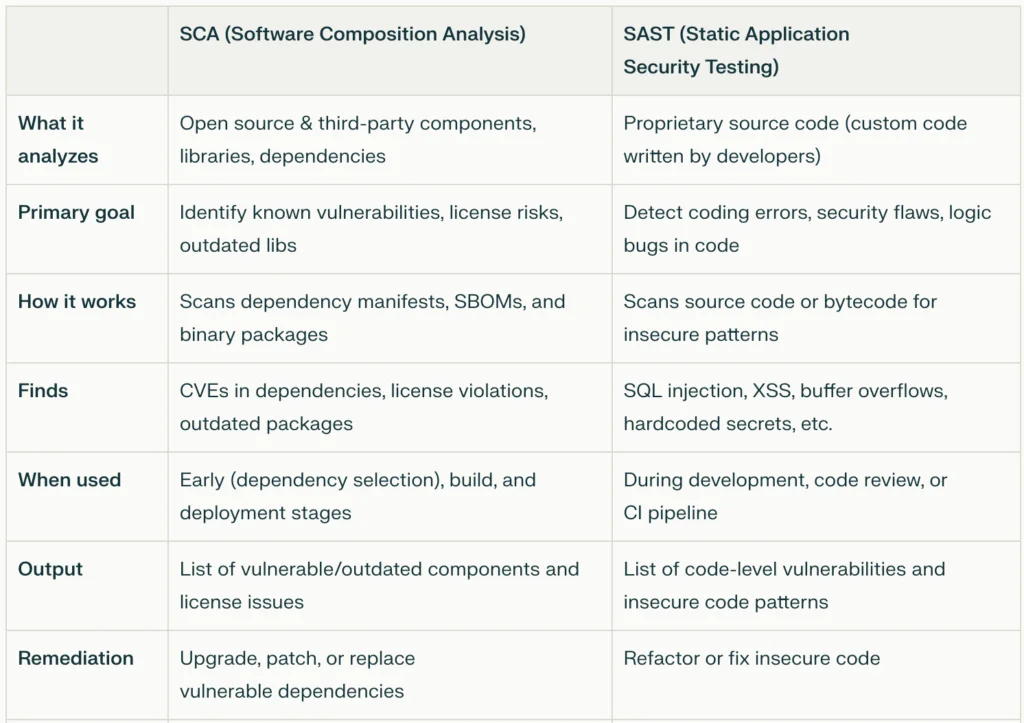
SAST vs. SCA: What’s the Difference?
SCA is often mentioned alongside Static Application Security Testing (SAST), and for good reason — they’re complementary.
- SAST analyzes your proprietary source code for insecure patterns, logic flaws, and other coding mistakes.
- SCA analyzes the open source and third-party code you didn’t write but rely on.
Together, they provide a more complete view of application risk. SAST catches vulnerabilities in your custom code; SCA covers your dependencies. Both are critical for secure software development.
Benefits of Software Composition Analysis
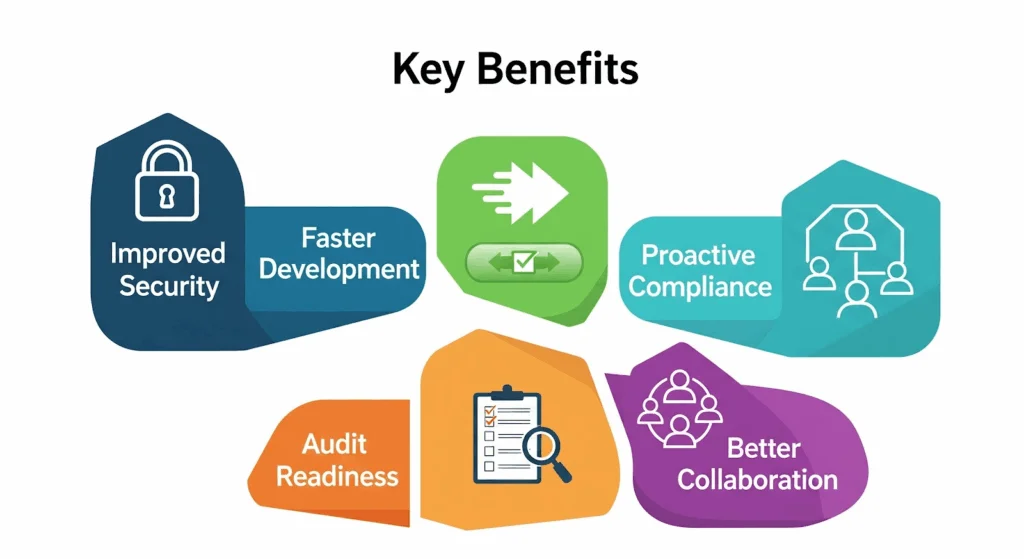
The benefits of implementing SCA scans are far-reaching:
- Improved security: Quickly detect and prioritize vulnerabilities in open source components.
- Faster development: Avoid manual license reviews and reduce rework caused by late-stage risk discovery.
- Proactive compliance: Ensure third-party code meets legal and policy requirements.
- Audit readiness: Maintain an always-updated SBOM for due diligence, vendor risk management, and regulatory reporting.
- Better collaboration: Create shared visibility across development, security, and legal teams.
Implementing SCA Effectively
Getting started with SCA requires more than just choosing a tool. Success comes from integrating SCA into your development lifecycle, CI/CD pipelines, and broader application security strategy.
Key best practices include:
- Automate early and often: Run SCA scans at every commit, build, and deployment stage.
- Create a comprehensive SBOM: Use SCA to maintain an accurate, detailed software inventory.
- Prioritize intelligently: Focus on exploitable vulnerabilities using runtime context when available.
- Reduce false positives: Tune alerts and policies to avoid alert fatigue.
- Track and report: Ensure findings are visible to both developers and security stakeholders.
Who Should Use SCA?
SCA is essential for any organization building, deploying, or managing modern software, especially if open source plays a role (which it almost certainly does).
Relevant stakeholders include:
- Developers who want visibility into their dependencies
- Security teams who are responsible for securing applications across the SDLC
- Legal/compliance who must enforce license policies and ensure regulatory alignment
- Executives who are concerned about software supply chain risk
Types of SCA Scanning Tools
The SCA market includes a wide range of tools, from open source linters to full-featured enterprise platforms. Categories include:
- Standalone scanners: Local or cloud-based tools for manual scans
- CI/CD integrations: SCA tools embedded into build pipelines
- Platform integrations: SCA as part of larger AppSec or DevSecOps platforms
How to Choose the Right SCA Tool
When evaluating SCA scanning tools, consider:
- Language and framework support: Does the tool support your stack?
- SBOM generation: Can it export CycloneDX or SPDX formats?
- Runtime context: Does it distinguish exploitable from theoretical risk?
- Integration: Does it fit into your existing workflows (e.g., GitHub, Jenkins)?
- Remediation support: Does it offer actionable advice or PR generation?
Why Automated SCA Scanning Matters
Automation is key. Without it, SCA scans can become outdated quickly, and vulnerabilities can slip through the cracks.
Automated SCA scans enable:
- Continuous visibility into open source use
- Rapid identification of new risks
- Faster response to disclosed vulnerabilities
- Scalable risk reduction across large codebases
Conclusion
As open source software becomes increasingly critical to digital products and services, so too does the need to secure it. SCA tools provide the insight, automation, and context security teams need to manage open source risk — without slowing down development.
By implementing effective SCA scanning with a trusted solution like OX Security, organizations can build safer, more resilient applications and do so with confidence.