Summary
Reached zero critical vulnerabilities and 95% AppSec noise reduction via OX.
Swisscom, a leading European telecommunications provider, confronted a modern engineering paradox: rapid AI adoption was accelerating software delivery, but it was also generating flawed code at an unmanageable scale.
To cut through the noise of legacy scanners, Swisscom moved beyond narrow, reactive security tools and deployed OX AINAPP. By adopting a unified, code-to-runtime approach, Swisscom reduced critical findings by 95% and achieved zero critical vulnerabilities in key areas for the first time in the company’s history.
The Catalyst
VibeCoding and the Vulnerability "Swamp"
For Colin Geisser and the Omni Channel Experience team, managing security alerts had become an exhausting, reactive battle. Geisser described the effort vividly, noting that
“Managing vulnerabilities felt like draining a swamp, we had so many that it became overwhelming”.
This challenge was heavily compounded by the rise of AI-assisted coding.
As the team embraced AI native development (VibeCoding), the speed of software creation skyrocketed, but so did the volume of vulnerabilities. Geisser explains the impact of AI on code quality:
“Now, with AI, we still have bad code like before, just more of it, and at a faster pace”.
Traditional, after-the-fact scanning tools simply created alert fatigue and could not keep pace with AI-generated code. Swisscom urgently needed a paradigm shift from finding vulnerabilities to ensuring prevention at creation.
The Strategy
A Unified Platform for AI-Native Security Engineering
To regain control and fundamentally restructure their risk management, Swisscom transitioned to AI native Security Engineering (Vibe Security). The implementation was seamless, as Geisser points out:
“From the beginning, the onboarding process to their SaaS solution was simple and smooth”.
This allowed the team to onboard 1,000 repositories in just a few days without encountering a single issue.
Swisscom’s new security posture was built on the core pillars of the OX Security platform, operating through a Unified control plane:ё
- OX Security VibeSec & OX Security Code: Embedding real-time protection directly into IDEs and AI editors to stop vulnerabilities before they are created.
- OX Security Cloud & OX Security Agentic Pentester: Closing the loop on application security risk by using autonomous agents to conduct environment-aware, dynamic testing.
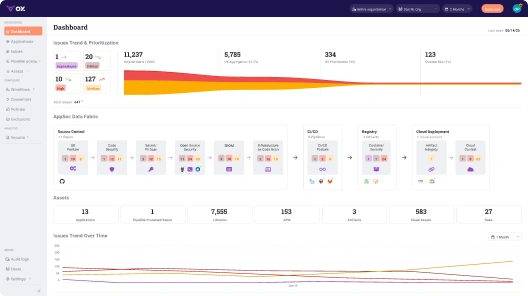
By unifying SAST, SCA, DAST, and container security into a single unified platform, Swisscom established a comprehensive PBOM (Pipeline Bill of Materials) and achieved seamless code-to-runtime visibility.
The Transformation
Context That Predicts Risk
Rather than relying on static alerts or arbitrarily filtering out noise, the OX Security platform empowered Swisscom with context that predicts risk before runtime. The autonomous security agent analyzes dynamic, environment-aware context to understand how code actually behaves, effectively cutting out the false positives that traditionally consumed the security team’s resource.
Beyond the technology itself, the collaborative nature of the transformation was critical. As Geisser highlights,
“The OX team has been great, always helping us understand and get the most out of the tool”.
This intuitive prioritization allowed security champions and architects across different Swisscom teams to easily adopt the platform and track risks comprehensively.
The Results
A Historic Security Milestone
The shift from reactive scanning to AI-native prevention yielded dramatic, measurable outcomes for Swisscom:
- 95% Drop in Critical Findings: By leveraging deep context to prioritize actual threats, Swisscom reduced their critical findings from several thousand down to fewer than 100.
- Zero Critical Vulnerabilities: The intelligent, unified approach allowed the team to achieve a fundamental shift in their security posture, reaching zero critical vulnerabilities in some areas, a first in Swisscom’s history. “This marks the first time in our history that we’ve reached zero critical vulnerabilities,” says Geisser.
- A True Partnership: Beyond the technology, Geisser highlighted the continuous, hands-on support from the OX Security team, noting that the frictionless SaaS onboarding and ongoing partnership led him to unequivocally recommend the platform. When asked if he would recommend OX Security, his response was: “We would definitely recommend it”.
Key Takeaways
Strategic Lessons for Security Leaders
- VibeCoding Requires Vibe Security: As developers use AI to generate code faster, security teams must deploy AI-native engineering tools to secure applications at the speed of creation.
- Prevention > Detection: Moving beyond reactive ASPM to a proactive, code-to-runtime model stops risks at the source, preventing them from ever reaching production.
- Context is the Ultimate Filter: To eliminate alert fatigue, organizations need a unified platform that utilizes environment-aware context to predict real risk before runtime.