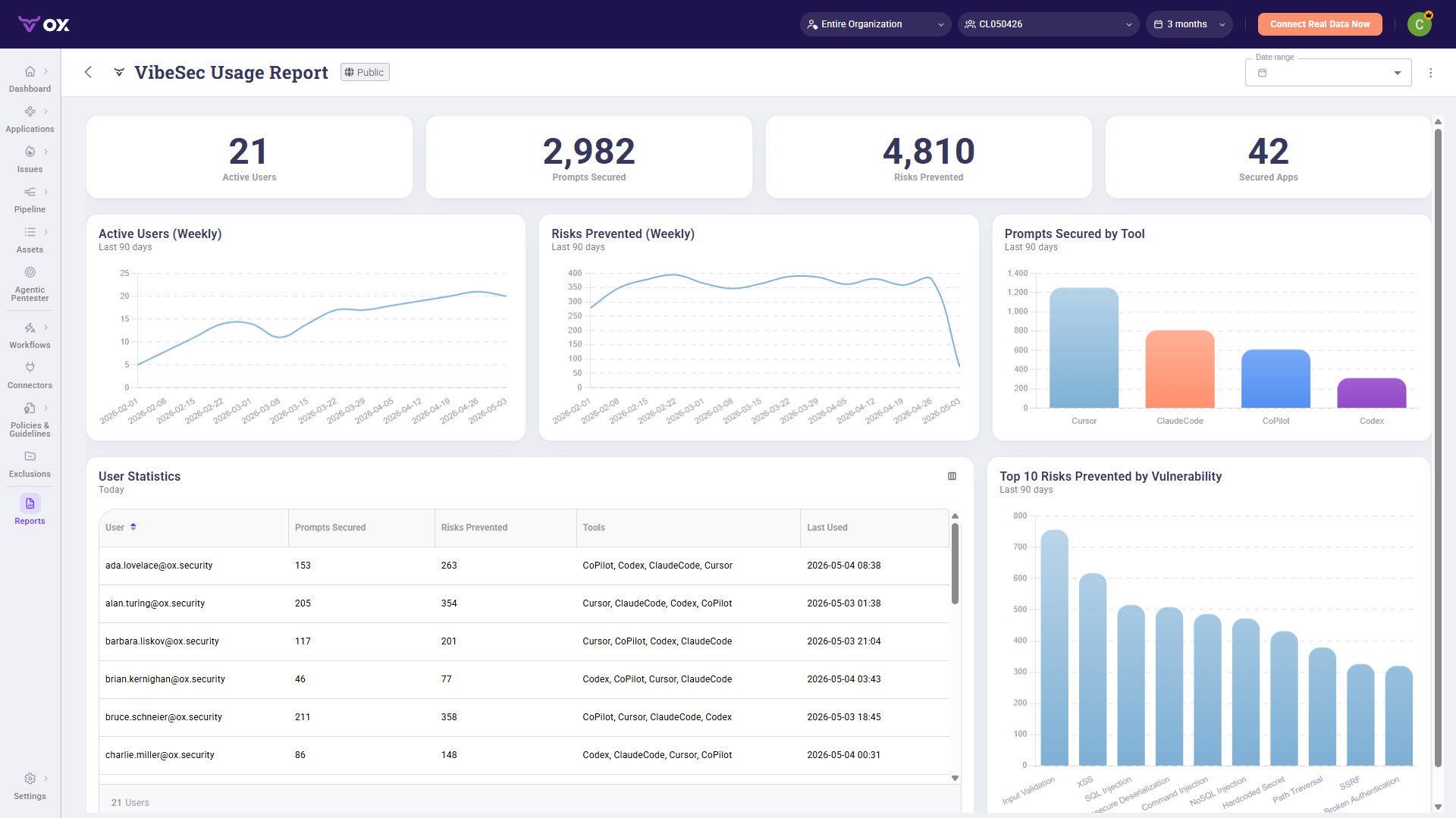
TL;DR
- AI risk management frameworks are guidelines that define how organizations govern AI, focusing on policies, processes, and accountability. They do not control how AI-generated code, models, and services behave once deployed. When AI moved from experimental projects to production-critical systems in 2025, this separation became impossible for enterprises to ignore.
- Most enterprise AI programs encounter the same failure point: governance exists through policies and audits, while real risk emerges inside CI pipelines, APIs, and runtime environments that operate at AI-driven speed
- A 2025 Gartner survey shows that AI-related information governance risks rose to the second-most-cited enterprise risk, and that concerns over unauthorized AI use increased, highlighting growing challenges in monitoring and controlling AI systems.
- Frameworks such as NIST AI Risk Management Framework and ISO/IEC 42001 provide structure, shared terminology, and accountability models for AI governance. While they define policies and best practices, organizations still need tools to observe and enforce consistent application across code, pipelines, and production.
- The OX Platform acts as a Unified Control Plane that correlates AI-generated code, pipelines, and runtime behavior, providing Code-to-Runtime traceability to make AI governance observable, enforceable, and auditable at the source.
AI risk management has become a pressing issue for enterprise security teams in 2026 because it is embedded directly into how software is built and shipped. Organizations routinely use AI to generate code, modify build logic, recommend dependencies, and automate operational decisions. These changes flow through CI/CD pipelines designed for human-written code and predictable release processes.
This disconnect is visible at the organizational level, where many enterprises advance AI adoption without matching risk controls. The 2025 Bigid AI Risk & Readiness report shows that over 93 % of organizations lack full confidence in the security of AI-driven data. Nearly 70 % cite AI-powered data leaks as a top concern. Risk grows across repositories, pipelines, cloud environments, and runtime systems, making accountability difficult to demonstrate during audits or incidents.
OX approaches AI risk management as an application security and governance problem rooted in execution rather than documentation. By correlating AI-generated code, CI/CD activity, build artifacts, APIs, and runtime behavior, OX makes AI risk observable and enforceable across the full software lifecycle.
What “AI Risk” Means in Enterprise Environments
AI risk in large organizations comes from how software is designed, built, reviewed, and released at scale. When AI systems generate code, select dependencies, or make operational decisions, risk enters early and can spread quickly across pipelines and deployments. This shifts the focus from managing known vulnerabilities to governing evolving behavior across thousands of builds and releases.
Why AI Risk Is Not Just Another IT Risk
AI risk is fundamentally different from traditional IT risk because AI systems are dynamic and adaptive rather than static and predictable, whereas conventional software behaves largely the same after deployment. AI-driven systems evolve after deployment mainly due to:
- Data updates
- Model retraining
- Configuration changes
- Agent-driven workflows
This means risk continues in production after release approval.
Most enterprise security processes assume predictable systems, relying on static reviews, scheduled scans, and periodic audits that expect code behavior to remain stable. AI-driven systems break this assumption by introducing unpredictability in outputs, decision paths, and impacts across technical, organizational, and regulatory boundaries.
AI risk is therefore not just an IT issue, it’s a governance challenge that affects the entire delivery lifecycle.
Categories of AI Risk that Enterprises Face
AI risk typically falls into four overlapping categories:
1. Technical Risks
- AI-generated code may introduce insecure patterns or weak authorization logic
- Non-deterministic outputs and model drift make behavior hard to reason about over time
- Lack of explainability can make it difficult to understand AI decisions
2. Data Risks
- Training data, prompts, and inference inputs may be poorly governed
- Poisoned datasets, unintended data exposure, and bias amplification create privacy and compliance issues
- Unclear training data PBOM (Pipeline Bill of Materials) lineage can lead to audit challenges. OX provides Predictive Risk Context by tracking the code journey via a PBOM
3. Operational Risks
- Shadow AI services and unmanaged inference endpoints bypass standard delivery paths
- Automated changes outside pipelines reduce visibility and weaken ownership
- Ungoverned deployment paths increase the risk of untracked system changes
4. Regulatory & Compliance Risks
- Difficulty demonstrating how AI decisions were made or approved
- Missing traceability between AI output, deployment activity, and runtime behavior often causes audit failures
- Inability to prove accountability during incidents or audits
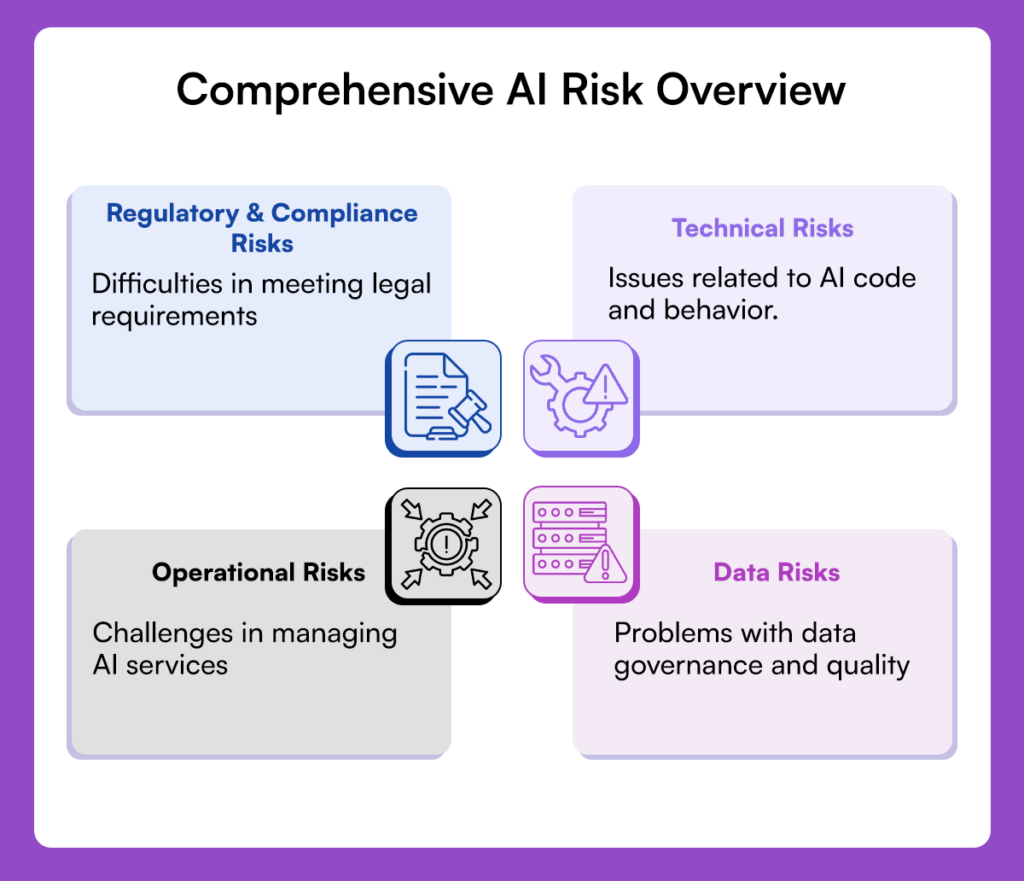
Note: These risks rarely exist in isolation and often compound across codebases, pipelines, and runtime environments. This makes it critical to tie governance to real execution data rather than policy intent alone.
What an AI Risk Management Framework Is Supposed to Do
An AI risk management framework provides organizations with a structured way to govern AI systems, providing clarity and consistency across teams. It helps leaders make informed decisions as AI moves from design to production and ensures that risk is managed systematically rather than ad hoc.
Purpose of an AI Risk Management Framework
An effective framework achieves four key outcomes at the organizational level:
- Identify and Manage AI-Specific Risks: Establish clear methods for spotting and handling AI-related risks across products, teams, and projects.
- Define Ownership and Escalation Paths: Specify who is responsible for decisions, who has authority, and how issues are escalated when risk thresholds are exceeded.
- Align AI Development with Risk Appetite: Ensure that AI development practices follow the organization’s defined tolerance for risk and compliance requirements.
- Enable Auditability: Connect risk decisions directly to real systems, pipelines, and runtime behavior rather than relying solely on policy documents.
Without these foundations, AI risk management often fragments across teams, leaving security, platform, and compliance groups to operate with partial information.
Why Lifecycle-Based Risk Management Is Mandatory for AI
AI risk begins long before code reaches production, and managing it effectively requires controls that cover every stage of the AI lifecycle: design, training, integration, deployment, and runtime operation. Organizations need an approach that provides ongoing visibility and accountability, ensuring risk decisions reflect how AI behaves in real environments.
Static assessments performed at a single point in time are not sufficient once AI systems evolve in production through data changes or automated updates. For enterprise teams, this shifts risk management from one-time certification toward ongoing evaluation that reflects how systems actually behave over time.
This lifecycle-based approach ensures that organizations maintain a stable and auditable risk posture even as AI drives development and operational complexity grows.
Components of an AI Risk Management Framework
An AI risk management framework only works if its components reflect how enterprise systems are actually built and operated. In large organizations, AI risk emerges across repositories, pipelines, shared platforms, and runtime environments, not in a single place or at a single moment. The components below describe what must exist for AI risk management to function at scale:
1. Risk Identification Across the AI Lifecycle
Identifying AI risk is the foundation of any framework; it must go beyond model design or deployment checklists. Enterprises need to know where AI is used, how decisions are made, and how outputs move through systems.
Key practices include:
- Mapping AI use cases, data flows, and decision boundaries: Understand where AI is embedded across products and platforms.
- Identifying risks in AI-generated code and dependencies: Track risks from automated code generation, third-party models, and integration workflows.
- Considering contextual factors: Evaluate risk based on business domain, regulatory exposure, system criticality, and interactions between services or APIs.
2. Risk Assessment and Prioritization
Once risks are identified, enterprises must determine which require action. AI systems can generate numerous findings, but not all carry the same weight.
Below are the key practices that help organizations assess and prioritize AI risks effectively:
- Assessing likelihood and impact: Distinguish theoretical issues from risks that are reachable in real workflows.
- Prioritizing based on actual usage: Focus on high-risk AI components embedded in production pipelines rather than low-impact experimental tools.
- Lowering noise and fatigue: Avoid applying equal scrutiny to all findings, which can stall remediation efforts.
3. Risk Mitigation and Control Mechanisms
After risks are assessed and prioritized, mitigation puts those insights into action. It evaluates if controls are applied effectively and integrated directly into existing engineering and platform processes.
Below are the primary mechanisms organizations use to mitigate and control AI risk effectively across technical, organizational, and legal dimensions:
- Technical controls in development pipelines: Embed checks and safeguards directly into CI/CD workflows where AI output is introduced.
- Organizational controls: Define ownership models, approval gates, and escalation paths to ensure deliberate, traceable decisions.
- Legal and ethical safeguards: Implement enforceable policies that are observable in real systems rather than relying on documentation alone.
4. Governance, Accountability, and Oversight
Effective governance ensures that every AI risk decision is tied to organizational responsibility, so teams know who is accountable and how actions are coordinated across complex environments.
Below are the key elements that support strong governance and accountability:
- Clear ownership: Assign responsibility across teams, products, and environments to ensure that AI risks are monitored and managed consistently.
- Defined decision authority and escalation paths: Specify who can make risk decisions and how to respond quickly when AI behavior produces unexpected outcomes.
- Documentation aligned with reality: Ensure governance models reflect actual system behavior, multiple pipelines, and shared platforms so they remain effective as teams scale.
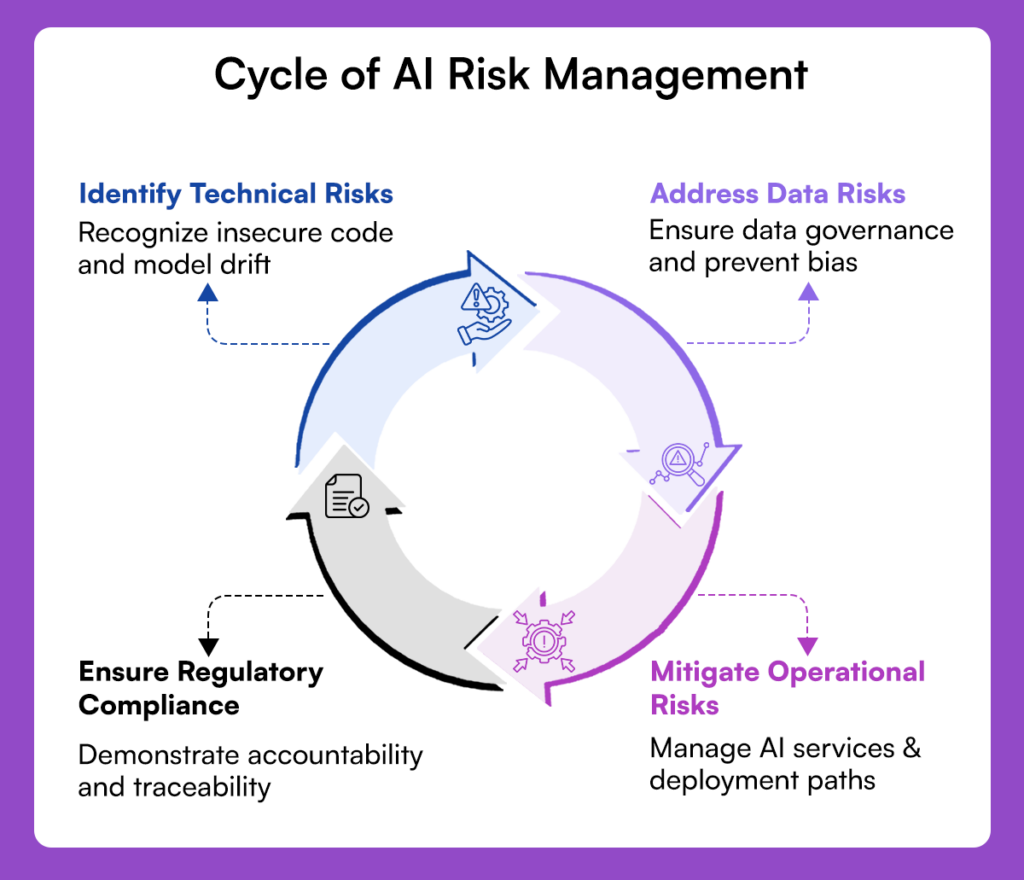
5. Regular Monitoring and Improvement
AI risk does not stop at deployment. Systems evolve as data changes, integrations update, and usage patterns shift.
AI risk does not end once systems are deployed, as AI models, data, and integrations continue to evolve over time. Organizations must maintain ongoing visibility into production behavior and adjust controls accordingly.
Below are the key practices that support ongoing risk management for AI systems:
- Post-deployment monitoring: Detect drift, misuse, or unexpected behavior in production environments to catch risks before they escalate.
- Contextual risk analysis: Identify new risks introduced through updates, integrations, or changing usage patterns, considering them in the context of overall system behavior.
- Feedback loops for refinement: Connect incidents back to their origin in code, pipelines, or configuration to regularly improve governance, controls, and risk visibility.
Major AI Risk Management Frameworks Enterprises Use Today
Most enterprises do not start AI risk management from scratch. They adopt established frameworks to create shared language, define responsibility, and demonstrate governance to leadership and regulators. The two most common reference points today are the NIST AI Risk Management Framework and ISO’s emerging AI standards. Each plays a distinct role in providing structure and accountability guidance, yet has limits when applied to real-world enterprise systems.
NIST AI Risk Management Framework (AI RMF)
The NIST AI RMF is a voluntary framework built to help organizations reason about AI risk in a consistent way. Its primary value lies in providing structure and a common language, rather than enforcing controls directly. It enables enterprises to discuss AI risk across technical, legal, and business teams without binding them to a specific technology stack or industry.
The framework organizes its guidance around four main functions to show how AI systems are built and operated:
- Govern: Establish policies, define roles, accountability, and oversight.
- Map: Understand context, use cases, stakeholders, and potential impacts.
- Measure: Evaluate risks such as bias, robustness, security, and other key factors.
- Manage: Respond to and mitigate risk while sustaining ongoing risk handling processes.
This structure helps organizations establish baseline governance, align stakeholders, and build a consistent approach to AI risk. It is well suited useful for enterprises early in AI adoption or operating across diverse business units.
ISO/IEC 23894 and ISO/IEC 42001
ISO standards take a more formal approach to AI risk management. ISO/IEC 23894 provides AI-specific risk guidance aligned with traditional enterprise risk principles, while ISO/IEC 42001 defines an AI Management System intended to be auditable and certifiable, similar in structure to ISO 27001.
For compliance-driven organizations and regulated industries, ISO standards provide clear advantages, such as:
- Defined management processes and documented controls.
- Strong alignment with enterprise risk and compliance programs.
- Certification readiness that supports external audits and customer assurance.
These strengths make ISO standards appealing for organizations that need formal proof of governance maturity. They help standardize how AI risk is discussed, reviewed, and reported across the enterprise.
Comparing AI Risk Management Frameworks
The table compares widely used AI risk management frameworks, focusing on their approaches to governance, auditability, and practical controls in enterprise environments.
| Dimension | NIST AI Risk Management Framework | ISO/IEC 23894 | ISO/IEC 42001 |
| Nature of Framework | Voluntary and non-certifiable | Informative and guidance-oriented | Auditable and certifiable standard |
| Target Audience | AI developers, deployers, and risk owners | Risk, compliance, and governance teams | Regulated enterprises and compliance-driven organizations |
| Scope | Full AI lifecycle from design to post-deployment | AI risks mapped to ISO 31000 risk principles | Organization-wide AI governance and controls |
| Structure | Govern, Map, Measure, Manage functions | Risk identification, analysis, evaluation, treatment | Policies, roles, controls, audits, and regular improvements |
| Governance Focus | Strong emphasis on roles, oversight, and accountability | Conceptual clarity around AI-specific risks | Formal governance structures and documentation |
| Enforcement Mechanism | None; relies on internal adoption | None; advisory guidance only | Process enforcement through audits and certification |
| Runtime Visibility | Not addressed directly | Not addressed | Indirect and process-based, not technical |
| Strengths | Flexible, technology-neutral, widely adopted | Aligns AI risk with existing enterprise risk models | Strong auditability and regulatory credibility |
| Key Limitations | No technical enforcement or runtime validation | No operational controls or execution visibility | Controls often disconnected from real execution paths |
| Best Fit For | Organizations building internal AI risk programs | Enterprises standardizing AI risk terminology | Enterprises needing formal certification and compliance evidence |
From Governance to Runtime Reality
AI risk management frameworks focus on policies, roles, and review processes, while AI risk itself emerges dynamically across repositories, CI/CD pipelines, APIs, and runtime services. This creates a gap between governance intent and actual system behavior, as exposure accumulates through automated builds, integrations, and production activity that is rarely reviewed.
Where AI Risk Actually Emerges in Enterprise Systems
AI risk becomes tangible at execution points rather than at formal checkpoints. Key areas include:
- CI/CD pipelines: AI-generated code, dependency updates, or configuration changes can reach production with minimal human review.
- APIs and services: AI-driven functionality exposed without clear ownership, context, or boundaries increases operational and compliance risk.
- Runtime environments: Issues that were theoretical in design can become exploitable based on interactions between services and access to sensitive data.
- Distributed systems: When multiple repositories, pipelines, and platforms are involved, no single tool has full visibility, leaving gaps in detection and accountability.
Viewing these signals together, rather than in isolation, reveals how AI decisions propagate across the enterprise and where governance needs to actively intervene.
What “Enforceable” AI Governance Means at Enterprise Scale
Enforceable governance ensures that rules influence system behavior rather than just documentation. Key aspects include:
- Policies applied at creation: Governance is enforced at the point where AI output is generated or accepted, not post-deployment.
- Correlated risk evaluation: Risk is assessed across repositories, pipelines, container images, APIs, and runtime services as a connected execution path.
- Prioritization based on exposure: High-impact, reachable risks are addressed first, instead of static classifications.
- Ongoing governance: Oversight reflects day-to-day system behavior, replacing periodic compliance checks with real-time visibility.
This approach allows security teams to maintain accountability and respond quickly to emerging risks while scaling AI adoption across large, complex environments.
How OX Enables Enforceable AI Risk Management
For large enterprises, the main challenge is ensuring that AI risk policies are actually enforced as AI-generated code, automated decisions, and frequent deployments move through complex engineering systems. OX addresses this challenge by anchoring AI risk management in real execution paths, giving security leaders clear visibility and control from the moment code is created all the way through runtime behavior.
Correlating AI Risk Across the Full Software Lifecycle
Challenge: Signals of AI risk are scattered across tools, teams, and pipelines.
OX Approach: Security rules are embedded at the moment AI-generated code is written via VibeSec, vulnerabilities are detected and remediated across CI/CD pipelines before production via OX Code, and infrastructure is secured at runtime via OX Cloud, giving security teams complete Code-to-Runtime traceability across every stage.
Benefit: Security teams can trace how changes move from repositories, through pipelines, into deployable artifacts, and finally into production, eliminating blind spots and fragmented ownership across the full software lifecycle.
Addressing AI Risk at the Point of Creation
Challenge: Risk enters before traditional controls can act.
OX Approach: Through OX VibeSec, security context is embedded into development and builds workflows to evaluate AI-generated outputs at the source, delivering AI-native security engineering and Vibe Security that blocks vulnerabilities before they are written.
Benefit: Insecure patterns, risky dependencies, and policy violations are caught early, lowering downstream remediation and blocking unsafe changes from propagating.
Turning Governance Policies Into Enforceable Controls
Challenge: Policies mean little if they do not influence behavior.
OX Approach: Translates governance rules into actionable controls within existing engineering systems.
Benefit: Rules, such as handling AI-generated code, controlling which pipelines can deploy artifacts, and enforcing conditions before exposure, apply consistently across repositories, pipelines, and environments, scaling with teams and evolving workflows.
Providing Audit-Ready Evidence-Based on Execution
Challenge: Audits fail when organizations cannot show enforcement.
OX Approach: Preserves execution context across the software lifecycle.
Benefit: Every risk decision can be traced to concrete events: code changes, pipeline runs, artifact promotions, or runtime interactions, allowing enterprises to demonstrate accountability with evidence grounded in real system behavior, not assumptions.
Outcome: By aligning AI governance with how software is actually built and operated, OX enables enterprises to manage AI risk as a ongoing operational discipline rather than a static documentation exercise.
Conclusion
AI risk management frameworks have brought much-needed structure for enterprise governance, accountability, and oversight. However, as AI became embedded across development and delivery workflows in 2025, it became clear that risk no longer appears only where policies and reviews are defined. It emerges through execution paths that span code generation, pipelines, APIs, and runtime systems.
This article showed why frameworks such as NIST AI RMF and ISO standards are useful for setting expectations and responsibilities, but they do not provide operational control. They cannot track how AI-driven changes actually move through complex engineering systems. In large organizations, this gap becomes clear during audits or incidents, when intent is documented but real execution cannot be shown
OX addresses this gap by grounding AI risk management in real system behavior. By correlating AI-generated code, CI/CD activity, artifacts, APIs, and runtime execution, OX Security gives security leaders the context needed to understand which risks are reachable, how they propagate, and where governance rules were applied in production. Organizations that connect governance to execution and accountability to runtime evidence will be better positioned to manage AI risk without sacrificing delivery speed or control.
FAQ
AI risk management frameworks struggle because they stop at guidance and process definition, while enterprise risk emerges across distributed pipelines, shared platforms, and runtime environments. OX addresses this gap by translating framework expectations into controls that operate inside development and delivery workflows, making governance observable and enforceable across decentralized teams.
OX embeds governance controls into existing developer and platform workflows instead of adding separate review processes. This allows organizations to apply consistent AI risk policies across polyglot codebases and multiple CI/CD systems without introducing manual bottlenecks or slowing delivery.
Frameworks define what good governance looks like, but they do not enforce it. OX maps framework requirements to specific controls across development, pipelines, and runtime. VibeSec enforces AI coding guardrails at the point of code creation, blocking policy violations before they enter the codebase, turning framework requirements into technical enforcement.
Yes. OX provides audit-ready evidence that shows how AI-generated changes were introduced, validated, and monitored across the software lifecycle. This allows organizations to demonstrate governance and accountability based on real execution data rather than manual attestations.