TL;DR
- Continuous pentesting shifts security from point-in-time snapshots to event-driven validation triggered by real-time code and infrastructure updates.
- While Penetration Testing as a Service (PTaaS) modernizes delivery via dashboards, continuous pentesting evolves execution by running autonomous threat validation 365 days a year.
- Embedding offensive testing into CI/CD pipelines enables teams to shift left and trace runtime flaws directly to the source commit.
- Prioritizing vulnerabilities based on deterministic proof of exploit eliminates tool noise and prevents developer dashboard fatigue.
- Automated testing excels at horizontal scale but requires a human-in-the-loop model to evaluate abstract business logic and novel zero days.
What is Continuous Pentesting?
Modern cloud-native environments and rapid deployment pipelines change far too quickly for old-school security assessments to keep pace. Continuous pentesting (also known as continuous penetration testing or continuous security validation) replaces static, point-in-time checks with always-on offensive testing programs designed to represent realistic real-world adversarial environments.
Instead of waiting for an annual scheduled audit, continuous pentesting works programmatically in the background. It maps your expanding attack surface and launches real-time, non-destructive exploit simulations as soon as new code or infrastructure modifications are detected. This approach drastically shrinks an attacker’s window of exploitability, ensuring configuration drifts or fresh code bugs are caught and validated immediately.
Continuous Pentesting vs. Traditional Penetration Tests
The fundamental difference between these two methodologies is how they handle time. Traditional pentesting functions like a snapshot; it provides a comprehensive but momentary look at your application security posture. The moment a developer ships an updated microservice or modifies an API schema after the audit concludes, that snapshot becomes obsolete.
Continuous pentesting shifts the paradigm from a calendar-driven event to an event-driven mechanism. It unifies ongoing asset discovery with automated reasoning loops that revalidate your perimeter every time a build runner triggers a release.
| Feature | Traditional Penetration Tests | Continuous Pentesting |
| Execution Frequency | Discontinuous snapshot (annual or quarterly blitz). | Perpetual, always-on programmatic execution. |
| Methodology | Scoped manual testing bounded by a fixed time window. | Adaptive real-time scanning and multi-stage exploit chaining. |
| SDLC Integration | Completely isolated; results arrive later in a static report. | Natively embedded into CI/CD pipelines with code-to-cloud telemetry. |
| Remediation Path | Delayed validation cycles, requiring a separate engagement. | Immediate, regression-style validation to confirm patches hold up. |
This guide is designed for AppSec specialists, security leaders, and red teams to understand how continuous pentesting eliminates the structural blind spots of traditional, point-in-time audits by embedding always-on offensive validation directly into high-velocity development lifecycles.
Continuous Pentesting vs. PTaaS
While both terms are frequently used in modern DevSecOps discussions, Penetration Testing as a Service (PTaaS) and continuous pentesting describe entirely different operational layers.
- Penetration Testing as a Service (PTaaS) is primarily an evolution in delivery. It modernizes conventional pentesting by replacing consulting contracts with a cloud-hosted SaaS dashboard. In a PTaaS model, human ethical hackers are hired on a subscription basis to target specific applications over defined testing windows. However, once that specific window closes, active adversarial probing stops until the next sprint is booked.
- Continuous Pentesting is an evolution in execution. It moves past human scheduling limitations by using a persistent, autonomous testing framework to validate exposures 365 days a year.
Target Use Cases: PTaaS is an excellent fit for organizations looking to streamline vendor procurement, achieve compliance milestones (like SOC 2 or PCI DSS), and get human feedback during major releases. Continuous pentesting is designed for high-velocity software environments that deploy code daily and require always-on validation to catch immediate configuration drift between human assessments.
The Benefits of Continuous Security Validation
Implementing a continuous security validation program reshapes how organizations manage risk, moving defensive operations from a reactive bottleneck to a proactive engineering accelerator.
Security Keeps Pace with Software Delivery
Traditional penetration testing creates a severe operational drag on modern agile pipelines. When engineering groups push code updates multiple times a day via automated CI/CD runners, calendar-bound testing schedules fall hopelessly behind. Continuous security validation natively aligns offensive testing with rapid delivery loops. By operating as an automated pipeline gate, the testing engine evaluates dynamic cloud configurations and code changes in runtime, matching the breakneck velocity of modern software deployment without slowing down feature releases.
Ability to “Shift Left” by Finding and Fixing Security Flaws as They Emerge
Catching a critical architecture flaw or injection vulnerability in a live production environment is costly and disruptive. A continuous approach enables development organizations to effectively “shift left” by injecting real-time adversarial testing directly into the staging and build phases. By identifying exposures at their inception (immediately after an engineer runs a commit or alters a deployment schema) application owners can isolate the precise line of code or container layer responsible for the exposure, preventing risky vulnerabilities from ever breaching production.
Broader Coverage Than Human Testers Can Achieve
Human red teams excel at creative, highly targeted exploitation, but they lack the operational bandwidth to maintain total visibility over a sprawling, distributed infrastructure. Modern enterprise environments change constantly as new microservices, API schemas, and cloud resources spin up automatically.
Continuous automated pentesting delivers unmatched horizontal scale, scanning your entire external and internal perimeter 365 days a year. It catalogs unmapped subdomains and hidden API endpoints programmatically, achieving a persistent breadth of attack-surface coverage that manual engagements simply cannot replicate.
Freeing Up Security Professionals to Focus on Other Tasks
AppSec engineers and internal red teams frequently waste critical working hours triaging hundreds of unverified, noise-heavy static alerts or manually assembling proof-of-concept exploits to verify reachability. Automating these repetitive, low-level scanning and validation workflows removes an immense administrative burden from your defensive workforce. By offloading continuous reconnaissance and automated attack chaining to a programmatic engine, security leaders can reallocate their highly specialized human practitioners to focus on complex business-logic threats, architectural hardening, and overarching strategic initiatives.
The Role of Continuous Pentests in Compliance and Auditing
Historically, enterprise compliance has relied on “point-in-time” evidence – an annual penetration test report generated over a single week to check a box for the auditors. However, modern regulatory and trust frameworks are shifting toward mandatory, ongoing control verification. Continuous penetration testing natively bridges this gap by providing an uninterrupted audit trail that satisfies rigorous compliance criteria throughout the entire reporting window.
- SOC 2 Audits: For Type II certifications, where organizations must demonstrate the operational effectiveness of security controls over an extended review period, continuous validation moves past static snapshots. It provides auditors with an uninterrupted, chronological record of vulnerability hunting and remediation, proving your security posture remains active between audit cycles.
- PCI DSS Compliance: Under modern payment card security standards, penetration testing is required not just annually, but explicitly after any significant infrastructure or application change. For high-velocity environments pushing updates frequently, continuous pentesting automates this obligation by immediately launching validated tests whenever modifications occur, maintaining constant audit readiness.
How Frequently Do Continuous Pentests Occur in Practice?
In an automated ecosystem, continuous pentesting does not mean a single script running on an infinite, unguided loop. Instead, its execution frequency is driven by a highly calibrated, event-based cadence that synchronizes with your development and infrastructure lifecycles.
In practice, a continuous testing engine actively monitors your entire attack surface and deploys targeted, automated probing sequences based on three primary types of real-time triggers:
- Code-Level Changes: Every time an engineering sprint concludes and a developer pushes an update, merges a pull request, or modifies an internal API schema, the CI/CD pipeline triggers the testing engine. The system immediately performs focused regression testing against that specific microservice to catch new vulnerabilities at their inception.
- Infrastructure Modifications: Network perimeters are fluid. The moment a DevOps team alters a Web Application Firewall (WAF) rule, updates a load balancer configuration, or misconfigures an S3 storage bucket, the continuous framework registers the structural drift. It automatically initiates a perimeter scan to verify that these systemic modifications haven’t inadvertently exposed an internal network path.
- Deployment of New Assets: When an organization spins up a previously unmapped subdomain, launches a new public-facing web tool, or links a third-party API integration, the platform’s asset discovery engine indexes it in real time. The system automatically launches an autonomous reconnaissance loop discovering exposed endpoints, mapping input fields, and safely executing multi-stage attack chains to harden the asset before a malicious actor can discover it.
Common Continuous Pentesting Challenges and Limitations
While continuous security validation provides unprecedented scale and real-time coverage, it is not a silver bullet. Transitioning to an always-on automated offensive strategy introduces unique operational constraints and logical boundaries that organizations must actively manage.
Inability to Simulate Highly Complex Attack Scenarios
Automated continuous pentesting tools – including early-stage agentic AI systems – excel at executing known attack patterns and chaining routine vulnerabilities. However, they struggle to replicate the creative intuition of an experienced human red team.
Complex, multi-stage attack vectors that require inventing entirely new exploitation paradigms or uncovering abstract, non-technical zero-days remain firmly out of reach for automated engines. Furthermore, automated tools frequently fail to comprehend highly customized business-logic flaws, such as manipulating a multi-step e-commerce checkout sequence to bypass payment processing, which demands deep, contextual human reasoning.
Lack of Support for Evaluating Social Engineering Risks
A critical structural blind spot of continuous automated frameworks is their inability to evaluate human-centric vulnerabilities. Because these systems are strictly engineered to interact with digital assets (such as source code repositories, API definitions, and cloud infrastructures) they cannot stress-test an organization’s human perimeter. Evaluating susceptibility to sophisticated phishing campaigns, spear-phishing, vishing, or physical tailgating requires human threat actors who can dynamically manipulate human psychology, leaving a major element of real-world risk completely untested by automated engines.
Risk of False Positives That Could Slow Down Software Delivery
The ultimate velocity killer in any modern DevSecOps pipeline is tool noise. If a continuous pentesting platform is not precisely calibrated or backed by rigorous validation loops, it risks generating a wave of false positives or low-priority configuration anomalies. When an automated scanner flags unexploitable exposures or misinterprets application architecture feedback, it recreates the very alert fatigue and dashboard noise that legacy tools suffer from. These inaccurate alerts force security teams into endless verification loops, distracting developers and dragging down engineering sprints.
Developers May Not Be Able to Fix Flaws as Quickly as Automated Pentests Discover Them
Shifting to an always-on offensive posture creates an immediate operational asymmetry: discovery is instantaneous, but remediation is manual. An automated engine can relentlessly scan an enterprise’s attack surface and uncover a massive backlog of code-level threat context and microservice exposures in hours.
This rapid velocity often creates an internal organizational bottleneck. Because application owners and development teams are focused on meeting strict feature release deadlines, the sheer rate of automated vulnerability discovery can easily outpace their capacity to code, test, and deploy security patches, leading to a mounting accumulation of security debt.
Integrating Continuous Pentests into the SDLC
Embedding continuous penetration testing into your Software Development Life Cycle (SDLC) requires shifting from isolated, point-in-time assessments to a frictionless, automated feedback loop. When properly integrated, your testing engine runs quietly alongside standard development workflows, providing real-time threat validation without stalling release gates.
The Integration Workflow
1. Establish Automated Asset & API Discovery (Prerequisite):
Before launching attack simulations, hook the continuous testing engine into your internal code graphs and API gateways. The system must automatically map your API Bill of Materials (API BOM) and track dynamic microservice routing changes so it knows exactly what to test the moment a change occurs.
2. Configure Event-Driven CI/CD Triggers (Pipeline Setup):
Embed the testing engine directly into your CI/CD pipelines (such as GitHub Actions, GitLab CI, or Jenkins). Configure webhook listeners to automatically trigger focused, non-destructive regression testing on staging environments whenever a developer merges a pull request or alters a deployment configuration.
3. Implement Strict Validation Guardrails (Noise Elimination):
To protect developer velocity, set strict guardrails that dictate how findings are handled. Ensure the testing engine requires definitive proof of exploit (such as verifying a vulnerability is reachable and actively weaponizable) before it can trigger an alert, preventing unverified static noise from disrupting the team.
4. Map Runtime Exploits Back to Source Control (Context Enrichment):
Utilize automated repository-to-application correlation. When a runtime flaw is verified on a staging server, the platform should automatically trace the exposure back to its precise repository origin, file, and individual developer commit, rather than simply exporting a generic external URL.
5. Automate Developer Workspace Routing (Remediation):
Configure the platform to export actionable diagnostics directly into your team’s native engineering workspaces (such as Jira or Slack). If a critical exploit is proven reachable during a pipeline run, the system should automatically block the contaminated build runner and open a prioritized ticket detailing the exact request-response sequence needed to resolve the root cause.
Critical Technical Considerations
Access Control & Isolation
Ensure your testing engine has sufficient white box visibility (such as access to environment variables and schemas) to run deep, contextual tests, but isolate its operational permissions via role-based access control (RBAC). It should never have destructive read-write access to core production database tables.
Environment Parity
For continuous security validation to yield accurate results, staging and testing environments must closely mirror production architecture, including active Web Application Firewall (WAF) configurations and cloud data dependencies.
Best Practices for Implementing Continuous Security Validation
Transitioning to an always-on offensive security posture requires more than just deploying automated tools; it demands a structured operational framework. Implementing these core best practices ensures your testing engine maximizes risk reduction while maintaining peak development velocity.
Strive for Repeatable and Observable Workflows
Continuous security validation should never function as a chaotic black box. Every automated attack path, payload generation step, and reconnaissance loop must be transparent and fully trackable. Security teams should utilize centralized dashboards that provide real-time visibility into active scan coverage. Maintaining chronological, reproducible logs of how the engine chains vulnerabilities ensures findings are easily verifiable for developer troubleshooting and compliance audits.
Assess and Prioritize Vulnerabilities Based on Severity Level
An always-on testing engine discovers a massive volume of code mutations, cloud exposures, and dependency risks. To prevent dashboard fatigue, implement an automated prioritization framework based on real-world reachability. Rather than relying solely on generic CVSS metrics, elevate exposures that provide a deterministic proof of exploit. If the platform can safely execute a multi-stage attack and prove a flaw is weaponizable at runtime, it immediately jumps to the top of the remediation queue.
Know the Limits of Automation
Relying exclusively on automated testing creates a dangerous false sense of security. While continuous engines excel at mapping vast API schemas, running fuzzing scripts, and catching configuration drift, they cannot think like a human adversary. Automation struggles to grasp non-technical business logic context and cannot invent novel, zero-day exploitation paradigms. Acknowledging these boundaries ensures automation is used as a continuous baseline layer rather than a complete security solution.
Keep Humans in the Loop
No matter how advanced a programmatic engine becomes, it lacks the business risk perspective and architectural intuition of a seasoned practitioner. Effective continuous validation relies on a “human-in-the-loop” model where the system absorbs the tedious work of routine data-gathering and validation loops. This elevates human engineers, freeing them to analyze abstract logic flaws, define sensitive scoping boundaries, and strategically manage the remediation lifecycle.
Achieving Continuous Security Validation with OX Agentic Pentester
The high velocity of modern software delivery has made traditional, point-in-time penetration testing obsolete. Relying on an annual or quarterly audit snapshot leaves a structural visibility gap that modern adversaries can easily exploit. Achieving resilient, cloud-native security demands a strategic shift toward continuous security validation an always-on offensive testing posture that matches the scale and speed of daily engineering sprints.
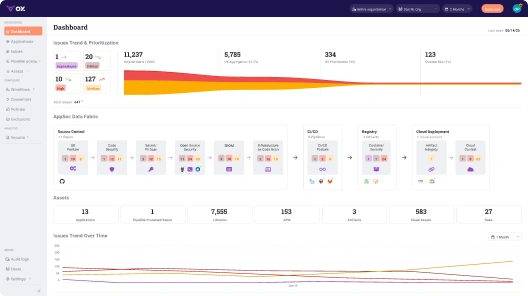
The OX Agentic Pentester (currently in Early Access) delivers autonomous exploit validation against live web applications, mapping each finding back to its precise repository origin and developer commit. While the current Early Access offering is manually triggered against web apps, the platform is designed to integrate into a continuous, event-driven validation loop alongside OX Code and OX Cloud. This unified, closed-loop approach allows your security and engineering teams to eliminate tool sprawl, minimize dashboard fatigue, and accelerate collaborative remediation from code to cloud.
Ready to eliminate security blind spots between audit cycles? Discover how to achieve continuous, machine-driven offensive validation tailored to your dynamic build pipelines by booking a demo.
FAQs
Continuous pentesting uses an event-driven cadence that initiates automated, non-destructive attack simulations the moment changes are detected in your ecosystem. These targeted re-tests are instantly triggered by code-level modifications (such as merging a pull request or updating an API schema), infrastructure shifts (like altering WAF rules or cloud permissions), and the deployment of entirely new assets, ensuring that fresh exposures are identified before they can be exploited.
Continuous security validation is an umbrella category, but continuous pentesting and Breach and Attack Simulation (BAS) serve different purposes. Continuous pentesting focuses on application vulnerability depth, safely executing multi-stage attack chains to prove that specific code bugs and configuration drifts are actively weaponizable. Conversely, BAS focuses on defensive control verification, simulating known threat profiles to test whether existing tools like firewalls and SIEMs are properly configured to detect and alert your security team.
Penetration Testing as a Service (PTaaS) is ideal for organizations that require human intuition to uncover abstract business-logic flaws, evaluate social engineering risks, or fulfill compliance mandates that demand manual, human-vetted testing windows. However, high-velocity, cloud-native teams that ship code or alter infrastructure multiple times a day do not benefit from PTaaS alone, as human-scheduled windows leave massive visibility gaps between deployments. These environments require autonomous, continuous pentesting to maintain a scalable, always-on offensive layer directly inside their CI/CD pipelines.
Continuous pentesting platforms eliminate the noise associated with legacy scanners by implementing strict, proof-of-exploit validation guardrails before alerting a development team. Instead of flagging thousands of theoretical vulnerabilities or unreachable code paths, the engine requires definitive proof that an exposure is reachable and weaponizable in runtime. By filtering out the vast majority of harmless static noise and providing clear, automated diagnostics directly within engineering workspaces, it allows developers to focus exclusively on fixing high-risk, validated threats without disrupting their deployment velocity.