
A malformed Base64 string can crash vulnerable Java applications, but remote code execution requires specific hardware, an exposed decoder, and an application-specific exploit.
Overview
A critical memory-corruption vulnerability in OpenJDK, dubbed Java4Shell (CVE-2026-114938), was disclosed on November 17, 2026. On affected servers, a short malformed Base64 string sent by an unauthenticated attacker can corrupt the memory of the Java Virtual Machine (JVM), potentially causing a crash or, under specific conditions, enabling remote code execution (RCE).
OX Research estimates that less than 0.12% of JVM instances worldwide are exposed to RCE, while approximately 0.8% are exposed to crashes resulting from the Base64 decoder vulnerability.
Unlike other highly publicized vulnerabilities, such as PHP2Shell, which was exploited before its CVE was disclosed, Java4Shell has no publicly available RCE exploit or confirmed exploitation in the wild as of November 18, 2026. So far, RCE has been demonstrated only in controlled environments, rather than through widespread real-world attacks.
The vulnerability has been fixed in OpenJDK versions 17.0.21.1, 21.0.13.1, 25.0.5.1, and 27.0.1.1, with corresponding fixes available from major Java vendors.
TL;DR
On November 17, 2026, Oracle and the OpenJDK Vulnerability Group released fixes for CVE-2026-114938. Java underpins banking, telecommunications, aviation, and much of the enterprise software stack. Its two most widely used versions, Java 21 and Java 17, are both affected.
The vulnerability lies in an optimization the Java Virtual Machine (JVM) uses to decode Base64 faster on newer Intel and AMD server processors. Base64 is widely used to transmit binary data as text, including in login headers, tokens, cookies, and file uploads, meaning attacker-controlled Base64 can reach web-facing Java applications before authentication. When the decoder encounters a malformed string, the vulnerable code writes beyond its allocated buffer, corrupting nearby memory before Java rejects the input.
What this means in practice:
- Crashing a vulnerable service is easy: The crash has been independently reproduced, and a short burst of requests can reliably bring an affected service down.
- Pre-authentication RCE is possible, but difficult: Remote code execution has been demonstrated against several widely deployed products in their default configurations, but each target requires a carefully tailored exploit. As of November 18, 2026, no exploitation in the wild has been reported.
- Exposure depends on hardware: Only x86-64 servers supporting AVX-512 VBMI, including Intel Xeon Ice Lake and newer and AMD Zen 4 and newer, execute the vulnerable code. ARM servers, older x86 servers, Java 8, and Java 11 are not affected
Recommendations
- Upgrade now. Move to the November 17, 2026 OpenJDK or Oracle builds, or your vendor’s patched distribution as soon as it is available. Update bundled runtimes too, by upgrading the product or replacing its embedded JRE, and rebuild container images on patched base images.
- Mitigate if you can’t patch yet. Start the JVM with -XX:-UseBASE64Intrinsics, which disables only the vulnerable decoder and keeps other AVX-512 optimisations. Alternatively, -XX:UseAVX=2 disables AVX-512 entirely; apply it only on x86-64 hosts, because OpenJDK on ARM does not recognise the flag and will fail to start.
- Check your hardware. On Linux, run grep -m1 ‘^flags’ /proc/cpuinfo | tr ‘ ‘ ‘\n’ | grep -E ‘^(avx512f|avx512bw|avx512vbmi|bmi2)$’. A host is affected only if all four flags are present.
- Prioritise by exposure. Patch internet-facing identity providers such as Keycloak and PingFederate first. Next come internet-facing Jenkins, Artifactory, Jira and Confluence, then other services that decode tokens, credentials or uploads. Internal Kafka, Solr, Elasticsearch, Gerrit and Spinnaker follow.
- Don’t rely on proxies. Request buffering in nginx breaks some exploit chains but not all, and it does not apply after a WebSocket upgrade.
- Watch for signs of exploitation. Look for unexpected JVM crashes or hs_err_pid*.log files on affected hosts, and for bursts of IllegalArgumentException from Base64.Decoder on inputs ending in =. If you find them on an exposed service, treat secrets held in that JVM’s memory as compromised and rotate signing keys, tokens and credentials.
- Don’t hunt for PoC exploits on GitHub. Fake proof-of-concept repositories for high-profile CVEs regularly carry malware aimed at the researchers and defenders who run them. Calif has not released its exploits, so treat any repository claiming a working Java4Shell RCE chain as suspect. To confirm exposure, use Calif’s published safe trigger on your own test host instead.
How Many Servers Are Actually Affected?
OX Research estimates that of every 10,000 Java instances, approximately 2,200 run vulnerable code on affected hardware, 80 could be crashed remotely by an unauthenticated attacker, and just 12 are realistic targets for remote code execution (RCE).
To understand how many servers, services, JVM instances, and other components are actually exposed, we need to examine the specific conditions required for exploitation. The breakdown below shows how each condition narrows the pool of potentially affected instances, with each percentage representing the share of remaining instances that meets the next requirement.
| Condition | Share that passes | Remaining (of all JVMs) | Basis |
| HotSpot-based JVM | ~95% | 95% | Estimate: OpenJ9, Android ART and native images are a small server share |
| Java 17.0.6+, 21, 25 or 27 | ~60% | 57% | Second Talent, September 2026: in JetBrains’ 2025 survey, 40% of developers regularly use Java 21, 39% Java 17, 31% Java 8 and 17% Java 11; the Eclipse 2025 survey has Java 21 at 43%. Latest production data (New Relic 2024): 35% of apps on Java 17 |
| Not yet patched | ~95% | 54% | Estimate: fixes shipped November 17 |
| x86-64 host | ~80% | 43% | UBS via Rallies: Arm at 17.7% of server CPU units in Q1 2026 |
| CPU has AVX-512 VBMI | ~50% | 22% | Estimate: share of installed x86 servers on Ice Lake (2021) / Zen 4 (2022) or newer (Calif CPU list) |
| Base64 decoder JIT-compiled | ~90% | 19% | Estimate: happens quickly in any service decoding Base64 regularly |
| Untrusted input reaches java.util.Base64 basic/URL decoder | ~50% | 9.7% | Estimate: Basic auth, JWT, SAML, uploads; not the MIME decoder or third-party Base64 libraries |
| Reachable before login | ~55% | 5.4% | Calif: 6 of the 11 products it tested were pre-auth |
| Internet-facing | ~15% | 0.8% | Estimate |
| RCE feasible today | ~15% | 0.12% | Estimate: no public chain, and no independent lab has reproduced remote RCE |
The gates are treated as independent, which likely understates risk. Newer Java versions tend to run on newer CPUs.
No vendor has yet published absolute counts of exposed Java4Shell hosts, so these are shares, not totals.
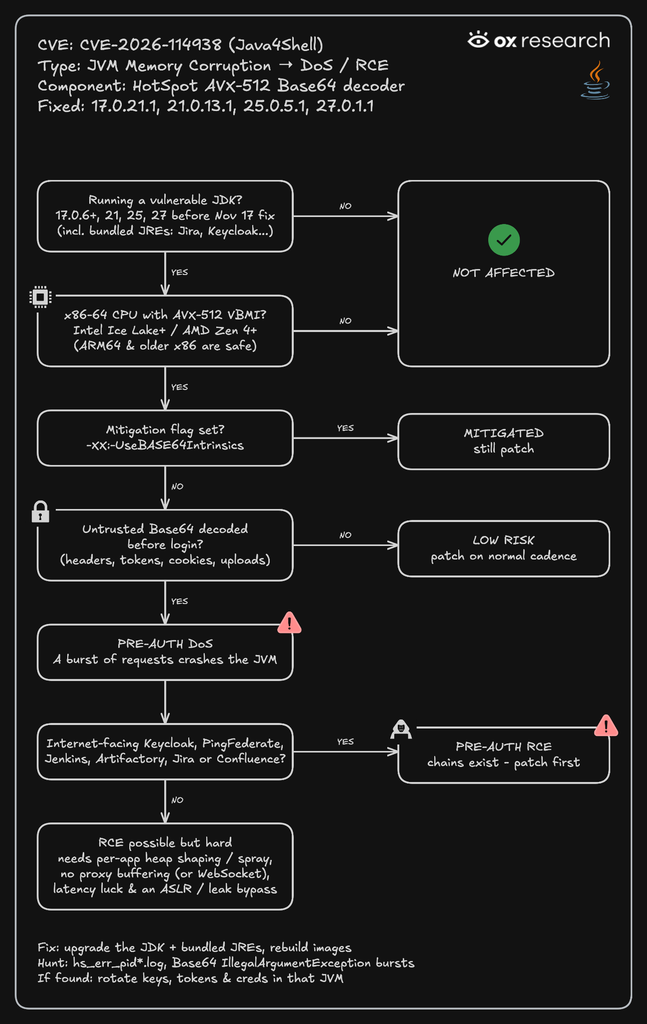
You can use the following flow chart as guidance for your internal audit:
Why This Isn’t PHP2Shell
Java4Shell comes from the same research team and carries the same 9.2 CVSS 4.0 score as PHP2Shell, but the two vulnerabilities present very different levels of risk. PHP2Shell was exploited in the wild four days before its CVE was published, while researchers were still working with limited technical details. In contrast, more than 24 hours after Java4Shell’s disclosure, there have been no confirmed attacks in the wild and no publicly available working RCE exploit.
While PHP2Shell could turn a single request to a vulnerable PHP server into a shell, Java4Shell requires specific hardware, a reachable vulnerable code path, and a carefully tailored exploit for each application. A crash is far easier to trigger than unauthenticated remote code execution. That doesn’t make Java4Shell harmless: organizations should patch promptly, before working exploits and exploitation attempts emerge. But despite its critical severity and widespread publicity, Java4Shell is considerably harder to weaponize than PHP2Shell.
| PHP2Shell (October 2026) | Java4Shell (November 2026) | |
| CVEs | CVE-2026-109618, CVE-2026-109619 | CVE-2026-114938 |
| Where the bug lives | PHP core: out-of-memory corruption and a use-after-free in the session upload progress handler, on by default | Hand-written AVX-512 assembly in HotSpot’s JIT-compiled Base64 decoder |
| Hardware condition | None | x86-64 with AVX-512 VBMI only (Ice Lake / Zen 4 and newer); ARM64 unaffected |
| What exposes an app | Running a vulnerable PHP version; application code cannot protect it | Passing attacker-controlled Base64 to java.util.Base64’s basic or URL decoder |
| Exploit | Generic: one request, one shell | Per-application heap profile, sensitive to latency and proxies |
| Public exploit | Multiple PoCs on GitHub | Safe local trigger only; product chains withheld |
| In-the-wild activity | Amazon honeypots saw attempts on October 17, four days before disclosure | None observed as of November 18 |
| Internet exposure | About 2.6 million internet-facing services showing a PHP version | Not yet measured |
The two do share a lesson. Both bugs sit in low-level code under a language people treat as safe, both were found with AI assistance in hours, and both leaked before coordinated disclosure.
Affected versions
A system is exposed only when it runs an affected Java version on an x86-64 CPU with AVX-512 VBMI. That means Intel Xeon Ice Lake, Sapphire Rapids, Emerald Rapids or Granite Rapids, or AMD EPYC and Ryzen Zen 4 or newer. ARM64 hosts (AWS Graviton, Ampere and similar) and older x86 CPUs such as Skylake-SP, Cascade Lake and Zen 2/3 are not affected.
| Package | CVE | Component | Versions | Fixed Versions | Ecosystem |
| OpenJDK 17 | CVE-2026-114938 | HotSpot x86-64 Base64 decode intrinsic | 17.0.6 – 17.0.21.0.3 | 17.0.21.1 | OpenJDK |
| OpenJDK 21 | CVE-2026-114938 | HotSpot x86-64 Base64 decode intrinsic | 21.0.13.0.3 and earlier | 21.0.13.1 | OpenJDK |
| OpenJDK 25 | CVE-2026-114938 | HotSpot x86-64 Base64 decode intrinsic | 25.0.5.0.3 and earlier | 25.0.5.1 | OpenJDK |
| OpenJDK 27 | CVE-2026-114938 | HotSpot x86-64 Base64 decode intrinsic | 27.0.1.0.3 and earlier | 27.0.1.1 | OpenJDK |
| Oracle Java SE 8 (performance build) | CVE-2026-114938 | HotSpot x86-64 Base64 decode intrinsic | 8u511b33-perf | 8u513 | Oracle Java |
| Amazon Corretto 17 | CVE-2026-114938 | HotSpot x86-64 Base64 decode intrinsic | 17.0.6 and later | 17.0.21.1.2 | OpenJDK distributions |
| Oracle GraalVM for JDK | CVE-2026-114938 | HotSpot x86-64 Base64 decode intrinsic | 17.0.21.0.3, 21.0.13.0.3 | November 2026 Critical Patch Update | Oracle Java |
| Oracle GraalVM Enterprise Edition | CVE-2026-114938 | HotSpot x86-64 Base64 decode intrinsic | 21.3.20.0.3 | November 2026 Critical Patch Update | Oracle Java |
| Other downstream OpenJDK builds (Eclipse Temurin, Azul Zulu, BellSoft Liberica, SAP SapMachine, Microsoft, Red Hat) | CVE-2026-114938 | HotSpot x86-64 Base64 decode intrinsic | Builds based on the affected branches above | Each vendor’s November 2026 release | OpenJDK distributions |
Standard Java 8 and Java 11 builds and Java 17.0.0 to 17.0.5 do not contain the vulnerable code. Many products ship their own runtime, including Jira, Confluence, Jenkins images, Keycloak and Elasticsearch, so the version that java -version reports on the host may not be the one the service uses.
Conclusions
AI has reduced the bar for finding and exploiting vulnerabilities in the wild, causing mass panic every week with a new Something2Shell dropping. And while some are actually relevant and exploitable, or just very cool (but impractical) to learn about, (like the *sshole OpenSSH vulnerability), the mass panic causes more harm than good. Security teams fight alert fatigue and constant feeling of “everything is important,” but in reality, exploitation of Java4Shell are more like Java4Shell_WITH_X86_AND_Base64_AND_OPENJDK – which isn’t as cool as just saying Java4Shell, right?
Teams that really want to keep their systems safe must first check the basics – Are we internet exposed? Is this connected to a real system, with valuable data? Do we meet all of the criteria for exploitation? – before they go into full-on panic mode.
Don’t expect the next weeks to be quiet, but make sure you panic about the right issues and not only the high-profile ones.