The inaugural Gartner® Magic Quadrant™ for Software Supply Chain Security recognizes OX as a Leader
We’re proud of where OX landed. We’re more interested in what it means for the security teams who have spent five years defending an attack surface that didn’t have a name yet.
A market that had to exist
The software supply chain has been the defining attack surface of the last five years. SolarWinds. Log4Shell. XZ Utils. And now Shai-Hulud, the self-propagating malicious package campaign tearing through developer toolchains. Each one exposed the same gap: organizations had reasonable visibility into their own code and almost none into the pipeline, the dependencies, and the tooling that produced it.
Gartner formalizing this as a Magic Quadrant category is recognition that the gap is no longer theoretical — and that the market of solutions addressing it has matured enough to evaluate rigorously. If you’re still treating supply chain security as a subset of AppSec or a compliance checkbox, that’s a signal worth paying attention to.
What sets OX apart
A new category demands a different kind of platform. Three things define how OX is built for it.
End-to-end pipeline lineage with PBOM. Most tools tell you what’s in your code. OX tells you where every artifact came from, what touched it, and whether it can be trusted by the time it reaches production. The Pipeline Bill of Materials (PBOM), our proprietary extension of the SBOM, provides dynamic, end-to-end lineage across the SDLC: pipeline activity, provenance, artifact integrity, and configuration changes from first commit to runtime. We’ve extended it to include AI-BOM, so the models and agents entering your pipeline are governed with the same rigor as everything else.
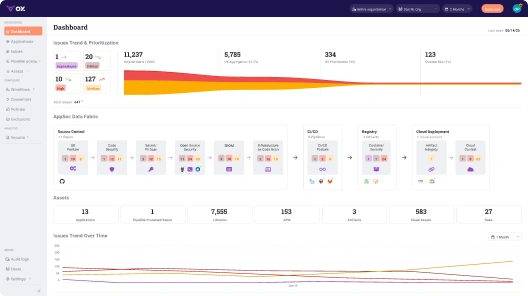
Prioritization over accumulation. The teams we work with aren’t failing to find issues. They’re drowning in them. OX correlates findings with runtime context to determine what’s actually reachable and exploitable, turning an endless vulnerability list into a ranked, workable risk posture. That’s the difference between knowing you have a problem and knowing which one to fix first, before runtime rather than after.
Innovation that anticipates the next attack surface. AI has rewritten what the software supply chain is. Code is written by agents, packages are pulled by autonomous tools, and prompts have become an input that can compromise a build. OX VibeSec secures this AI software supply chain directly inside AI code-generation workflows: Code Output Security validates code before it’s committed and blocks risky packages in real time, prompt authorization governs the inputs driving AI coding tools, and AI coding agent governance and toolchain control enforce policy on autonomous agents and the tools they reach for. Securing AI-generated code is table stakes. Governing the agents writing it is where the next several years of risk will be decided, and it’s where OX already operates.
Built for how security teams actually work
OX understands that supply chain security needs to operate as part of a single platform. That is why the platform includes a rich reporting and analytics layer, with built-in and fully customizable reports, dashboards, and views tailored to different roles and programs, plus extended data retention of up to 18 months, so teams can track trends, show progress, and meet audit requirements over a meaningful time horizon.
Best-in-class supply chain security should be the baseline every software-driven organization can reach, not a budget reserved for the few. OX’s subscription pricing is designed with that in mind, and is available as SaaS or on-premises.
What this means for your security program
The first edition of any Magic Quadrant is a snapshot of where a market stands the moment it becomes too important to ignore. This one says supply chain security is that moment, and that AI has raised the stakes faster than most programs have adapted.
If you’re building or revisiting your program in 2026, evaluate vendors on the questions that will define the next five years. Can the platform trace every artifact end to end? Does it prioritize on real exploitability, or just pile up alerts? And is it securing the AI that now writes and ships your software, or just the code that comes out the other end? We built OX to answer all three.
Learn more about OX Security’s Software Supply Chain Security Solution →
_________________________________________________________
Gartner® Magic Quadrant™ for Software Supply Chain Security, By Aaron Lord, Johnny Walters, Jason Gross, June 17, 2026, ID G00843814.
Gartner does not endorse any company, vendor, product or service depicted in its publications, and does not advise technology users to select only those vendors with the highest ratings or other designation. Gartner publications consist of the opinions of Gartner’s business and technology insights organization and should not be construed as statements of fact. Gartner disclaims all warranties, expressed or implied, with respect to this publication, including any warranties of merchantability or fitness for a particular purpose. GARTNER and MAGIC QUADRANT are trademarks of Gartner, Inc. and/or its affiliates.