
A one-byte heap overflow in Ruby’s string case conversion, plus six related flaws in the regex engine, could let attackers crash or take over Ruby applications. Administrators are urged to upgrade to Ruby 4.0.10, 3.4.13 or 3.3.14.
On November 18, 2026, the Ruby core team disclosed seven vulnerabilities in Ruby’s regular expression engine and string case conversion, and released Ruby 4.0.10, 3.4.13 and 3.3.14 to fix them. The first to get a CVE is CVE-2026-132825, a one-byte heap overflow in string case conversion. Ruby’s maintainers say proofs of concept show some of these flaws can lead to remote code execution, and even without code execution, a crafted request can crash the Ruby process. No exploitation in the wild has been reported so far.
What is Ruby?
Ruby is an open-source programming language. It powers Ruby on Rails and widely deployed products such as GitLab, GitHub Enterprise Server, Mastodon and Discourse. Because these flaws are in Ruby itself, every application on an affected Ruby version carries them, regardless of which gems it uses.
Recommendations
- Upgrade, but not ASAP. Move to Ruby 4.0.10, 3.4.13 or 3.3.14, rebuild the images that depend on it, and install fixed vendor releases as they come out.
- Restart and verify. Restart application processes and check the Ruby version the running process reports, not only the installed one.
- Find bundled Ruby. Include background workers, container base images, distro packages and products that ship their own Ruby, such as GitLab and GitHub Enterprise Server.
- Plan off EOL versions. Ruby 3.2 and earlier have reached end of life and won’t receive these fixes.
Affected versions
CVE-2026-132825 is rated 7.4 (High), and the other six advisories are still awaiting CVE assignment and scoring.
| Package | CVE | Component | Versions | Fixed Versions | Ecosystem |
| ruby | CVE‑2026‑132825 (Ruby2Shell) | String case conversion | 4.0.0 – 4.0.9 | 4.0.10 | Ruby |
| ruby | CVE‑2026‑132825 (Ruby2Shell) | String case conversion | 3.4.0 – 3.4.12 | 3.4.13 | Ruby |
| ruby | CVE‑2026‑132825 (Ruby2Shell) | String case conversion | ≤ 3.3.13 | 3.3.14 | Ruby |
| ruby | 6 additional advisories (CVE pending) | Regexp engine / string case conversion | 4.0.0 – 4.0.9, 3.4.0 – 3.4.12, ≤ 3.3.13 | 4.0.10, 3.4.13, 3.3.14 | Ruby |
| ruby | CVE‑2026‑132825 (Ruby2Shell) + 6 additional advisories (CVE pending) | — | ≤ 3.2 (EOL) | No fix: upgrade to a supported version | Ruby |
The Fix
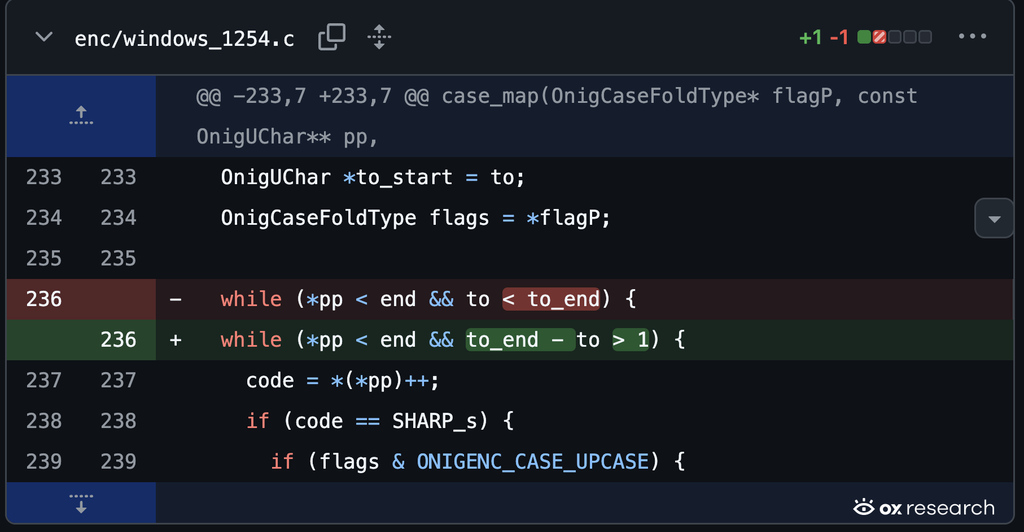
Looking at the actual patch for CVE-2026-132825, the bug is an off-by-one heap overflow in Ruby’s case-conversion code for legacy single-byte encodings (ISO-8859-x and Windows-125x). In these encodings, the character ß (0xDF) becomes two characters when its case changes (“ß”.upcase → “SS”), but the conversion loop only checked that one byte was free in the output buffer. An attacker who controls a string in one of these encodings, and gets the application to call upcase, swapcase, capitalize, casecmp? or downcase(:fold) on it, can place a ß so that one byte is written past the end of a heap buffer. This can crash the process, and under certain conditions the out-of-bounds write can be shaped into code execution.
In practice, turning this into an unauthenticated RCE is a high bar. The application has to accept attacker input in one of the affected encodings (UTF-8 strings, Ruby’s default, aren’t affected), run one of these case-conversion methods on it, and give the attacker enough control over the heap layout to make a single-byte overwrite useful. Ruby’s advisory says PoCs reach RCE in some scenarios, so it shouldn’t be dismissed. But for most real-world applications, exploitation depends on narrow conditions and likely on additional primitives.
Our Verdict: More Marketing Than Actual Risk
Ruby2Shell is more marketing than actual risk. The bug is real and the fix is worth installing, but nothing published so far shows that attackers can, or will, turn it into a working attack against real Ruby applications. Measured against the Trend or Risk checklist from our Cry2Wolf analysis, it lands in the same bucket as Java4Shell and NGINX2Root:
- Exploited in the wild? No. No exploitation has been reported.
- Working exploit? No. The maintainers describe proofs of concept, not a weaponized exploit that works against real-world applications.
- Reliable? Unlikely. Turning a one-byte heap overflow into code execution typically means grooming the heap, tailoring the exploit to each target and crashing the process on every miss.
- Preconditions? The attacker has to get crafted input into the affected regex or string case conversion code of a specific application.
- Severity? CVE-2026-132825 is rated 7.4 (High), not Critical, and the other six advisories have not been scored yet.
As we wrote in Cry2Wolf, “proving a bug can be exploited and actually exploiting it are two different things.” Ruby2Shell has the name, the headlines and the proofs of concept. It does not have the exploitation. Disclosure “exists to protect systems, and through them, people. It is not a marketing stunt.”
Bottom line: mostly trend. Patch at a reasonable pace, starting with internet-facing Ruby applications that pass untrusted input to regular expressions or case conversion, and don’t pull your team into a weekend war room for this one. We will update this verdict if exploitation is observed.