Key findings:
One root cause.
The five most common AI coding missteps share a common root: security controls built for human-paced development that can’t keep up with AI velocity.
The fix is prevention at the point of creation.
Embed security directly into AI development workflows and across the SDLC, not just downstream in delivery pipelines.
VibeSec maps to each misstep.
Secure code generation, an AI Bill of Materials, policy enforcement, role-based AI policies, and prevention at creation.
Unified platform context.
AI findings are connected to application security, cloud runtime, and offensive testing, so alerts become prioritized, real-world risk.
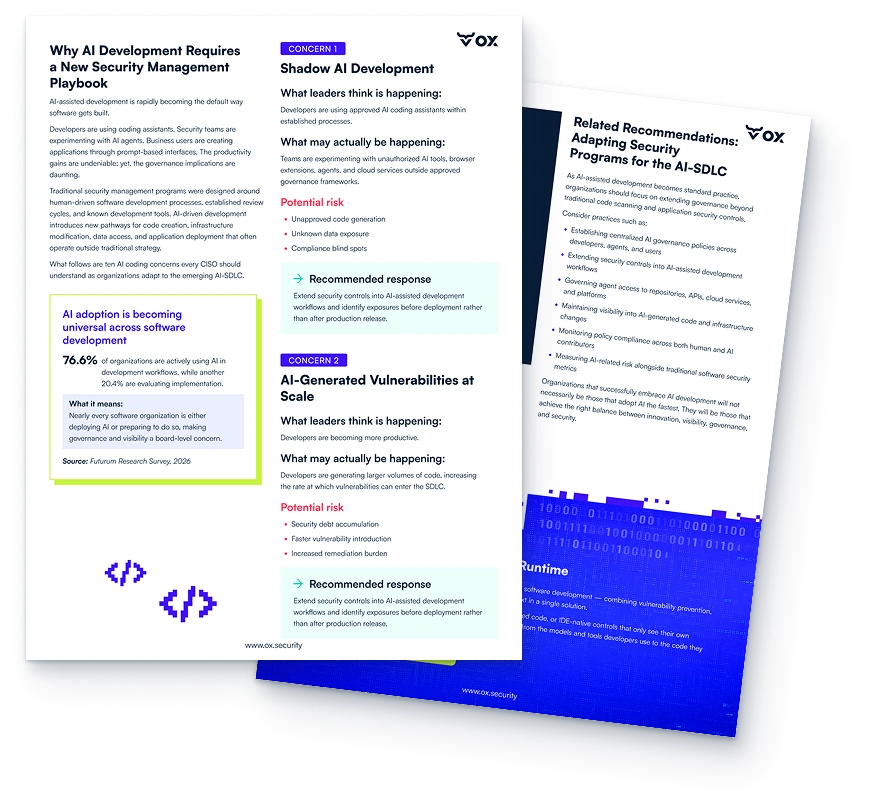
If security controls are slowing your AI development, or missing it entirely, this cheat sheet is for you.
The solution to AI coding risk isn’t to slow development or limit the tools. It’s to embed security at the point of creation and across the SDLC. That’s the design principle behind OX VibeSec: combining vulnerability prevention, governance, visibility, and runtime context into a unified approach that works at the speed AI coding demands.
Inside the cheat sheet: how VibeSec addresses each misstep
- Accepting AI code without review. Secure code generation directly in the workflow, insecure patterns flagged at generation time, with frictionless inline remediation.
- No visibility into AI tools. A continuously updated AI Bill of Materials (AI BOM), AI coding lineage tracking, and exportable activity history for audit and compliance.
- Broad agent access. Policy enforcement across AI workflows, approved-tool and integration governance, and blocking of risky, hallucinated, or non-compliant components.
- AI coding outside policy. Role-based AI coding policies, enforcement across models/MCPs/dependencies, and governance for autonomous and vibe coding workflows.
- Post-production scanning. Prevention at creation instead of detection after deployment, unified AppSec + cloud + runtime context, and runtime/pentest insights fed back into development.
By the numbers:
- 45% of AI-generated code samples introduce OWASP Top 10 vulnerabilities.
- 10x more security findings from AI-assisted developers vs. non-AI peers.
- 35 CVEs in a single month (March 2026) directly attributed to AI coding tools.
- Source: Cloud Security Alliance. The velocity gain from AI coding is real — so is the security debt it creates.