







Scan your whole stack








Latest version: v0.12.0
Django Admin MCP was last scanned on 23 Nov 2026 at version 0.12.0. Risk score 0 of 100. No malicious behavior was detected.
| Version | Published | Status |
|---|---|---|
| 0.12.0 LATEST | 23 Nov 2026 | No rules fired |
| 0.11.1 | 20 Oct 2026 | No rules fired |
| 0.11.0 | 16 Oct 2026 | No rules fired |
| 0.10.1 | 9 Oct 2026 | Not shown |
| 0.10.0 | 5 Oct 2026 | Not shown |
Findings for v0.12.0. The score is a capped sum of the weights of the rules that fired — not CVSS, not exploitability, and not a probability. It is not comparable across packages with different scan coverage.
The score describes 0.12.0; other versions have their own rules, not their own score.
The publisher’s own README, as collected from the registry.
Add a mixin to your ModelAdmin and MCP clients get CRUD, admin actions and relationship traversal, inside Django's existing permissions. Only Django and Pydantic as dependencies.
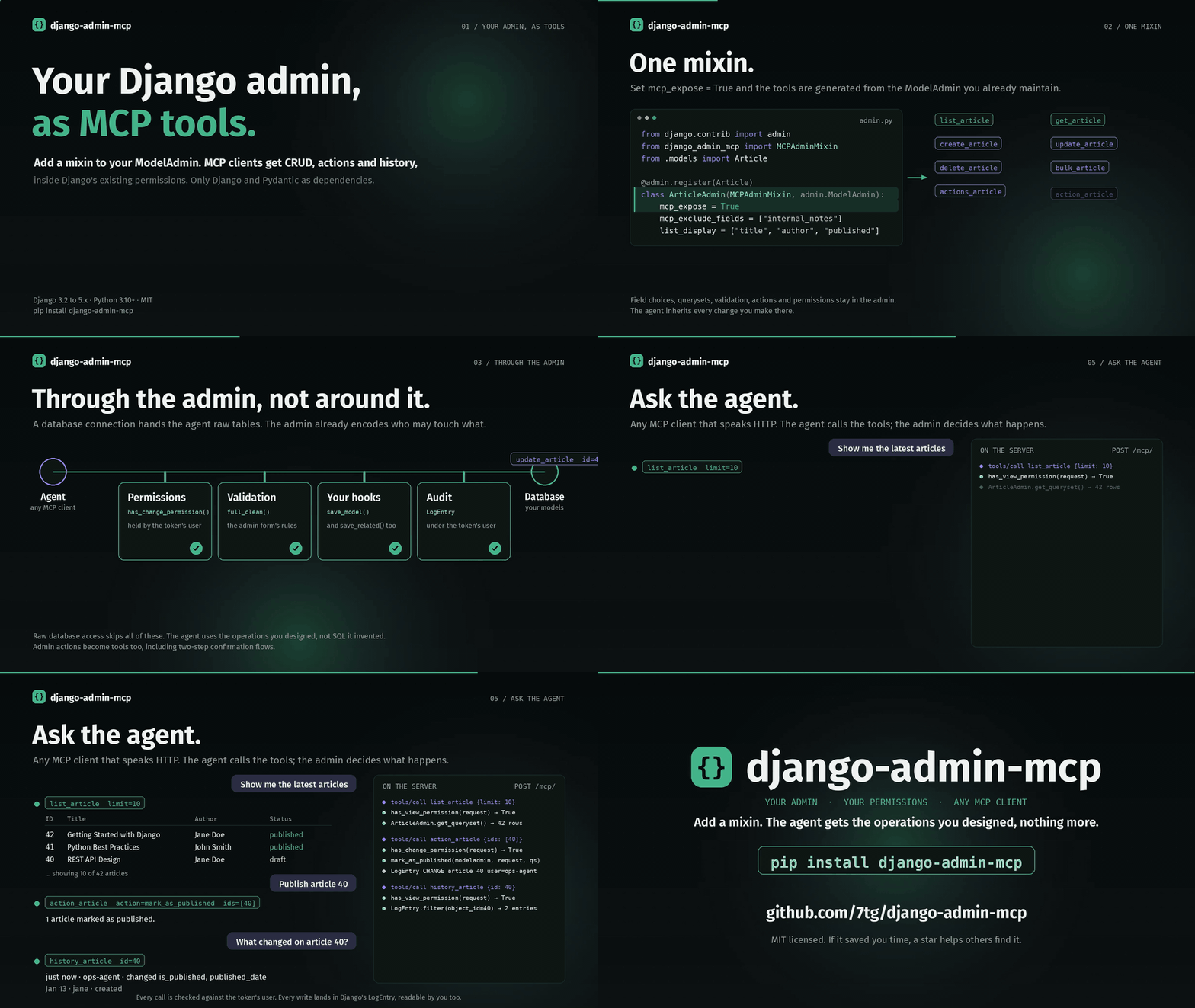
One mixin, the request's path through the admin, a token, a conversation with the agent, then getting started. 50 seconds · 1080p · 60 fps · original soundtrack. Watch the film.
A database connection hands the agent raw tables. The Django admin is where your project already encodes who may touch what, how records are validated, and what the sanctioned bulk operations are. This package puts the agent behind that layer instead of around it:
ModelAdmin.has_*_permission(). A token can only do what its linked user can do, and starts with no access until you grant it.full_clean() and your save_model() / save_related() hooks, so the agent cannot save a record the admin form would reject.LogEntry under the token's user. You can see what the agent changed, and the agent can read the history too.mcp_fields / mcp_exclude_fields keep password hashes and secrets out of the agent's view; get_queryset() still limits which rows it can see.A generic Django MCP server or a hand-rolled FastMCP wrapper asks you to define tools, schemas and permission checks yourself, one function at a time. This package reads the ModelAdmin classes you already maintain and generates the tools from them, so field choices, querysets, validation, actions and permissions stay in one place and the agent inherits every change you make to the admin. It also ships as a plain Django app with no MCP SDK or extra HTTP stack.
pip install django-admin-mcp# settings.py
INSTALLED_APPS = [
'django_admin_mcp',
# ...
]
# urls.py
urlpatterns = [
path('mcp/', include('django_admin_mcp.urls')),
# ...
]python manage.py migrate django_admin_mcp1. Expose a model. Set mcp_expose = True to generate tools for it. Models with the mixin but without the flag are discoverable through find_models only.
from django.contrib import admin
from django_admin_mcp import MCPAdminMixin
from .models import Article, Author

@admin.register(Article)
class ArticleAdmin(MCPAdminMixin, admin.ModelAdmin):
    mcp_expose = True                    # list_article, get_article, create_article, ...
    mcp_exclude_fields = ['internal_notes']
    list_display = ['title', 'author', 'published']

@admin.register(Author)
class AuthorAdmin(MCPAdminMixin, admin.ModelAdmin):
    pass                                 # discoverable, no direct tools
2. Create a token in the admin at /admin/django_admin_mcp/mcptoken/. Grant it exactly the permissions and groups the agent needs. The linked user caps what the token can do and is the identity its changes are logged under.
3. Point your MCP client at it, for example in a .mcp.json for Claude Code:
{
  "mcpServers": {
    "django-admin": {
      "type": "http",
      "url": "http://localhost:8000/mcp/",
      "headers": { "Authorization": "Bearer YOUR_TOKEN" }
    }
  }
}
4. Ask the agent.
User: Show me the latest 10 articles
Agent: [calls list_article with limit=10]

User: Mark articles 1, 2 and 3 as published
Agent: [calls action_article with action="mark_as_published", ids=[1, 2, 3]]

User: What changed on article 42?
Agent: [calls history_article with id=42]For each exposed model (here Article) the server generates:
| Tool | Does |
|---|---|
list_article, get_article |
Read with pagination and filtering (needs view) |
create_article, update_article, delete_article |
Write single records (needs add / change / delete) |
bulk_article |
Create, update or delete many records at once |
actions_article, action_article |
List and run registered admin actions, including file-returning exports |
describe_article |
Field definitions, types and constraints |
related_article |
Follow foreign keys and reverse relations |
history_article |
Django admin change history |
autocomplete_article |
Search suggestions for foreign-key fields |
Plus find_models to discover everything exposed, MCP prompts for common workflows, and read-only resources at models:// and data:// URIs. The endpoint speaks JSON-RPC 2.0 over HTTP with GET /mcp/health/ for health checks. Full reference in the docs.
mcp_<key>.<secret>; only a salted hash of the secret is stored.MCP_ACTION_MAX_FILE_BYTES (default 5 MiB).See Permissions and Token Management for details.
Python 3.10 to 3.14, Django 3.2 to 6.0, Pydantic 2. Tested against every Django release in that range.
If this saved you time, a star on GitHub helps others find it. Issues and PRs are welcome; see the contributing guide.
MIT
Find threats in your stack.
OX Radar can check high-priority threats, like critical package CVEs, against your context.
Each incident is marked Detected or Not Detected with a remediation plan and proof all tracked in the Response Center.
The probe returned only these fields for this server — auth requirement, protocol and tool list weren’t observed, so they’re not shown (never guessed).
The publisher’s own links, as the registry reports them. These are not sources for the assessment on this page.