Scan your whole stack


From OX Research Newsroom






Latest version: v0.12.8
sextant was last scanned on 24 Nov 2026 at version 0.12.8. Risk score 0 of 100. No malicious behavior was detected.
| Version | Published | Status |
|---|---|---|
| 0.12.8 LATEST | 24 Nov 2026 | No rules fired |
| 0.12.7 | 23 Nov 2026 | No rules fired |
| 0.11.1 | 16 Nov 2026 | No rules fired |
| 0.11.0 | 16 Nov 2026 | Not shown |
| 0.10.0 | 15 Nov 2026 | Not shown |
Findings for v0.12.8. The score is a capped sum of the weights of the rules that fired — not CVSS, not exploitability, and not a probability. It is not comparable across packages with different scan coverage.
The score describes 0.12.8; other versions have their own rules, not their own score.
The publisher’s own README, as collected from the registry.
Search your own documents from any AI assistant — and see the numbers that say how well the search works.
sextant is a knowledge base that runs on your own machine as a standard Model Context Protocol server. Point it at a folder of PDF, Markdown or text files, plug it into Claude Desktop or any other MCP client, and ask. Answers come from your documents and name the file and the page.
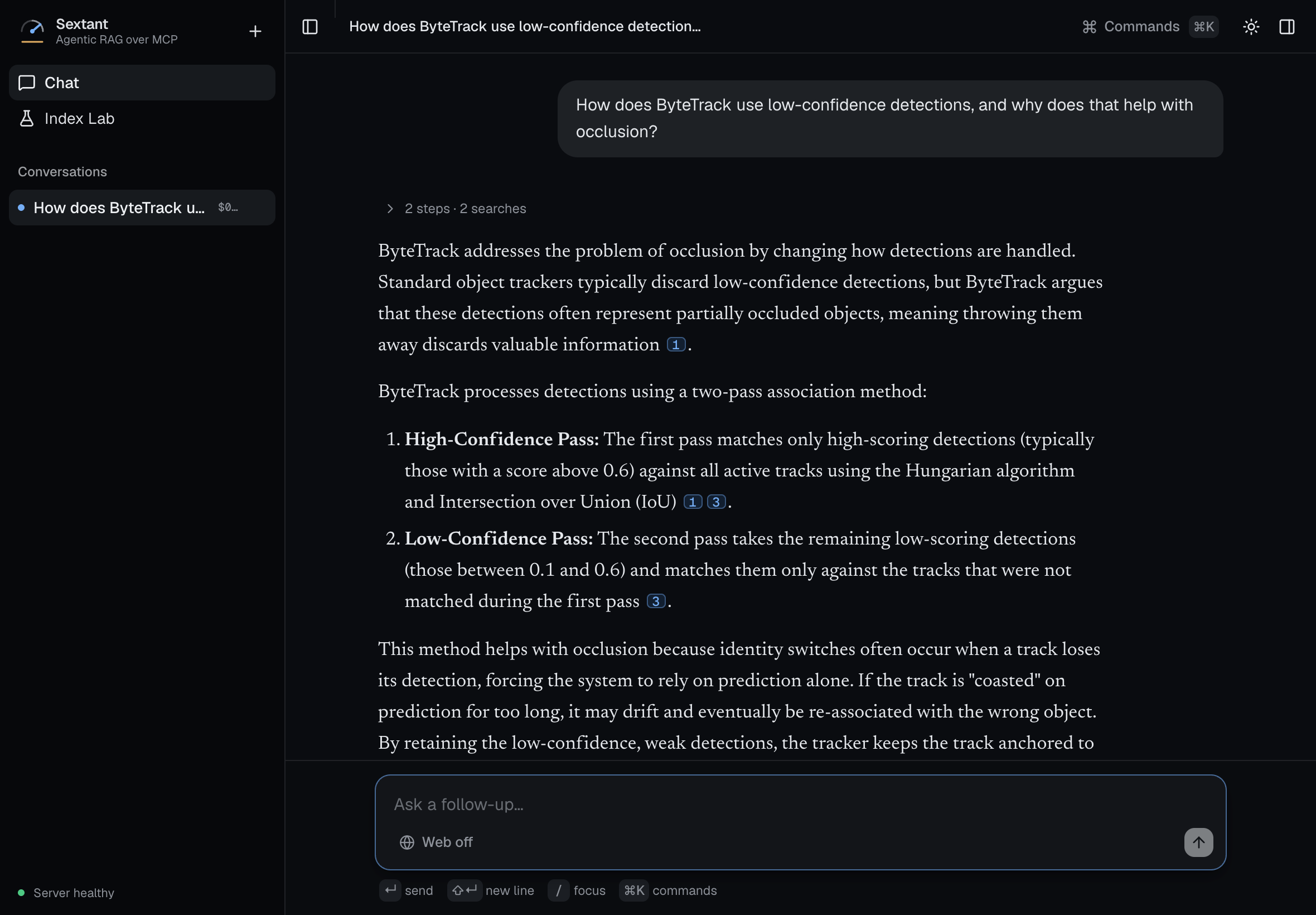
A real answer from the project's own web interface (2026-11-12). Each numbered marker opens the passage it came from.
Four steps. Most of the time is two downloads — about 170 MB of libraries, then about 180 MB of search models. No account and no key. It needs Python 3.11 to 3.14 — check first, because an older or newer one fails with a confusing "no matching distribution" message:
python3 --version1. Install it into a folder of its own, so its location is known:
python3 -m venv ~/sextant~/sextant/bin/pip install sextant-kb2. Add your documents — any folder of PDF, Markdown or text files.
Scanned PDFs are read with text recognition, which downloads about 4 MB
the first time it meets one; for another language set
SEXTANT_OCR_LANG=eng+mar (English and Marathi) or eng+hin.
~/sextant/bin/sextant-ingest ~/Documents/notes -rThe first run downloads the search models, once; after that it works
offline. A note that it is storing text only is expected: an optional
model-written overview per document needs a Gemini key, and nothing else
does. Searching happens on your machine; the passages it finds go to
whichever assistant you plug it into. To add more documents later, quit the
assistant first: only one program may write the library at a time, and
sextant-ingest refuses, saying so, while an assistant has it open.
3. Plug it into your assistant. In Claude Desktop: Settings → Developer →
Edit Config, then add this and restart the app. The command must be a full
path; echo ~/sextant/bin/sextant-kb prints yours.
{
  "mcpServers": {
    "knowledge-base": {
      "command": "/Users/you/sextant/bin/sextant-kb"
    }
  }
}
4. Ask. For example: "Search my knowledge base — what do my notes say about onboarding?" The assistant calls the search tool and answers from your documents, with the source of each passage.
To see what is indexed, or take a document back out:
~/sextant/bin/sextant-forget --listAny other MCP client works the same way: its server command is the full path
to sextant-kb. On Windows the config file is
%APPDATA%\Claude\claude_desktop_config.json and a virtual environment keeps
its commands in Scripts\ rather than bin/; this project has not been
tested on Windows.
A sextant-<version>.mcpb file, from the
releases page, installs
it in the Claude desktop app with no terminal: double-click it, choose the folder to search, and wait while it
indexes. It needs Python 3.11 to 3.14 on the computer. Without one, the
app downloads Python (about 20 MB) from github.com during the install, which
is where two of the first three people to try it got stuck:
cpython-… from github.com:
the network blocked or slowed that site. Switch networks (a phone hotspot
works), or install Python 3.12 from
python.org, quit Claude fully, and
install the file again.onnxruntime has no wheel (or no matching distribution) for the
computer: an older bundle picked a Python newer than 3.14. Use a bundle
from 0.11.2 or later, which asks for a supported one.On a Mac with Apple silicon there is a second file,
sextant-<version>-macos-arm64.mcpb (about 330 MB), which carries its own
Python, libraries and search models: from 0.12.6 it downloads nothing, at
install or on its first start, so neither error above can happen and it
works with no internet connection. Reading scans in a language other than
English downloads a few MB once. The other file downloads the search models
(about 180 MB) on its first start.
With uv installed, one pasted line replaces the
four steps: it installs sextant, tells the assistant about it, and points it
at a folder. Change ~/Documents to the folder you want searched. Each line
runs --version first, so the first install (a few hundred MB) finishes in
the terminal rather than timing out inside the assistant. When the assistant
starts it, the folder is indexed in the background and kb_stats shows the
progress and any file it could not read. While it runs, files added, changed
or deleted in the folder show up in search within about a minute; only files
it indexed from the folder are ever removed, and a folder that goes missing
(an unplugged drive) removes nothing. --python keeps uv off a Python
newer than sextant's libraries support.
Claude Code (the terminal program; for the Claude desktop app, use the
.mcpb bundle instead):
uvx --python '>=3.11,<3.15' --from 'sextant-kb>=0.11.1' sextant-kb --version && claude mcp add sextant --scope user --env SEXTANT_FOLDER=~/Documents -- uvx --python '>=3.11,<3.15' --from 'sextant-kb>=0.11.1' sextant-kbVS Code (needs the code command: in VS Code run Shell Command: Install
'code' command in PATH once):
uvx --python '>=3.11,<3.15' --from 'sextant-kb>=0.11.1' sextant-kb --version && code --add-mcp '{"name":"sextant","command":"uvx","args":["--python",">=3.11,<3.15","--from","sextant-kb>=0.11.1","sextant-kb"],"env":{"SEXTANT_FOLDER":"~/Documents"}}'Cursor: add this to ~/.cursor/mcp.json. It has not been tried in
Cursor yet.
{"mcpServers": {"sextant": {"command": "uvx", "args": ["--python", ">=3.11,<3.15", "--from", "sextant-kb>=0.11.1", "sextant-kb"], "env": {"SEXTANT_FOLDER": "~/Documents"}}}}| Tool | Does |
|---|---|
kb_search |
Finds the passages that answer a question, ranked, with source and page |
kb_list |
Lists every document with its title, size and what it is about |
kb_ingest |
Adds documents; re-using an id replaces the old version |
kb_stats |
Library size, search model, where it is stored |
kb_ann_benchmark, kb_ann_compare |
Compare index types on your own library |
kb_selftest_sample, kb_selftest_grade |
A self-test: your assistant writes a question for a sample of passages and sextant checks whether search finds each one. Ask "how well does search work on my documents?". It answers with a short report: one score with how far chance could move it, the questions it missed, the files search cannot use (scanned, empty or copies), and at most one thing to fix first, backed by a number. A rough guide: on public test sets it followed true quality only roughly |
Your library is stored in your user-data folder (set SEXTANT_CHROMA_DIR to
move it), never inside the install, so reinstalling does not lose it.
Measured, on a committed test set, and re-checked on every change:
| Search stage | Right passage first |
|---|---|
| Meaning search only | 87% |
| Keyword search only | 78% |
| Both, fused | 91% |
| Both, fused, then re-read (the shipped pipeline) | 93% |
65 test questions over 21 documents. Asked 10 questions those documents cannot answer, it declines 8.
On three public test sets (BEIR) the full search beats the published BM25 + re-reading baseline on all three sets; where a stage loses to a plain baseline is the first thing on the results page.
The full comparison, the nine ideas that were measured and rejected, and what
a question costs are on one page: docs/RESULTS.md. Every
figure there is generated from the measurement files.
The package above is the reusable part. This repository also holds what is built on it: an agent that decides for itself what to look up, a web interface with clickable citations, and the evaluation tools. That part needs a Gemini API key, which is the only key the project reads.
git clone https://github.com/hulagerushikesh/sextant && cd sextantpython3 -m venv .venv && ./.venv/bin/pip install -e ".[dev]" && (cd frontend && npm install)cp .env.example .envAdd your key to .env, then:
./start_all_services.shThe interface opens on http://localhost:3000. Or run both halves in
containers with docker compose up --build. Details, every setting and the
HTTP routes are in docs/running.md.
Last checked 2026-11-12.
| What | State |
|---|---|
| Search over your own documents: PDF, Markdown, text; add, replace, remove | Working |
Standard MCP server, published as sextant-kb |
Working — on the public package index and in the official MCP registry as io.github.hulagerushikesh/sextant; the quickstart installs the latest release |
| Measured search quality with a check on every change | Working |
| Agent, web interface, citations, cost per question, daily spend cap | Working |
| Each person's uploads kept apart on a shared deployment | Working — proven on a hosted box 2026-11-04 |
| Hosted demo | None. The hosted box was removed 2026-11-13; deploy/ is the recipe to build one |
| Used by anyone outside the project | Not yet — see planning/PLAN.md |
Known limits, stated plainly, are in docs/known-issues.md.
The two that matter most to a new user: a scanned PDF is read by text
recognition, in English unless you name other languages, so a poor scan gives
wrong words; and the test questions were written alongside the test
documents, so the numbers grade the search pipeline, not your library.
Find threats in your stack.
OX Radar can check high-priority threats, like critical package CVEs, against your context.
Each incident is marked Detected or Not Detected with a remediation plan and proof all tracked in the Response Center.
The probe returned only these fields for this server — auth requirement, protocol and tool list weren’t observed, so they’re not shown (never guessed).
The publisher’s own links, as the registry reports them. These are not sources for the assessment on this page.