Scan your whole stack


From OX Research Newsroom






Are you using @acarmisc/backstage-plugin-litellm?
Find out what’s in your code.
Scan your apps free in minutes (opens in a new tab) Read the latest findings
Latest version: v0.58.0
@acarmisc/backstage-plugin-litellm was last scanned on 29 Nov 2026 at version 0.58.0. Risk score 0 of 100. No malicious behavior was detected.
| Version | Published | Status |
|---|---|---|
| 0.58.0 LATEST | 29 Nov 2026 | No rules fired |
| 0.57.1 | 17 Nov 2026 | No rules fired |
| 0.57.0 | 17 Nov 2026 | No rules fired |
| 0.56.0 | 17 Nov 2026 | Not shown |
| 0.55.0 | 16 Nov 2026 | Not shown |
Findings for v0.58.0. The score is a capped sum of the weights of the rules that fired — not CVSS, not exploitability, and not a probability. It is not comparable across packages with different scan coverage.
The score describes 0.58.0; other versions have their own rules, not their own score.
The publisher’s own README, as collected from the registry.
Frontend for the Backstage LiteLLM Governance Plugin — lets developers manage their LiteLLM virtual keys and follow their AI usage and budgets from Backstage.
Built for the New Frontend System
(@backstage/frontend-plugin-api). It needs the backend,
@acarmisc/backstage-plugin-litellm-backend,
which talks to LiteLLM and enforces every rule.
Full documentation — adoption guide, configuration, permissions, security model and architecture — starts at the project README.
yarn --cwd packages/app add @acarmisc/backstage-plugin-litellmIf your app discovers features from its dependencies (app.packages: all),
the plugin is picked up automatically. Otherwise register it:
// packages/app/src/App.tsx
import { createApp } from '@backstage/frontend-defaults';
import litellmPlugin from '@acarmisc/backstage-plugin-litellm';

const app = createApp({
  features: [litellmPlugin],
});
This adds the /litellm page and the liteLlmApiRef API used by every
component below.
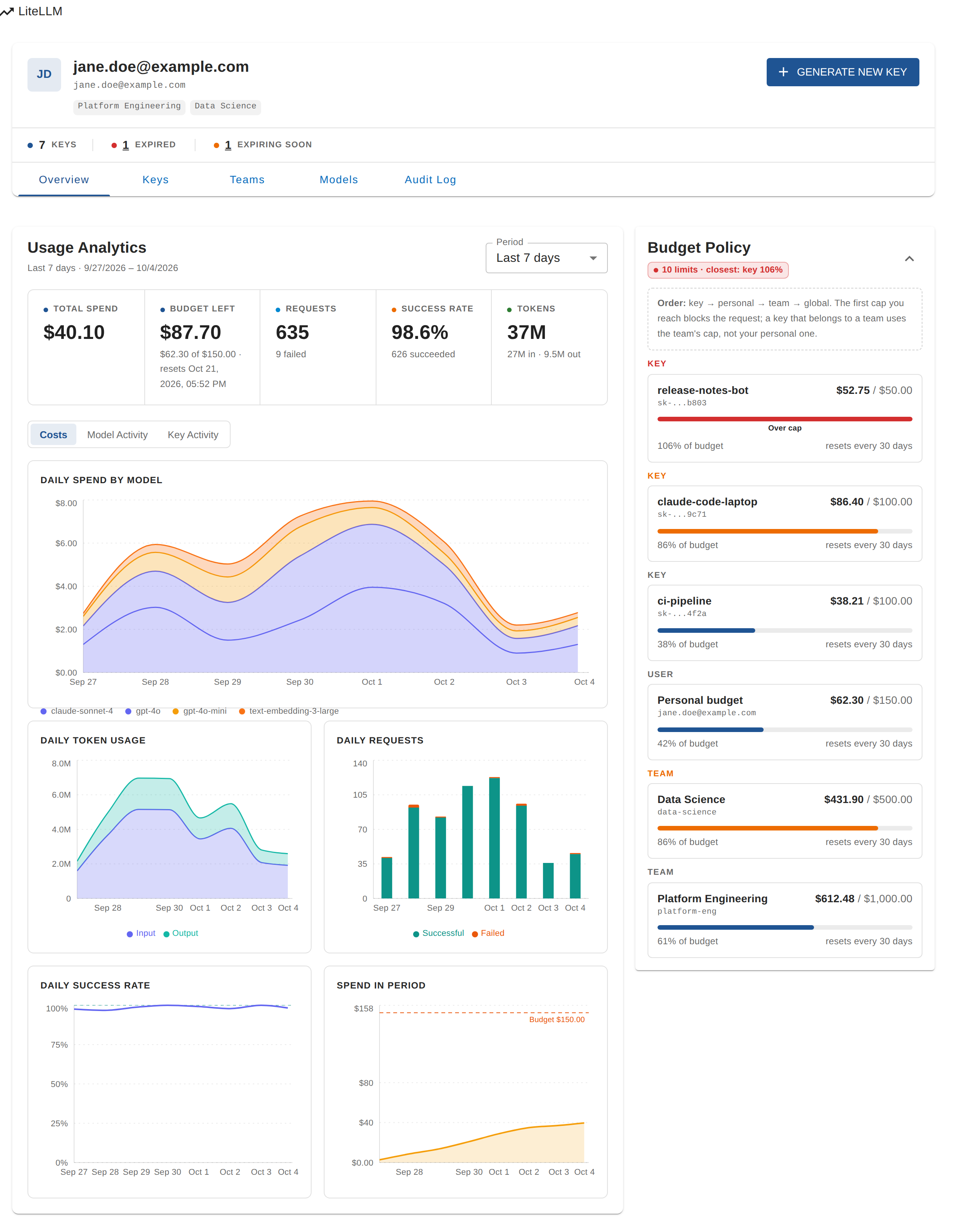
/litellm pageTabs: Overview (usage KPIs and charts), Keys (your virtual keys: edit,
block / unblock, reset spend, delete), Teams (team usage, and team
management for admins), Models (the proxy's model catalogue) and Audit
Log (members of litellm.audit.group only) and Users Monitoring (audit
group: all users; group managers: only their group's members). ?tab=<name> opens a tab and
?generate=1 opens the Generate New Key dialog.
| Component | What it shows |
|---|---|
LiteLLMHomeWidget |
Spend and tokens for Today / 7d / 30d with a daily sparkline |
LiteLLMBudgetWidget |
The budget hierarchy (key → personal → team → global) with a meter per limit |
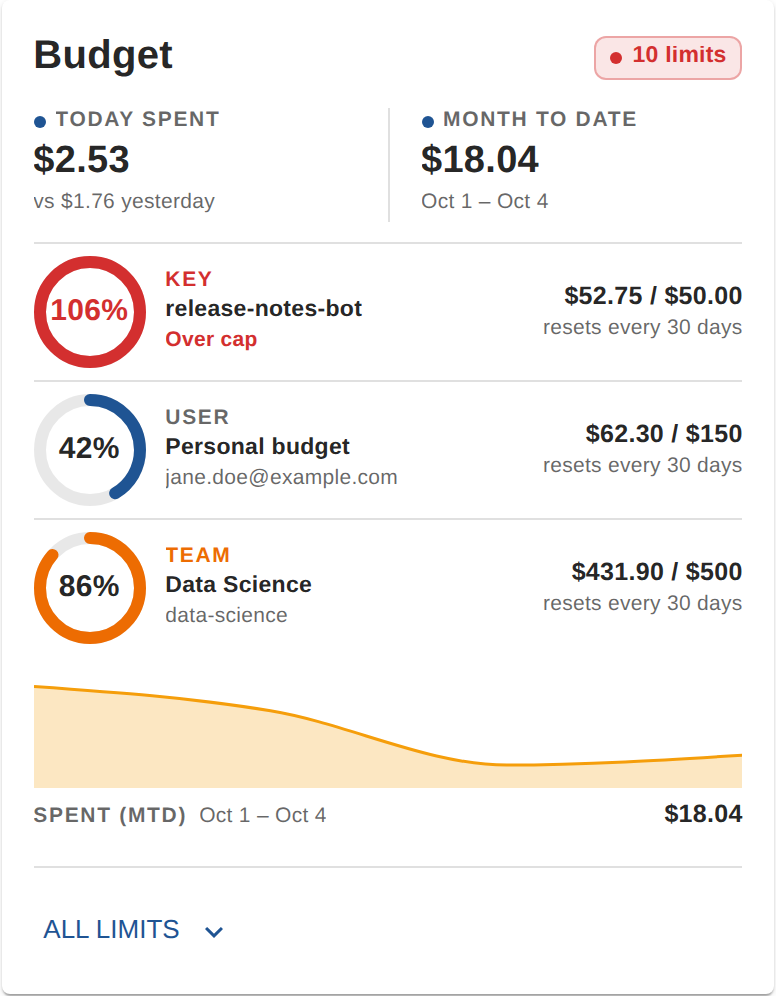
LiteLLMBudgetGauges |
A condensed budget card: one ring per level and a month-to-date chart |
GenerateKeyButton |
The shared "Generate New Key" button (onClick, or to="/litellm?generate=1") |
import {
  LiteLLMHomeWidget,
  LiteLLMBudgetGauges,
} from '@acarmisc/backstage-plugin-litellm';

<LiteLLMHomeWidget defaultPeriod="7d" />
<LiteLLMBudgetGauges />
Props for each component are documented in docs/frontend.md.
To try it without a backend, run npm start in this package: it serves the
plugin with mock data at http://localhost:3000/litellm (see
CONTRIBUTING.md).
litellmPlugin (also the default export)LiteLLMPage, and the building blocks it uses: DashboardHeader,
KeysTable, UsageStats, TeamUsage, KeyFormDialog, ManageTeamDialog.
Prefer LiteLLMPage; composing the pieces yourself means wiring their data
and callbacks the way the page does.LiteLlmApi, liteLlmApiRef, the shared API types, and the
litellmTeam*Permission definitions.Apache-2.0
Find threats in your stack.
OX Radar can check high-priority threats, like critical package CVEs, against your context.
Each incident is marked Detected or Not Detected with a remediation plan and proof all tracked in the Response Center.
The probe returned only these fields for this server — auth requirement, protocol and tool list weren’t observed, so they’re not shown (never guessed).
The publisher’s own links, as the registry reports them. These are not sources for the assessment on this page.
Read the latest findings