Scan your whole stack








Are you using @ddd-ts-kit/drizzle?
Find out what’s in your code.
Scan your apps free in minutes (opens in a new tab) Read the latest findings
Latest version: v0.115.0
@ddd-ts-kit/drizzle was last scanned on 26 Nov 2026 at version 0.115.0. Risk score 0 of 100. No malicious behavior was detected.
| Version | Published | Status |
|---|---|---|
| 0.115.0 LATEST | 26 Nov 2026 | No rules fired |
| 0.114.1 | 19 Nov 2026 | No rules fired |
| 0.113.2 | 17 Nov 2026 | No rules fired |
| 0.113.1 | 16 Nov 2026 | Not shown |
| 0.113.0 | 16 Nov 2026 | Not shown |
Findings for v0.115.0. The score is a capped sum of the weights of the rules that fired — not CVSS, not exploitability, and not a probability. It is not comparable across packages with different scan coverage.
The score describes 0.115.0; other versions have their own rules, not their own score.
The publisher’s own README, as collected from the registry.
English · Français
Drizzle adapters of the kernel and events ports on PostgreSQL: a unit of work that repositories never see, the transactional outbox store, the processed-event store, and one database schema per bounded context. Drizzle is the default persistence of the kit, not a requirement: everything here implements ports, and another ORM is another adapter passing the same contract suites.
npm i @ddd-ts-kit/drizzle drizzle-ormWorks with every drizzle PostgreSQL driver (node-postgres, postgres-js, PGlite, Neon): the
functions are generic over the database type, so executor() is typed exactly like your db.
Nothing here is imported from domain/ or application/. A handler depends on the repository
port of its domain; the adapter of that port, in infrastructure/, runs its statements on the
Database of the project; the platform builds the unit of work once and binds it.
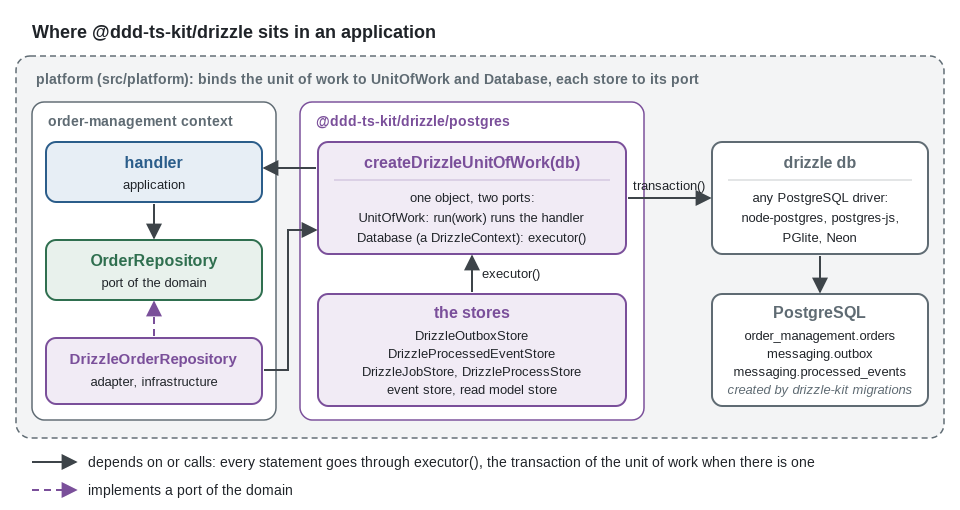
The one idea to keep: every statement goes through executor(). Inside a unit of work it
is the transaction of that unit of work, so the row of the aggregate, the outbox record of the
event it published and the processed-event mark of a consumer commit or roll back together.
Outside one (a query, a script) it is the database itself.
The tables are plain drizzle definitions: export them from the schema files drizzle-kit reads and they are created by your own migrations.
// platform/database/schema.ts
import { integer, text } from 'drizzle-orm/pg-core';
import { contextSchema, outboxTable, processedEventsTable } from '@ddd-ts-kit/drizzle/postgres';

export const outbox = outboxTable('messaging'); // messaging.outbox; no argument: public.outbox
export const processedEvents = processedEventsTable('messaging');

// contexts/order-management/infrastructure/persistence/order-management.schema.ts
export const orderManagement = contextSchema('order-management'); // schema order_management
export const orders = orderManagement.table('orders', {
  id: text('id').primaryKey(),
  status: text('status').notNull(),
  version: integer('version').notNull(),
});
outbox is indexed for the relay (pending records by next attempt, partial index);
processed_events has (consumer, event_id) as its primary key.
DrizzleContext is the handle repositories and stores run their queries on. It is generic
over the drizzle database, so the project names its own database with a class, which is then
the injection token:
// platform/database/database.ts
import type { PgQueryResultHKT } from 'drizzle-orm/pg-core';
import { DrizzleContext } from '@ddd-ts-kit/drizzle/postgres';

export abstract class Database extends DrizzleContext<PgQueryResultHKT> {}
This is the class the CLI writes: typed on the driver-neutral base, so the same repositories
run on node-postgres in production and on PGlite in the tests, the connection being typed
PgDatabase<PgQueryResultHKT>. A project bound to one driver may name its kind instead
(DrizzleContext<NodePgQueryResultHKT>), which types the raw result of execute exactly.
createDrizzleUnitOfWork(db) gives one object that is both the kernel UnitOfWork and that
Database. Bind it to both:
// platform/database/persistence.module.ts
import { drizzle } from 'drizzle-orm/node-postgres';
import type { PgDatabase, PgQueryResultHKT } from 'drizzle-orm/pg-core';
import { defineContextModule } from '@ddd-ts-kit/di';
import { IntegrationEventPublisher, ProcessedEventStore, UnitOfWork } from '@ddd-ts-kit/kernel';
import { OutboxPublisher, OutboxStore } from '@ddd-ts-kit/events';
import {
  createDrizzleUnitOfWork,
  DrizzleOutboxStore,
  DrizzleProcessedEventStore,
} from '@ddd-ts-kit/drizzle/postgres';
import { Database } from '@/platform/database/database';
import { outbox, processedEvents } from '@/platform/database/schema';

const db: PgDatabase<PgQueryResultHKT> = drizzle(process.env.DATABASE_URL);
const unitOfWork = createDrizzleUnitOfWork(db);

export const persistenceModule = defineContextModule({
  name: 'persistence',
  register(builder) {
    builder.rebind(UnitOfWork).toValue(unitOfWork);
    builder.bind(Database).toValue(unitOfWork);
    builder
      .bind(OutboxStore)
      .toFactory((resolve) => new DrizzleOutboxStore(resolve(Database), { table: outbox }));
    builder
      .rebind(ProcessedEventStore)
      .toFactory((resolve) => new DrizzleProcessedEventStore(resolve(Database), { table: processedEvents }));
    builder.rebind(IntegrationEventPublisher).toClass(OutboxPublisher, [OutboxStore]);
  },
});
// main.ts
const app = createApplication({ modules: [kernelModule(), persistenceModule, contextModule('order-management', orderManagementDeclarations)] });List the module after kernelModule(): rebind replaces its in-memory defaults. The command
bus of the kernel module runs every command in the bound UnitOfWork; handlers do not know it.
contextModule of @ddd-ts-kit/di turns the declared classes of a context into its module.
A project written by the CLI holds the same wiring in two files:
platform/database/persistence-over.ts builds the unit of work and the two stores once, and
platform/composition/platform.module.ts binds them, the outbox publisher being given to
kernelModule({ eventPublisher }).
The factories pass the tables of the messaging schema. With the tables in public, the
stores need no option and the class is bound directly:
builder.bind(OutboxStore).toClass(DrizzleOutboxStore, [Database]),
builder.rebind(ProcessedEventStore).toClass(DrizzleProcessedEventStore, [Database]).
The relay reads the same store and hands the records to the broker:
const relay = new OutboxRelay({ store: app.resolve(OutboxStore), publisher: broker, clock: app.resolve(Clock) });
relay.start({ intervalMs: 500 });
unitOfWork.run(work) opens db.transaction and keeps the transaction in an
AsyncLocalStorage; a nested run joins the outer transaction. Because append uses the
current transaction, an event published by a handler that then fails is rolled back with the
business write: that is the whole point of the outbox.
run is built on unitOfWorkOver of the kernel. The domain events of the aggregates saved
inside it wait until work has returned, then are dispatched inside the transaction, before
the commit: their handlers see every save, and what they write commits or rolls back with it.
If work, a handler or the commit fails, nothing is left: no row, no outbox record, no handler
run after the commit. Handlers declared after-commit run once the transaction has committed.
A nested run joins the unit of work in progress: one dispatch, at the end of the outermost.
Called inside the unit of work of another database, run opens its own: its events are
dispatched before its own commit.
The unit of work commits or rolls back as a whole: once a nested run has failed it no longer
commits, and when the work caught that failure and went on the outermost run rejects with a
UnitOfWorkAbortedError whose cause it is.
A run called directly (a consumer, a script) has the same timing as a command.
unitOfWorkContract of @ddd-ts-kit/testing/contracts proves it on PGlite, with a deferred
constraint for the commit that fails. The README of @ddd-ts-kit/kernel draws this timeline
(Domain events and the unit of work).
The port lives in the domain, the adapter in infrastructure. A repository receives the
database, never a transaction: executor() is the transaction of the unit of work when there
is one and db otherwise.
// Instead of: a transaction handed down by the caller, which every port and every handler would then carry
save(order: Order, transaction: PgTransaction<PgQueryResultHKT>): Promise<void>;

// Write: the database, whose executor() is the transaction of the unit of work in progress
constructor(private readonly database: Database) {}
The domain side, an aggregate that knows nothing of rows, and its port:
import { AggregateRoot, DomainRefusal, Repository } from '@ddd-ts-kit/kernel';

// contexts/order-management/order-management.codes.ts
export const OrderManagementCodes = {
  OrderAlreadyPlaced: 'ORDER_ALREADY_PLACED',
} as const;

// contexts/order-management/domain/errors/order-already-placed.error.ts
export class OrderAlreadyPlaced extends DomainRefusal {
  readonly code = OrderManagementCodes.OrderAlreadyPlaced;

  static forOrder(orderId: string) {
    return OrderAlreadyPlaced.refusal(`Order ${orderId} is already placed.`, { orderId });
  }
}

// contexts/order-management/domain/order.aggregate.ts
export type OrderStatus = 'open' | 'placed';

export class Order extends AggregateRoot {
  private constructor(
    id: string,
    private status: OrderStatus,
  ) {
    super(id);
  }

  static open(id: string): Order {
    return new Order(id, 'open');
  }

  /** Rebuilds a stored order: used by the mapper only. */
  static rehydrate(id: string, status: OrderStatus): Order {
    return new Order(id, status);
  }

  get currentStatus(): OrderStatus {
    return this.status;
  }

  place(): void {
    if (this.status === 'placed') {
      throw OrderAlreadyPlaced.forOrder(this.id);
    }

    this.status = 'placed';
  }
}

// contexts/order-management/domain/repositories/order.repository.ts: findById and save come from Repository
export abstract class OrderRepository extends Repository<Order> {}
The infrastructure side, the table, the mapper and the adapter:
// contexts/order-management/infrastructure/persistence/drizzle-order.repository.ts
import { and, eq } from 'drizzle-orm';
import { integer, text, type PgQueryResultHKT } from 'drizzle-orm/pg-core';
import { AggregateRoot } from '@ddd-ts-kit/kernel';
import { Repository } from '@ddd-ts-kit/kernel/declarations';
import { aggregateMapper, contextSchema, DrizzleContext, insertIgnoringConflict, optimisticUpdate } from '@ddd-ts-kit/drizzle/postgres';

// The aggregate and its port of the previous sample, reduced to their shape.
type OrderStatus = 'open' | 'placed';
declare class Order extends AggregateRoot {
  static rehydrate(id: string, status: OrderStatus): Order;
  get currentStatus(): OrderStatus;
}
abstract class OrderRepository {
  abstract findById(id: string): Promise<Order | undefined>;
  abstract save(order: Order): Promise<void>;
}

// platform/database/database.ts: the injection token of the database
abstract class Database extends DrizzleContext<PgQueryResultHKT> {}

// order-management.schema.ts: the table of the schema sample, with a typed status
const orders = contextSchema('order-management').table('orders', {
  id: text('id').primaryKey(),
  status: text('status').$type<OrderStatus>().notNull(),
  version: integer('version').notNull(),
});

type OrderRow = typeof orders.$inferSelect;

// order.mapper.ts: the row never leaves infrastructure
const OrderMapper = aggregateMapper({
  toDomain(row: OrderRow): Order {
    return Order.rehydrate(row.id, row.status);
  },

  toRow(order: Order): Omit<OrderRow, 'version'> {
    return { id: order.id, status: order.currentStatus };
  },
});

@Repository(OrderRepository)
export class DrizzleOrderRepository implements OrderRepository {
  constructor(private readonly database: Database) {}

  async findById(id: string): Promise<Order | undefined> {
    // executor(): the transaction of the unit of work in progress, or the database outside one
    const [row] = await this.database.executor().select().from(orders).where(eq(orders.id, id));

    return row === undefined ? undefined : OrderMapper.toDomain(row);
  }

  async save(order: Order): Promise<void> {
    const db = this.database.executor();

    await optimisticUpdate(order, async ({ expected, next }) => {
      const row = { ...OrderMapper.toRow(order), version: next };

      if (expected === 0) {
        return (await insertIgnoringConflict(() => db.insert(orders).values(row), orders)) ? 1 : 0;
      }

      const written = await db
        .update(orders)
        .set(row)
        .where(and(eq(orders.id, order.id), eq(orders.version, expected)))
        .returning({ id: orders.id });

      return written.length; // 0 rows: optimisticUpdate throws ConcurrencyError
    });
  }
}
In the explicit style, without the decorator, the same binding is one line of
<context>.module.ts:
builder.bind(OrderRepository).toClass(DrizzleOrderRepository, [Database]).
The save above is written out to show each statement. saveAggregate does the same in one
call: it takes a table that keeps the key under id and the version under version, and one
save, the aggregate, the columns its mapper gave, the scope and the clock that stamp the audit
columns. saveTenantAggregate is the same for a table every tenant shares: it writes the row in
the tenant of the work in progress and confines its update to that tenant. A generated repository
saves this way and holds nothing else of the plumbing.
async save(invoice: Invoice): Promise<void> {
  await saveAggregate(this.database, invoices, {
    aggregate: invoice,
    row: InvoiceMapper.toRow(invoice),
    scope: this.scope,
    clock: this.clock,
  });
}
optimisticUpdate gives the version to expect and the version to write, raises a
ConcurrencyError (a DomainError with code CONCURRENCY_CONFLICT) when the guarded
statement wrote no row, and moves order.version on otherwise. If your database was created
with a relational schema (drizzle(url, { schema })), declare Database as
DrizzleContext<PgQueryResultHKT, typeof schema> to keep executor().query.
expected |
Statement | No row written means |
|---|---|---|
0: never saved |
insertIgnoringConflict: INSERT ... ON CONFLICT DO NOTHING, then ON CONFLICT (id) DO NOTHING when it wrote nothing |
the id is taken |
n |
UPDATE ... SET version = n + 1 WHERE id = ... AND version = n |
another transaction saved it since it was read |
insertIgnoringConflict(() => db.insert(orders).values(row), orders) inserts unless the primary
key exists, as the table declares it (primaryKeyOf(orders), the id, or every column of a key that
holds the tenant), and says whether it did. It takes two statements at most, which is why the
insert is given as a function. Neither conflict clause is enough alone. Without a target,
PostgreSQL also skips a row that takes a value another row holds under a unique constraint (an
email), and the save reads as a lost update. With the key as its target, two first saves of one
aggregate made at once (a request delivered twice) meet on the other unique index first, and the
one that lost is refused for a value no other row holds, where it lost an update. So the first
statement names no target, and only when it wrote nothing the second names the key: a key that is
held writes no row, which optimisticUpdate raises as a ConcurrencyError, and a value another
row holds is refused by the database, which it raises as a UniqueViolationError (code
CONFLICT, 409), as for an update that takes such a value.
Find threats in your stack.
OX Radar can check high-priority threats, like critical package CVEs, against your context.
Each incident is marked Detected or Not Detected with a remediation plan and proof all tracked in the Response Center.
The probe returned only these fields for this server — auth requirement, protocol and tool list weren’t observed, so they’re not shown (never guessed).
The publisher’s own links, as the registry reports them. These are not sources for the assessment on this page.
Read the latest findings