Scan your whole stack


From OX Research Newsroom






Are you using @intentius/behold?
Find out what’s in your code.
Scan your apps free in minutes (opens in a new tab) Read the latest findings
Latest version: v0.34.7
@intentius/behold was last scanned on 27 Nov 2026 at version 0.34.7. Risk score 0 of 100. No malicious behavior was detected.
| Version | Published | Status |
|---|---|---|
| 0.34.7 LATEST | 27 Nov 2026 | No rules fired |
| 0.34.6 | 24 Nov 2026 | No rules fired |
| 0.34.5 | 23 Nov 2026 | No rules fired |
| 0.34.4 | 21 Nov 2026 | Not shown |
| 0.34.3 | 21 Nov 2026 | Not shown |
Findings for v0.34.7. The score is a capped sum of the weights of the rules that fired — not CVSS, not exploitability, and not a probability. It is not comparable across packages with different scan coverage.
The score describes 0.34.7; other versions have their own rules, not their own score.
The publisher’s own README, as collected from the registry.
Your infrastructure repo as a graph, from the files.
npx @intentius/behold serve .Run it in a folder of Terraform and it finds each root and draws it as a box of resources, with an edge for each reference the configuration states. It needs no state file or cloud account, and it runs no terraform binary. It writes nothing into the folder it reads. The same command draws a Pulumi program and the Kubernetes manifests in a plain directory, since their lexicons come with the install. behold works beside the tools a repo already uses.
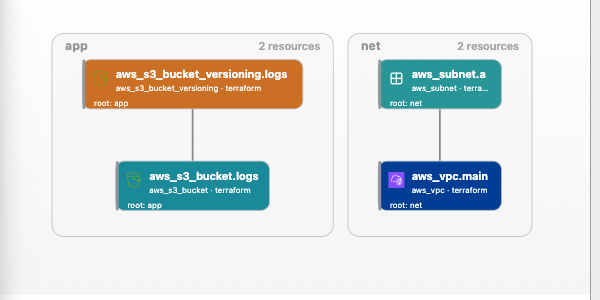
The documentation covers each command and view in full. This README is the map.
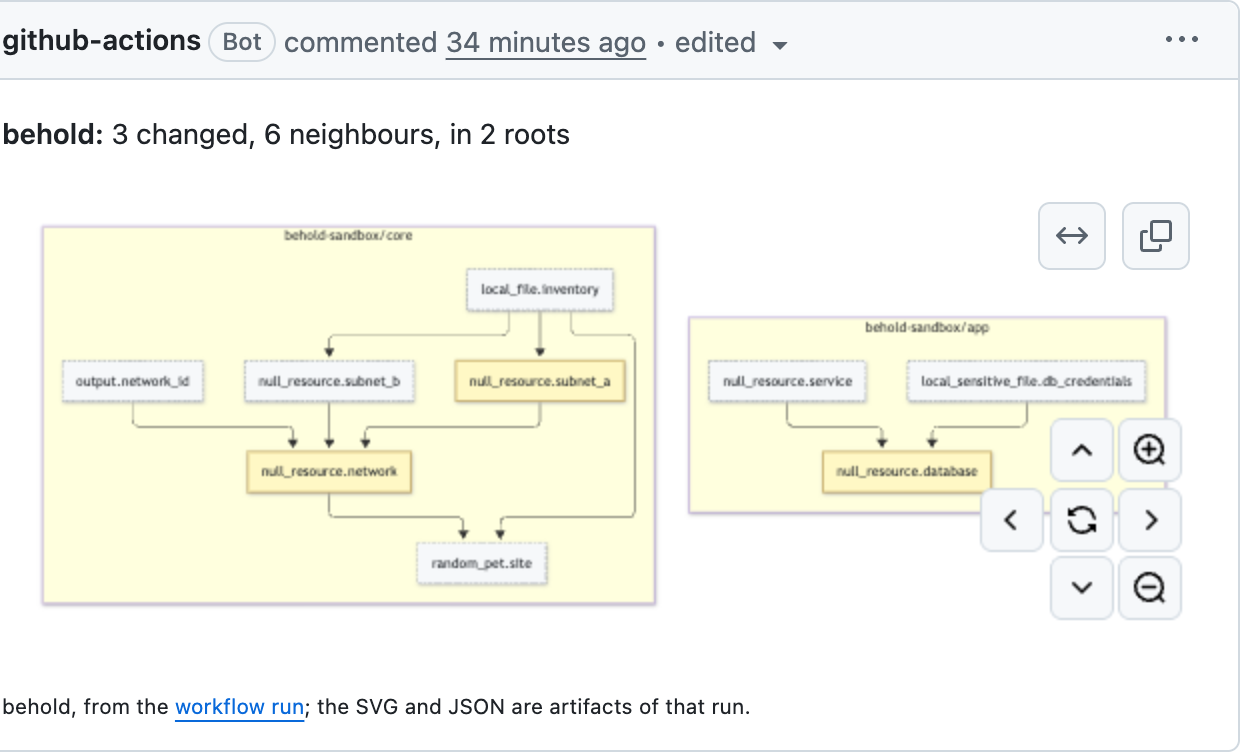
The GitHub Action in this repository comments a diagram of the resources a pull request changes and what they connect to. Each push edits the same comment, and the diagram also lands in the job summary with an SVG and JSON copy as artifacts. It reads the files in the repository and needs neither a plan nor cloud credentials.
name: behold
on: pull_request
permissions:
  contents: read
  pull-requests: write
jobs:
  draw:
    runs-on: ubuntu-latest
    steps:
      - uses: actions/checkout@v6
        with:
          fetch-depth: 0
      - uses: INTENTIUS/behold@behold-v0.34.6
action/README.md lists the inputs and shows the GitLab and Forgejo forms.
behold graphbehold graph [dir] reads a directory and prints its graph, with no server and no browser. A CI job, an editor or a script can take the output as it is. The directory can be a folder of .tf files, a chant project, a chant workspace root or a choudoufu estate.
npx @intentius/behold graph ./infra --json | jq '.nodes | length'
npx @intentius/behold graph ./infra --svg --theme light -o graph.svg
npx @intentius/behold graph ./infra --mermaid --forge gitlab
--json (the default) prints the behold-graph/1 document, described on the graph document page, with its schema in the package at schemas/graph/v1/graph.schema.json. --ir prints the unversioned {ir, meta} snapshot that /api/graph answers, without its SVG. --svg writes the picture as one self-contained SVG. --mermaid writes a Mermaid flowchart that fits the comment budget of the forge --forge names (github, gitlab or forgejo). No output holds an absolute path, and a card's source text is left out unless you pass --source. A root that does not parse is one card in the output, as it is in the browser.
Two cuts print part of the graph. --changed <base>..<head> keeps the cards added, removed or changed between two commits and the cards within --depth hops of them (default 1). Both commits are read with git archive into a temporary directory, so the checkout is not touched. Past --budget cards (default 60) the neighbours fold into a count per box. --around <id>[,<id>...] keeps the named cards or boxes and those within --depth hops, --up or --down for one direction.
npx @intentius/behold graph ./infra --changed origin/main...HEAD -o cut.json
npx @intentius/behold graph ./infra --around prod/prod/aws_vpc.main --depth 2
--context <name> draws a live Kubernetes cluster instead of a directory, through chant's read-only lister: API discovery, then a list per kind, a box per namespace and one for cluster-scoped objects. --namespace and --types narrow it. Nothing is written to the cluster. Add a directory (--context prod ./infra) and the folder is drawn in the same graph, with chant's reference catalog joining a ServiceAccount's cloud role annotation or an ExternalSecret's key to the Terraform that declares it, and the folder's aws_eks_cluster (or GKE or AKS cluster) to the context when its name matches. --git <clone> draws what the cluster's Argo CD Applications and Flux Kustomizations deploy from beside the live objects, read from a local clone with nothing fetched. --index aws joins the cloud index behold index aws wrote, so a ServiceAccount's role and an ExternalSecret's secret are drawn as the indexed resources. The cluster read also draws the edge from a Service to the Pods its selector picks, from an object to its owner, and from an EndpointSlice to its Service. --logical and --components group the objects by application, with each application's health (the graph document has the views). A kubeconfig user that runs an exec plugin (the EKS, GKE and AKS command line tools write these) is refused unless you pass --allow-exec-plugin.
behold graph --help lists every flag.
The same read feeds several places outside behold's own page. Each has a docs page or a README with the setup.
behold export on each push to main, so the graph has a stable URL. It also writes graph-dark.svg and graph-light.svg beside the export, for a README to embed.graph.json through the Infinity data source, with two ready dashboards (docs).argocd-cm entry gives annotated Argo CD Applications an "Open in behold" link, with nothing to install in Argo CD (docs).kubectl behold draws the current context, or one object and its neighbours, and opens the SVG. Install it with kubectl krew install behold; the current plugin is 0.1.1 (surfaces/kubectl-behold).behold mcp and a skill that starts behold serve: claude plugin marketplace add INTENTIUS/behold, then claude plugin install behold@behold (plugins/claude-code).npx @intentius/behold preview # the current directory, source graph only
npx @intentius/behold serve . --env prod # with the live drift overlay
npx @intentius/behold serve . --env prod --poll 30behold preview opens a project's graph at one port with no env and no emulator. behold serve takes the same project and more: --env <name> colours each card by what is deployed, --poll <secs> re-reads live drift on an interval, and several project directories compose into one estate with a box per project and edges across them. The page is at http://localhost:4600 unless --port says otherwise.
The server watches the served source and pushes a refresh over SSE (/api/events) when a file changes, so the graph follows your edits with no reload. The panel offers zoom levels (components, logical, composites, resources, attributes, and the ops track and apply order where the project has them), a radial layout, an inspect pane and ⌘K search in chant's query grammar. Reading the graph explains the colours and marks.
With chant, behold draws every substrate of an estate in one graph (cloud drift on AWS, supply-chain drift on GitHub Actions, artifact presence on Helm, an Argo CD or Flux cluster) and starts the project's own committed, gated Ops. Serve a chant workspace and Acting on it cover that path.
chant source --build/lint--> graph IR --behold--> live graph + drift + (delegated) actionsThe docs start with a prompt that gets a coding agent with a shell to a running graph. Paste it into Claude Code, or any such agent, from anywhere:
Clone https://github.com/INTENTIUS/behold and get me looking at a live
infrastructure graph in my browser.

I want the bundled demo. It needs Docker and no cloud account. Install what
it needs and start it, then tell me the URL.

Walk me through what I am looking at: what the colours mean, and how I make a
resource change colour while I watch.

When Docker is not running, say so. Show me the source graph on its own
instead.

For anything past the demo, read https://intentius.io/behold/llms.txt and
https://intentius.io/behold/using/agents/.

Never deploy with the Deploy button, `POST /api/apply` or `POST /api/ci/dispatch`. Gate approvals stay mine as well (`/api/ops/:name/signal/:gate`, `/api/workspace/gates/approve`, `/api/operator/approve/:op/:gate`). Op runs (`/api/ops/:name/run`) and rollbacks (`/api/rollback`) are mine too. Leave `--auto-sync` off, and keep a `behold preview` or `--public` serve read-only.behold doctornpx @intentius/behold doctor [dir] [--json]One line each for the project's kind, its own chant install and version, declared lexicons, which of them can be aimed at an emulator, the envs the picker will infer, the kube context chant binds against your ambient one, substrate readiness, committed Ops, the chant floor each read needs, and a line per non-chant member it found. Each is pass, warn or fail with a one-line fix. Nothing starts and nothing changes. The exit code is non-zero only when something would stop behold serving the project well, so CI can gate on it. --fix is the one form that writes: it writes chant.workspace.json for an estate root that still lists its members in .behold.json.
npx @intentius/behold demo            # the default: one S3 bucket on a local emulator
npx @intentius/behold demo --list     # the catalog, with what each one needs
A bundled demo copies its project into a directory that is yours to edit, installs it and serves it. The default (writes) is an S3 bucket and its policy against a local Floci emulator in Docker: the cards start blue (declared), you click Deploy on the panel's Deploy tab, and they turn green (managed). With Docker stopped, behold serves the source graph and says why.
| Demo | Shows | Needs |
|---|---|---|
writes |
the first apply, on an emulator | Docker |
k8s |
an nginx Deployment on a throwaway k3d cluster: runtime Pods, field-ownership drift, an unobserved context | Docker, k3d, kubectl |
flux-estate |
a Flux control plane and two app projects composed into one estate | Docker, k3d, kubectl |
argo-estate |
the Argo CD version of the same estate, declared only | nothing |
terraform-estate |
a multi-root Terraform estate boxed by root, and the edge behold declines to infer | nothing |
carve |
a chant project beside a Terraform root, and the six-step carve walkthrough | nothing (--live needs Docker and terraform) |
choudoufu-estate |
four tag-owned estates as one workspace, coloured by ownership | Docker, choudoufu |
terralith |
one Terraform root adopted into choudoufu and split into team estates | Docker, curl, choudoufu |
three-cloud |
a website on AWS, Azure and GCP emulators behind Route 53, on three engines | Docker, curl, choudoufu, plunge |
fountain |
a real self-hosted app on k3d, cloned from INTENTIUS/fountain-ops | Docker, k3d, kubectl, jq, just |
Loaded demos land in the panel's recents, and the Scope tab lists the whole catalog. The walkthroughs are in example-writes/README.md, example-k8s/README.md, example-carve/README.md and the three-cloud page.
serve --local is the same mechanism for any project: it boots the served project's own emulators through chant emulator up, aims the live overlay at them, and tears them down on exit.
behold export freezes the view into a static folder any static host can serve. Pan, zoom, the zoom levels, the radial layout, the inspect pane and the env and tier pickers all work with no backend; nothing live is observed and nothing deploys.
npx @intentius/behold export . --out ./behold-export
npx @intentius/behold export . --env prod --out ./behold-export   # with that env's overlay
npx @intentius/behold export . --single-file graph.html           # one HTML file
The bundle carries graph.json, the opening view as a behold-graph/1 document, and a wrangler.jsonc for Cloudflare's static assets (npx wrangler deploy from the folder). It holds nothing about the machine that made it: no recent projects, no user name, and absolute paths cut to the directory's name. --no-source also leaves out each card's source text. --open-env, --open-zoom, --note, --q and --count-by set the opening view and the searches it answers offline. --publish s3://<bucket>/<prefix>/views/<name> uploads the bundle there, filed by commit. Export a snapshot has the rest.
behold indexnpx @intentius/behold index aws --account <id> --regions us-east-1,eu-west-1
npx @intentius/behold index kubernetes --context <name>behold index <aws|azure|gcp|kubernetes> lists one account, subscription, project or cluster through that cloud's inventory API, types the result through chant, adds derived edges, and writes one stamped index version to the index store (by default $XDG_DATA_HOME/behold, else ~/.local/share/behold; --store names another). It needs no project, starts no server and refuses every action flag. behold index --help lists the scope and filter flags. An aws index is typed by the optional peer @intentius/chant-lexicon-aws; install it beside behold, or the resources are kept as nodes of unknown kind.
The graph pane at /graph on a served page loads every member's IR, engine graph document, index version and cloud listing it finds into one read-only database, and answers Cypher queries and templates over it (GET /api/graphdb/*). The query side needs the optional peer @ladybugdb/core. The graph database describes the tables, the routes and the limits.
A template is a named question with the resource filled in, so a click in the graph pane and behold mcp ask with resource and template run the same query. behold offers chant's templates, and a project adds its own in .chant/templates.json at the workspace root (the folder holding chant.workspace.json), or at the project root when there is no workspace:
{
  "version": 1,
  "templates": [
    {
      "id": "bucket-users",
      "title": "Who uses this bucket",
      "question": "Which resources reference this bucket?",
      "kinds": ["aws_s3_bucket"],
      "inputs": [{ "name": "node", "kind": "resource", "description": "the bucket" }],
      "reads": "session",
      "query": { "kind": "cypher", "text": "MATCH (u:Resource)-[:REF]->(b:Resource {key: $key}) RETURN u.key AS key ORDER BY key" }
    }
  ]
}Find threats in your stack.
OX Radar can check high-priority threats, like critical package CVEs, against your context.
Each incident is marked Detected or Not Detected with a remediation plan and proof all tracked in the Response Center.
The probe returned only these fields for this server — auth requirement, protocol and tool list weren’t observed, so they’re not shown (never guessed).
The publisher’s own links, as the registry reports them. These are not sources for the assessment on this page.
Read the latest findings