



Scan your whole stack








Are you using @lenard9191/pi-project-profile?
Find out what’s in your code.
Scan your apps free in minutes (opens in a new tab) Read the latest findings
Latest version: v1.6.0
@lenard9191/pi-project-profile was last scanned on 27 Nov 2026 at version 1.6.0. Risk score 0 of 100. No malicious behavior was detected.
| Version | Published | Status |
|---|---|---|
| 1.6.0 LATEST | 27 Nov 2026 | No rules fired |
| 1.5.2 | 22 Nov 2026 | No rules fired |
| 1.5.1 | 14 Nov 2026 | No rules fired |
| 1.5.0 | 9 Nov 2026 | Not shown |
| 1.4.0 | 27 Oct 2026 | Not shown |
Findings for v1.6.0. The score is a capped sum of the weights of the rules that fired — not CVSS, not exploitability, and not a probability. It is not comparable across packages with different scan coverage.
The score describes 1.6.0; other versions have their own rules, not their own score.
The publisher’s own README, as collected from the registry.
Project-aware π (pi) coding agent, with a verification gate. A π extension that detects any repository's stack, commands, conventions and instruction files (AGENTS.md, CLAUDE.md, .cursorrules, …), injects them as a stable <project_profile> system-prompt section, and then runs the project's own typecheck, lint, tests and build after every agent turn — with a bounded self-repair loop and a review of the agent's diff.
pi install npm:@lenard9191/pi-project-profile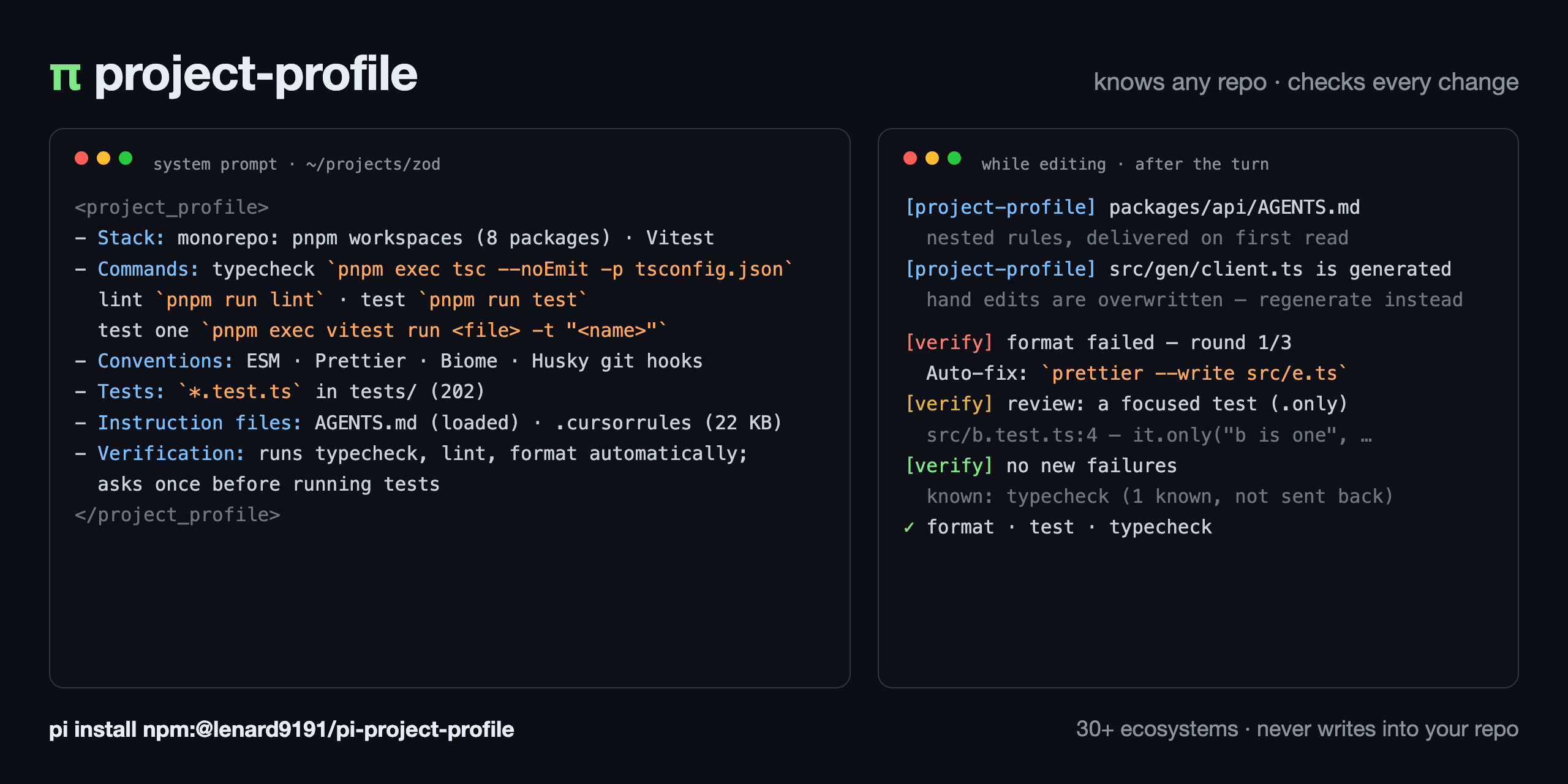
AGENTS.md, CLAUDE.md, .cursorrules, Copilot, Windsurf, Cline, Gemini, Codex, …), and injects them as a stable <project_profile> system-prompt section..env files, stale lockfiles.AGENTS.md files and glob-scoped rules (Cursor, Copilot, Windsurf) when the agent first touches a file they apply to, and warns before hand-editing generated files.remember tool, a sleep pass validates them against the repository at every session start, an automatic dream consolidates them in the background when they have changed (/profile dream starts one now), and the pre-existing-failure baseline survives between sessions on an unchanged tree.It never writes into the repository. Cache, notes, history and settings live under ~/.pi/agent/project-profile/ (/profile storage shows and prunes them).
A coding agent dropped into an unfamiliar repository guesses: which package manager, which test runner, whether tsc or biome is the source of truth, where tests live, which files are generated. Then it reports "done" without having run anything, or runs the wrong thing. pi-project-profile answers those questions once per repository, keeps the answer stable so prompt caching works, and turns "done" into "the project's own checks pass" — without ever running installs, migrations or deploys on its own.
~/.pi/agent/project-profile/, and rendered as <project_profile> in the system prompt. Re-detection happens automatically when a manifest changes. The notes of the repository are validated against it (a note that names a path that no longer exists is flagged), and the last session's pre-existing-failure baseline is restored when the tree has not changed since.AGENTS.md/CLAUDE.md and glob-scoped rules that apply to them are delivered with the first matching tool result; generated files get a warning. Without a restored baseline, the agent's first read in a project directory starts that project's typecheck and lint once, in the background, on the untouched tree: whatever already fails there is the baseline, so it is never blamed on the agent (a run that finishes after the agent's first write is discarded).[verification] message for at most three repair rounds; pre-existing failures are reported to you once and never blamed on the agent. The diff review runs alongside. Each verdict is appended to the repository's gate history (dates, checks, rounds — never code or output).pi install npm:@lenard9191/pi-project-profileRequires π ≥ 0.87 and Node ≥ 22.18. No runtime dependencies. Update with pi update npm:@lenard9191/pi-project-profile. Try it once without installing: pi -e npm:@lenard9191/pi-project-profile.
The package ships one extension and one Agent Skill (skills/project-profile): an operating and troubleshooting guide the model loads on demand when a verification message needs interpreting or you ask how to configure the extension. /skill:project-profile loads it explicitly.
<project_profile>
- Project: zod — ~/projects/zod · remote github.com/colinhacks/zod · ~741 tracked files
- Stack: monorepo: pnpm workspaces (8 packages) · pnpm · Vite · Vitest
- Commands: install `pnpm install` · typecheck `pnpm exec tsc --noEmit -p tsconfig.json` · lint `pnpm run lint` · test `pnpm run test` · test one `pnpm exec vitest run <file> -t "<name>"`
- Conventions: ESM · Prettier · Biome · Husky git hooks · License: MIT
- Tests: `*.test.ts` in tests/ (202)
- Instruction files: AGENTS.md (loaded) · .cursorrules (22 KB — read it when relevant)
- Notes: (user 3f9a1c) `pnpm test` needs Docker running for the Postgres container · (agent 8b02e4) Run `pnpm codegen` before the typecheck after a schema change — evidence: tsc failed on missing generated types until I ran it
- Verification: after each turn that changed files, the harness runs `pnpm exec tsc --noEmit -p tsconfig.json`, `pnpm run lint:check` automatically; asks once before running tests
</project_profile>
The section is identical for every turn of a session, so prompt caching keeps working.
| Tier | Examples | Policy |
|---|---|---|
| syntax | node --check, python -c ast.parse, ruby -c, bash -n, JSON parse |
automatic, changed files only |
| fast | tsc --noEmit, cargo check, go build/go vet, mypy/pyright, mix compile, dart analyze |
automatic |
| lint | eslint, biome, prettier --check, ruff, cargo fmt --check/clippy, gofmt, rubocop, swiftlint |
automatic |
| test | npm test, cargo test, pytest, go test, rspec, mix test, phpunit, swift test, ./gradlew test |
confirmed once per repo |
| build | pnpm build, ./gradlew compile*, swift build, zig build, cmake --build |
confirmed once per repo |
Installs, migrations, deploys and anything network-bound are never run.
turbo run lint are not started this way).vitest related, jest --findRelatedTests, go test ./<pkg>/..., cargo test -p <package> or pytest <changed test files> when that is safe; cargo check drops --all-targets when no test/bench/example code changed. Monorepo packages are checked in their own directory with their own scripts, and a workspace-wide root run replaces the per-package duplicates.prettier --write <files>, ruff check --fix <files>, …).maxRepairRounds (3); stops early when a round changes nothing or repeats the same failure, then asks the agent for a summary. Environment failures (an executable not on PATH, deps not installed, timeout, database down) go to you, one message per cause with the directories it affects, and disable those checks for the session; /profile refresh turns them back on.pi -p output, /copy) is the task's result, not a reply about a check.Compared with the content before the agent's first write (or git HEAD; files that were already dirty are never blamed on the agent):
@ts-ignore, eslint-disable, # type: ignore, # noqa, #[allow], //nolint, @Suppress, … added.skip, xit, @pytest.mark.skip, t.Skip, #[ignore]) or focused (.only), test files deleted (not when a whole worktree or clone is removed), test cases removedraise NotImplementedError, todo!(), throw new Error("not implemented"))"strict": false, ESLint rules "off", continue-on-error: true, || true in scripts).env files that are not gitignoredpnpm install, uv lock, go mod tidy, …)In JS and TS files, a suppression counts only as a directive that opens a comment and a focus or skip marker only in code, so test titles and fixture strings that mention them are not reported. Files in ignoreDirs (node_modules, build output) are not reviewed. Secrets, stale lockfiles and .only get one follow-up turn. Weakening that can hide a check that failed in this task also gets one follow-up turn: a @ts-ignore while the typecheck fails, a .skip while tests fail, but not an eslint-disable while tests fail. Everything else is shown to you.
The detected profile needs no memory: it is re-read from the repository every session. Memory is for what the files do not show and that cost effort to learn — a command that must run before another, an environment variable the tests need, a convention no check enforces. The design follows Anthropic's components of agent memory: a small injected layer, notes that carry how they were verified, and a sleep phase that checks memory against ground truth.
~/.pi/agent/project-profile/, never in the repository, and appear under Notes: in <project_profile> with their author and id: (user 3f9a1c) …, (agent 8b02e4) … — evidence: …. You write them with /profile note <text>; the agent writes them with the remember tool (text plus evidence: how it knows), at most 25 agent notes per repository, and you are told each time. forget_note lets the agent drop a note of its own that proved wrong; your notes it can remove only during a /profile dream you start. /profile notes lists them with ids and dates, /profile notes rm <id|n> removes one.profile.maxNotesChars (1200); the rest is counted and referenced by path instead of silently dropped./profile refresh): a note that names a path that no longer exists is flagged [may be stale: …] in the prompt and to you; a command override that detection now reproduces is reported with /profile set <key> default to drop it. It removes nothing.profile.autoDream, on by default): after a run settles in an interactive session, when the notes have changed since the last dream (or the sleep pass flagged an agent note) and 24 hours and 3 sessions have passed since that dream (at once from 20 agent notes on), the session's model checks the agent's notes against the repository in the background. Its tools only read: files inside the repository, .env files and keys excluded, known credential formats masked. It removes wrong or duplicated agent notes, merges overlapping ones and adds evidence; your notes it can only propose for removal, with the /profile notes rm command. At most 12 model calls, once per session, one π process per repository at a time; you get one line with what changed and what it cost (tokens, and dollars when the provider reports them). print/JSON/RPC sessions never start it./profile dream: the same pass now, in your session: the agent gets the notes, the overrides and the verification history with one instruction — check each note against the repository, remove what is wrong or duplicated, merge, add evidence, keep the set small, change no file — and may remove your notes too for that run. It ends with a summary of what it kept, changed and removed./profile history): every verdict, repair round, environment failure, review finding and note change is one JSON line per repository (dates, labels and counts only). The report shows first-attempt failures per check with the auto-fix that was offered, environment failures by session, pre-existing failures, and patterns such as "lint failed on the first attempt in 6 of 14 tasks" — the review that used to need a read of every session transcript.verify.baselineCache): the pre-existing-failure baseline is kept with a fingerprint of the tree (HEAD, every dirty file's content stamp, manifests, installed-dependency markers) for three days. A session that starts on the same tree knows what already failed before the agent's first write, without the background run and its race. Any change to the fingerprint, or no git, means no cache.All of it is bounded: history files rewrite themselves past 256 KB, a baseline past 2 MB or 5000 diagnostics per check is not written, and pruning at session start drops files of repositories whose root is gone (profiles with notes or overrides are kept: an unmounted disk is not a deleted project), baselines past their life, and profiles not visited for 120 days. /profile storage shows every directory with its size; /profile storage prune runs the pruning now; /profile forget drops one repository's profile, notes, history and baseline.
Find threats in your stack.
OX Radar can check high-priority threats, like critical package CVEs, against your context.
Each incident is marked Detected or Not Detected with a remediation plan and proof all tracked in the Response Center.
The probe returned only these fields for this server — auth requirement, protocol and tool list weren’t observed, so they’re not shown (never guessed).
The publisher’s own links, as the registry reports them. These are not sources for the assessment on this page.
Read the latest findings