Scan your whole stack


From OX Research Newsroom






Are you using openmascot?
Find out what’s in your code.
Scan your apps free in minutes (opens in a new tab)Latest version: v0.2.1
openmascot was last scanned on 24 Nov 2026 at version 0.2.1. Risk score 0 of 100. No malicious behavior was detected.
| Version | Published | Status |
|---|---|---|
| 0.2.1 LATEST | 24 Nov 2026 | No rules fired |
| 0.2.0 | 9 Nov 2026 | No rules fired |
| 0.0.0-stage | 30 Oct 2026 | Not shown |
Findings for v0.2.1. The score is a capped sum of the weights of the rules that fired — not CVSS, not exploitability, and not a probability. It is not comparable across packages with different scan coverage.
The score describes 0.2.1; other versions have their own rules, not their own score.
The publisher’s own README, as collected from the registry.
Pixel mascots for any website. Draw a character and its moves in the OpenMascot studio, download its JSON, and put it on a page with a <Mascot> React component or one script tag. It reacts to page load, clicks, hovers, timers and your own code.
prefers-reduced-motion.npm install openmascotimport { Mascot, emit } from "openmascot/react";
import moss from "./moss.json";
export const App = () => (
<>
<Mascot doc={moss} position="bottom-right" />
<button onClick={() => emit("success")}>Save</button>
</>
);Needs React 19. Works with server rendering (Next.js and others): the doc is passed through a ref, so it survives hydration.
<script src="https://cdn.jsdelivr.net/npm/openmascot@0" defer></script>
<open-mascot src="/moss.json" position="bottom-right"></open-mascot>

<script>
  Mascot.emit("success");
</script>
Put moss.json next to your page. Tags added or removed later start and stop on their own.
<Mascot> prop |
<open-mascot> attribute |
Meaning |
|---|---|---|
doc |
(property) | The mascot JSON as an object. |
src |
src |
URL of the mascot JSON, when doc isn't given. |
position |
position |
"bottom-right" or "bottom-left" pins it to a corner. Leave it out to render inline. |
scale |
scale |
Screen pixels per mascot pixel. Default 4. |
name |
name |
A handle for targeting one mascot. |
triggers={false} |
triggers="off" |
Turns off load, click, hover and timer moves. emit and play still work. |
emit("success"); // fires the mascot's "success" event: the studio decides which move plays
play("wave"); // plays a move by name
emit("success", { to: "inbox" }); // only the mascot named "inbox"
Both return true if a mascot played something. In the script tag they are Mascot.emit and Mascot.play.
To drive one mascot directly, take a ref (React) or the element (HTML). It has play(), emit(), pause() and resume().
const mascot = useRef<MascotElement>(null);

<Mascot ref={mascot} doc={moss} />;
mascot.current?.play("wave");
MascotElement is exported as a type from openmascot/react.
A move in the mascot JSON is a list of steps. Each step shows a pose for a while and can shift it:
{ "pose": "default", "hold": 3, "x": 2, "y": 1 }| Field | Meaning |
|---|---|
pose |
The pose to show. |
hold |
How many ticks it stays on screen. |
x |
Columns to move right. Negative moves left. Default 0. |
y |
Rows to move up off the floor. Negative sinks into the floor, cutting off its bottom rows. Default 0. |
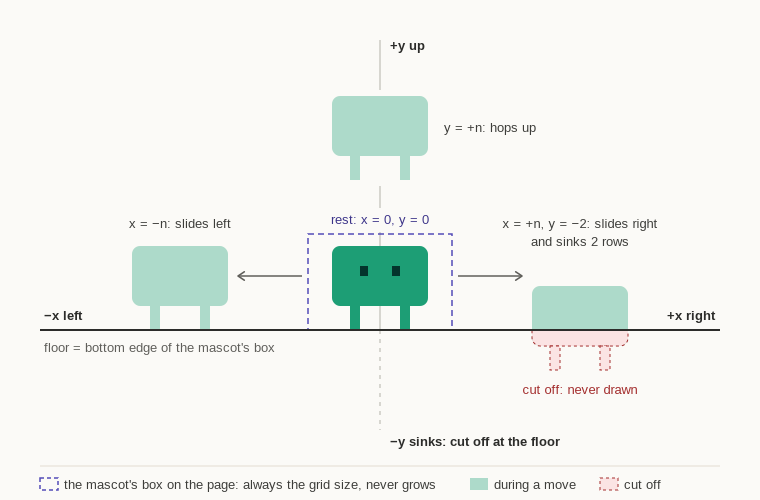
The floor is the bottom edge of the mascot's own box, and the box is always the grid size times scale. Moves never resize it: slides and hops draw outside it, so the page around the mascot doesn't shift while it moves.
MIT
Find threats in your stack.
OX Radar can check high-priority threats, like critical package CVEs, against your context.
Each incident is marked Detected or Not Detected with a remediation plan and proof all tracked in the Response Center.
The probe returned only these fields for this server — auth requirement, protocol and tool list weren’t observed, so they’re not shown (never guessed).
The publisher’s own links, as the registry reports them. These are not sources for the assessment on this page.