Scan your whole stack


From OX Research Newsroom






Are you using @sddio/cli?
Find out what’s in your code.
Scan your apps free in minutes (opens in a new tab) Read the latest findings
Latest version: v0.4.2
@sddio/cli was last scanned on 26 Nov 2026 at version 0.4.2. Risk score 0 of 100. No malicious behavior was detected.
| Version | Published | Status |
|---|---|---|
| 0.4.2 LATEST | 26 Nov 2026 | No rules fired |
| 0.4.1 | 26 Nov 2026 | No rules fired |
| 0.3.2 | 23 Nov 2026 | No rules fired |
| 0.3.1 | 23 Nov 2026 | Not shown |
| 0.3.0 | 23 Nov 2026 | Not shown |
Findings for v0.4.2. The score is a capped sum of the weights of the rules that fired — not CVSS, not exploitability, and not a probability. It is not comparable across packages with different scan coverage.
The score describes 0.4.2; other versions have their own rules, not their own score.
The publisher’s own README, as collected from the registry.
A spec-driven development tool for coding agents. The spec lives in your repo.
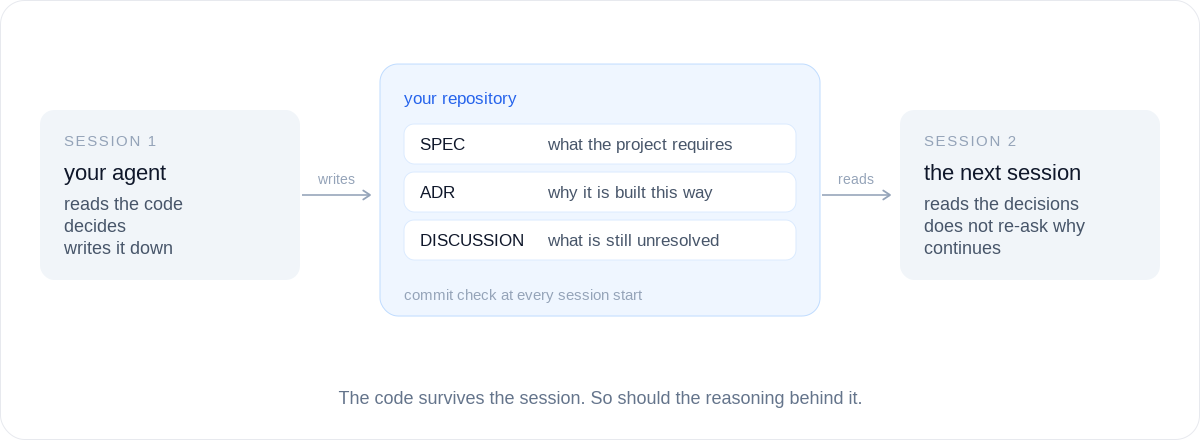
sddio writes a context layer and a workspace into a project, then hands your agent the first instruction it needs. All of it is plain Markdown committed with your code: what the project requires (SPEC), why it's built this way (ADR), and what's still unresolved (DISCUSSION). Work in progress is deliberately not one of them — that belongs to your board.
Repository · FAQ · How it works · Node ≥ 18 · MIT
npx -y @sddio/cli@latest initNothing is added to the project: the CLI runs from npm's cache, so a repository with no package.json — a Python, Go or Rust project — needs no special case and never gains node_modules. init records the release it ran in the sddio block of AGENTS.md, and that block is the command every later session runs: pinned, reviewable, and the only version record the project keeps.
Then paste the prompt init prints into your coding agent. That step is what turns an empty scaffold into project knowledge. The files on their own do nothing.
────────────────────────────────────────────────────────────────
Paste this into your coding agent
────────────────────────────────────────────────────────────────

Read `.sddio/context/instructions.md` and follow it.

This project has just been initialised with sddio. Before any other work:

1. Run the commit check in `.sddio/context/instructions/reconciliation.md`.
   `config.json` has no baseline yet, so the cursor is `unknown`.
2. Bootstrap as described in `instructions/bootstrap.md`, but do not describe the
   code back to me. Record only what the repository cannot say: a reversed
   decision and why, an outside constraint and its deadline, an abandoned path.
   At most six SPEC entries, each ending with `Not in the code:`.
3. Ask me up to three questions whose answers would change future work, and
   record at least one DISCUSSION (SPEC-016) for what stays open.

Report what you recorded, then set `reconcileCursor.lastProcessedCommit` in
`.sddio/context/config.json` to `HEAD` and commit it with the entries.
Amending that commit is safe: the baseline is recomputed from history each run.

Then answer this: <your first task>
Finally, commit .sddio/ and sddio_docs/ together with your next change. That's the whole install. init writes nothing outside the project, doesn't touch an agent's config directory, and runs no git command.
init prints| Situation | Prompt | Why |
|---|---|---|
| First run, files created | bootstrap | the workspace is empty; the agent derives the first SPEC and records the first open question |
Only .sddio/ changed |
reconcile | package upgrade; the rules may have changed, the knowledge did not |
| Nothing changed | none | already up to date |
--dry-run |
none | nothing was written, so there is nothing to hand over |
npx -y @sddio/cli@latest init.sddio/ and the version in AGENTS.md are refreshed in place, and sddio_docs/ is left alone. init then prints the reconcile prompt, so paste it in and let the agent update only the artefacts the upgrade affects. The cursor survives the upgrade: it describes this project's history, not the package's, so nothing is stale merely because you upgraded.
Two fields survive the refresh in .sddio/context/config.json: the hooks array and reconcileCursor. An upgrade must not silently re-wire the project to a caller it abandoned, or forget the commit it last reconciled against.
A file the new version stopped shipping is printed as orphaned, with one clause saying where its content belongs, and kept: --prune deletes it and touches nothing else. Passing --hook runs that hook's installer only when the declaration actually changes; --no-install declares it without fetching anything.
sddio init [--dir <path>] [--hook <name>] [--no-install] [--yes] [--force] [--dry-run]
sddio start [<path>...]      # cursor, hint and brief in one call
sddio brief [<path>...]      # entries that name those paths
sddio show <id>              # one entry, body included
sddio check [--json] [--strict] [--claims]  # behind HEAD? did a moved file go unrecorded?
sddio diff [--json] # the worklist: what each moved file touches| Command / flag | Effect |
|---|---|
init |
Create .sddio/, sddio_docs/ and the seed collections; register AGENTS.md; ask which hook to use; print the next step |
start |
The one call a hook makes: cursor state, a hint, and a brief, in ten lines or fewer |
brief |
Titles of the entries that name the given paths. Reads nothing else |
show |
One entry by ID, body included |
check |
Cursor state plus the files nobody wrote about. Prints, exits 0; --strict is the gate |
--claims |
Run the - Check: commands a SPEC bullet carries; drift exits 1 |
diff |
Which entries name a moved file, and which files nobody named. Prints; never writes |
--dir <path> |
Target project root (default: current directory) |
--hook <name> |
none (default) or flow-trail. Naming flow-trail installs it unless --no-install is given |
--no-install |
Declare the hook in config.json without running its installer |
--yes |
Take the default (none) without asking |
--force |
Re-initialise: refresh everything, and reset the sddio_docs/ seeds to empty |
--prune |
Remove the files this version no longer ships, and nothing else |
--dry-run |
Report what would change without writing |
With a terminal attached, init asks one question: which hook should keep the workspace current. The default is none, so a first run installs nothing and fetches nothing. Choosing flow-trail runs its own bootstrap in the target project — a card board in flow-trail/, a pointer in AGENTS.md. --no-install declares it without the fetch, for CI. A project that has already answered is not asked again, and an upgrade never re-downloads the hook.
.sddio/ belongs to the package and gets refreshed on init. sddio_docs/ is yours and is only touched with --force or --prune. A run that finds everything up to date reports all files as skipped.
--force resets the workspace seeds to empty files — it is meant for re-initialising a project, not for merging. It is not the way to remove an orphan: --prune deletes those and touches no entry.
.sddio/                      # context layer, generated from the sddio repository's own .sddio/
  context/                   # instructions, schema, routes, writing
sddio_docs/                  # the user's workspace: layout only, empty seeds
  spec/spec_100.md           #   → 0 bytes
  adr/adr_100.md             #   → 0 bytes
  discussions/discussions_100.md
AGENTS.md                    # sddio snippet appended, existing content preserved
The workspace ships no starter prose on purpose. It belongs to your project, and placeholder text would be rewritten immediately anyway. See ADR-005 in the sddio repository.
Does it need a specific agent? No. init writes AGENTS.md and nothing else agent-specific; any agent that reads repository files works, and the prompt it prints is plain text. No skill is installed and no agent configuration directory is read or written.
Does it send anything anywhere? No account, no server, no telemetry, no update check. It reads and writes files inside the target directory and runs no git command.
What does it not do? It does not write code, search or index the workspace, or enforce its rules on its own. check can fail CI when knowledge falls behind HEAD, but nothing can decide whether an entry still says the right thing — that stays the agent's reading. Entries are Markdown; grep is the query language.
See docs/faq.md for the rest.
npm install
npm run build      # regenerates templates/.sddio, then compiles
npm test
npm pack
templates/ is a build artefact, not source. npm run sync (run automatically by build and pack) recreates templates/.sddio from this repository's root .sddio/, which is the single source of truth. That way the shipped context can't drift from the one this repo dogfoods. The directory is git-ignored. The workspace layout lives in lib/workspace.ts.
The prompts printed by init live in lib/prompt.ts. The copies in this README and in the repository README are asserted against it by test/prompt.test.mjs, so they can't drift.
See TESTING.md for testing the packed tarball in another local project.
Find threats in your stack.
OX Radar can check high-priority threats, like critical package CVEs, against your context.
Each incident is marked Detected or Not Detected with a remediation plan and proof all tracked in the Response Center.
The probe returned only these fields for this server — auth requirement, protocol and tool list weren’t observed, so they’re not shown (never guessed).
The publisher’s own links, as the registry reports them. These are not sources for the assessment on this page.
Read the latest findings