
Scan your whole stack


From OX Research Newsroom






Are you using @ttsc/evidence?
Find out what’s in your code.
Scan your apps free in minutes (opens in a new tab)Latest version: v0.38.1
@ttsc/evidence was last scanned on 25 Nov 2026 at version 0.38.1. Risk score 0 of 100. No malicious behavior was detected.
| Version | Published | Status |
|---|---|---|
| 0.38.1 LATEST | 25 Nov 2026 | No rules fired |
| 0.38.0 | 24 Nov 2026 | No rules fired |
| 0.37.2 | 17 Nov 2026 | No rules fired |
| 0.37.1 | 13 Nov 2026 | Not shown |
| 0.37.0 | 12 Nov 2026 | Not shown |
Findings for v0.38.1. The score is a capped sum of the weights of the rules that fired — not CVSS, not exploitability, and not a probability. It is not comparable across packages with different scan coverage.
The score describes 0.38.1; other versions have their own rules, not their own score.
The publisher’s own README, as collected from the registry.
@ttsc/evidence




Every specification becomes a compile-time obligation.
Citing the evidence and describing the reason why are mandatory, so you get:
/**
 * @evidence docs/discount.md#coupon-stacking States the per-issuer stacking limit this section defines, in the buyer's words.
 * @evidence POST:/orders/{orderId}/coupons Explains the rejection this endpoint returns for an over-stacked coupon set.
 * @evidence {@link hooks.useCouponStacking} Renders the limit this hook resolves.
 * @evidence .agents/skills/principles/SKILL.md#no-hard-coding Renders limits from props instead of branching on known issuer names.
 * @evidenceExclude .agents/skills/principles/SKILL.md#fix-root-causes-not-symptoms No failure to fix.
 */
export function CouponStackingNotice(props: IProps): JSX.Element;
@evidence <target> <reason> is the agent's explicit claim about what this code implements and why. @evidenceExclude records why an obligation does not apply.
A target is one of four kinds:
Leave one obligation unanswered and the build stops.
$ npx ttsc
error TS16411: [evidence/graph] Missing acknowledgement for 'docs/discount.md#coupon-stacking'
  (Markdown H2 'Coupon Stacking' at docs/discount.md:3)
  in Claim 1 reference 1 (markdown, symbols: h2, h3).

...

Found 5 errors.
Missing obligations appear in the same build as type errors. The error list is the agent's task list.
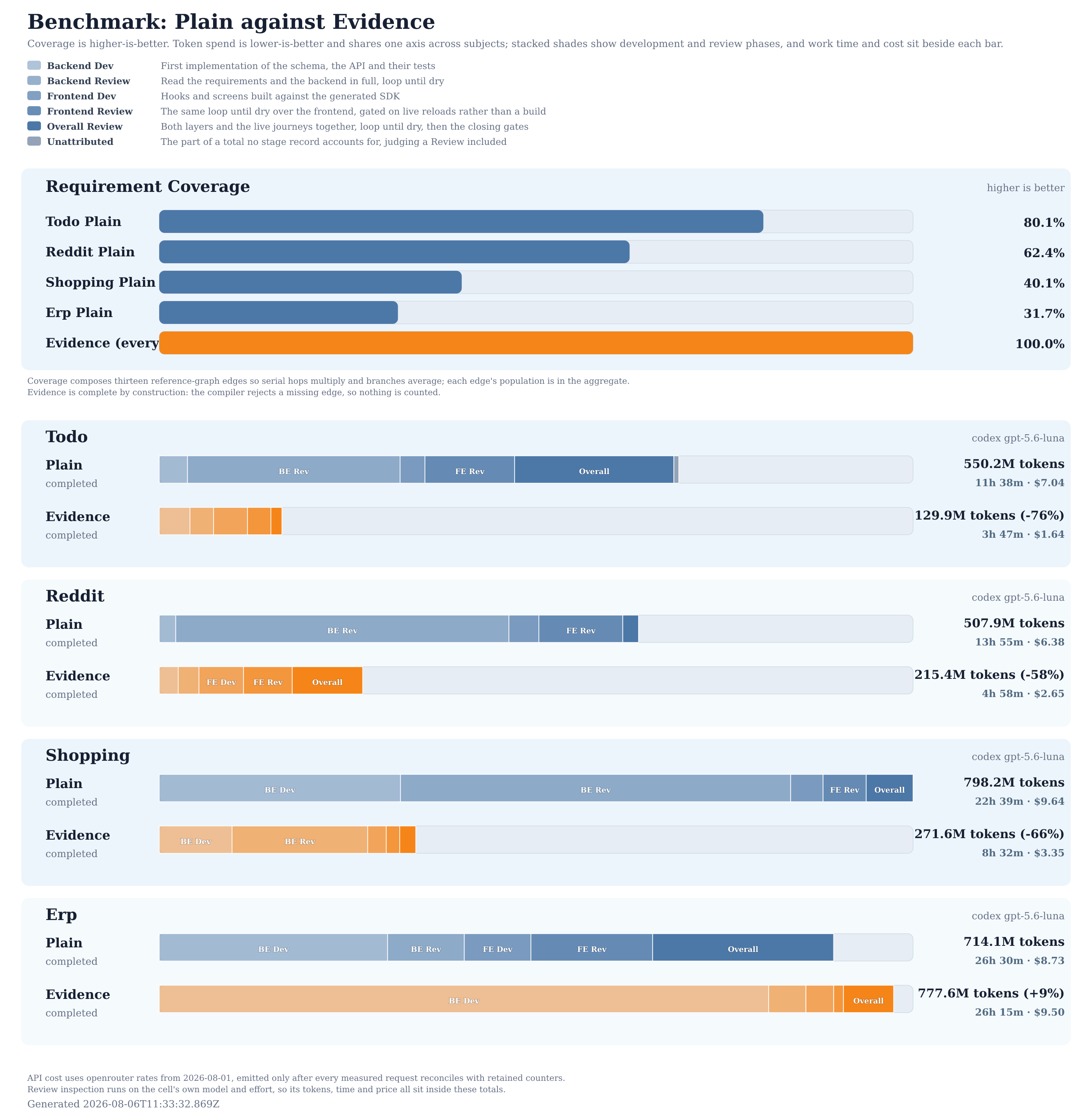
One agent built each subject twice. Same inputs, same engine, same model; only this plugin differs.
The benchmark guide breaks each run down by phase, and samchon/evidence-benchmark-results keeps the raw sessions.
npm install -D typescript ttsc @ttsc/lint
npm install -D @ttsc/evidence
This is a rule contributor to @ttsc/lint, so it runs on ttsc rather than on stock tsc with ESLint.
// lint.config.ts
import {
  evidence,
  type ITtscEvidenceGraphConfig,
  type ITtscEvidenceRules,
} from "@ttsc/evidence";
import type { ITtscLintConfig } from "@ttsc/lint";

const graph: ITtscEvidenceGraphConfig = {
  claims: [
    {
      type: "typescript",
      files: ["src/components/**/*.tsx"],
      symbol: "function",
      reference: {
        type: "markdown",
        files: ["docs/**/*.md"],
        symbol: ["h2", "h3"],
      },
    },
  ],
};

export default {
  plugins: { evidence },
  rules: {
    "evidence/graph": ["error", graph],
    "evidence/review": "error",
  },
} satisfies ITtscLintConfig<ITtscEvidenceRules>;
One claim: the components under src implement the docs, so every H2 and H3 under docs must be cited by a component. Run npx ttsc and the error count is the backlog. Passing ITtscEvidenceRules to ITtscLintConfig gives every Evidence rule exact option checking.
The configuration reference has every claim option and the four rules beside evidence/graph.
The configuration is written once. The tags are written forever: @evidence cites, @evidenceReview verifies, and @evidenceExclude declines. The tag reference has the full grammar.
A reason that needs paragraphs, a list or subheadings goes under an H2 to H4 heading, with the target on the heading and the explanation below it:
/**
 * ## @evidence docs/discount.md#coupon-stacking
 *
 * Renders the per-issuer limit this section defines.
 *
 * - Reads the limit from props.
 * - Names the issuer that reached it.
 */
A false tag removes the error, not the problem. @evidenceReview asks for a separate statement of what was verified, which a human then judges:
/**
 * @evidence docs/discount.md#coupon-stacking States the per-issuer limit.
 * @evidenceReview docs/discount.md#coupon-stacking #a1b2c3d
 *                 Verified against policy section 3.
*/Normalized Swagger operation fingerprints decode local component URI fragments before interpreting JSON Pointer tokens, including array indices. Upgrading can expire reviews of operations using encoded pointers, array elements, or malformed references that previously selected a literal property. Re-read those operations and their referenced contracts before replacing a fingerprint.
Raw OpenAPI 3.1 and 3.2 schema references retain their original targets through version normalization, including pointers into schema structures the converter relocates. Foreign, missing and malformed schema references do not bind to a local schema with the same final name. Reference-shaped example, default, constant, enum and extension values remain data. Reviews affected by these earlier interpretations also need to be read again before their fingerprints are replaced.
The compiler handles omissions. Humans handle falsehoods.
Requirements are the handoff: whether a human or an AI wrote them, a human must review them last. That reviewed layer is the source of truth, the evidence the AI builds everything else from.
Each arrow is one claim from lint.config.ts, pointing at the evidence it cites.
The compiler checks everything below: a dropped idea or a skipped requirement is a compile error, so nothing vanishes on the way down.
Even requirements cite their evidence, in comments, so the rendered document stays clean.
Backend, frontend, and even novels below are this same shape, drawn in detail.
100% compliance with every principle.
## No hard coding
## No monkey patching
## Use the conventional solution
## Fix root causes, not symptoms
Make them a checklist:
{
  name: "every function answers every engineering principle",
  type: "typescript",
  files: ["src/**/*.ts"],
  symbol: "function",
  reference: {
    type: "markdown",
    files: [".agents/skills/principles/SKILL.md"],
    symbol: "h2",
    checklist: true,
    requireReview: true,
  },
}
checklist changes the denominator from principles to functions times principles. Every selected function must answer every principle, with @evidence as CouponStackingNotice does for no-hard-coding or with @evidenceExclude as it does for fix-root-causes-not-symptoms; the two principles it leaves unanswered above would fail the build.
One missing answer fails the build. Adding a principle creates a new obligation on every selected function, and requireReview expires every affected review when that principle changes.
Real config:
api/lint.config.tsandbackend/test/lint.config.ts
The DB schema is Prisma, the rest is TypeScript, and one graph spans both:
Real config:
frontend/lint.config.ts
The source layer is the backend's own Swagger output: a graph can start from what another project publishes.
Screens and journeys also cite the documents, so every screen traces back to a requirement.
Real config:
napoleon-imperator/lint.config.ts
The graph reads no meaning, only obligations and citations, so it works on any text. Humans review only the settings (characters, world rules, history), and the novel follows. The principles are universal literary fundamentals, not something written per work.
Editing a setting expires every review on it, so a revision leaves no stale scene behind. samchon/novels runs this graph on 25 principles, 350 setting commitments, and 742 scenes.

Thanks for your support.
Your donation encourages @ttsc/evidence development.
ttsc: the TypeScript-Go toolchain this plugin runs on.@ttsc/lint: the lint engine that links this rule into the compiler.samchon/evidence-benchmark-resultsFind threats in your stack.
OX Radar can check high-priority threats, like critical package CVEs, against your context.
Each incident is marked Detected or Not Detected with a remediation plan and proof all tracked in the Response Center.
The probe returned only these fields for this server — auth requirement, protocol and tool list weren’t observed, so they’re not shown (never guessed).
The publisher’s own links, as the registry reports them. These are not sources for the assessment on this page.