Granulaire generates sand, gravel, pebbles, seeds, fruit, pellets, rubber mulch and packing peanuts
with realistic, measured shapes, sizes, masses and moisture, and exports them
to OpenUSD. It is built for Physical AI: robots trained and tested in
simulation (reinforcement learning, virtual test campaigns, sim-to-real) need
ground that looks and behaves like the real thing, not perfect spheres, and
perception models need synthetic images with exact ground truth. Every preset is
checked in MuJoCo and in Blender (a pile of grains, read back from the
file) and passes OpenUSD's own validators. Everything
can run on CPU; see Physics limits by grain size
for what current engines can simulate.
Granulaire is part of Primvaria, with
Maillage (textiles),
Filaire (cables) and
Quincaillerie (fasteners, cells
and holders), and follows the same approach: distributions instead of one
shape, measured outputs, honest limits.
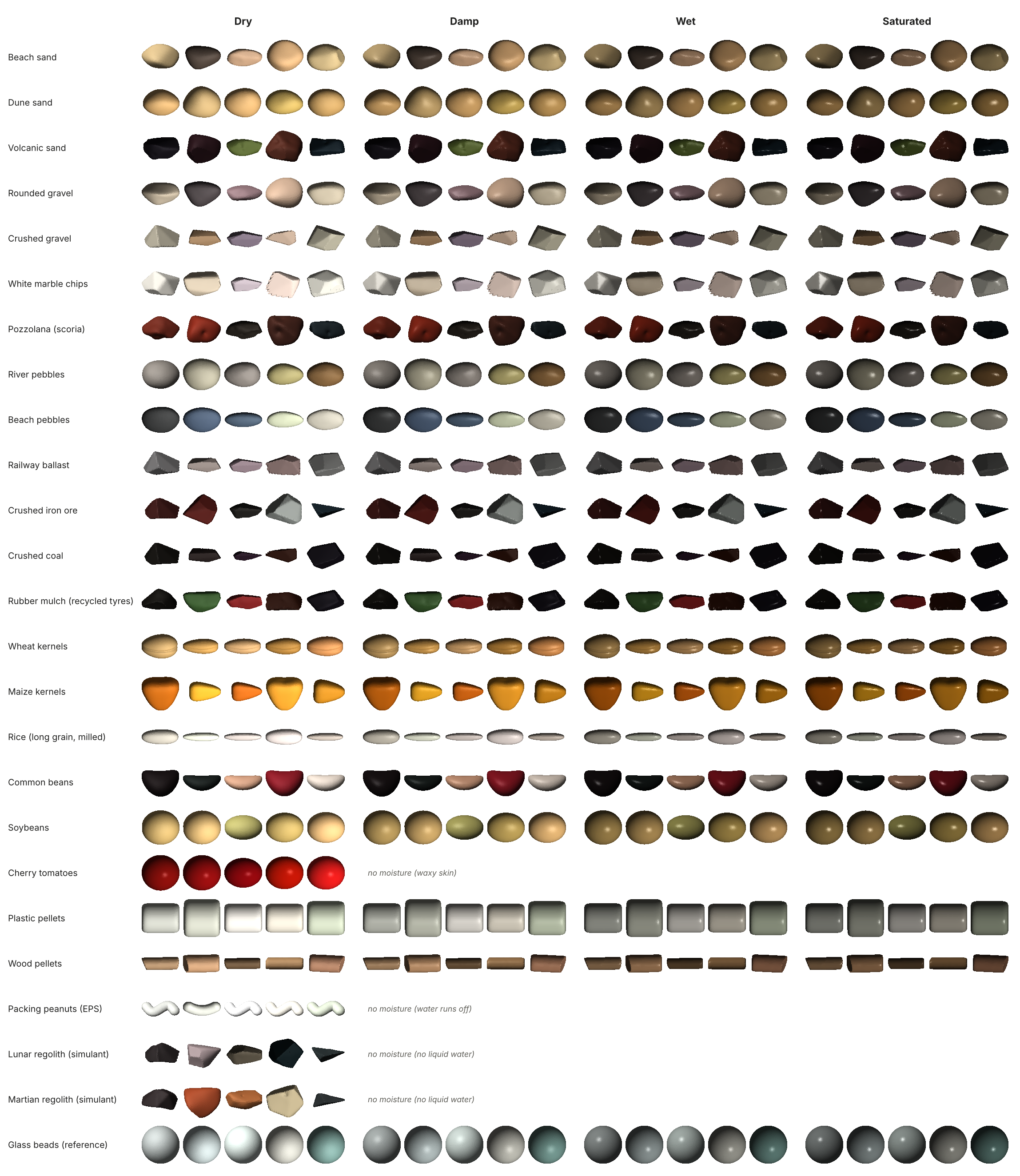
Five different grains of each of the 25 presets, dry, damp, wet and
saturated, rendered from the generated meshes. Each grain is drawn at its own
scale: sizes range from 0.07 mm (lunar regolith) to ~5 cm (river pebbles).
Regenerate with granulaire render-gallery (see Usage).
[!TIP]
If Granulaire is useful to you, please ⭐ star the repository. Stars show me
what people actually need, so I can decide which features to develop next.
What it does
- Generates N distinct grain shapes (100 by default) from distributions
borrowed from sedimentology: size on the phi scale (Wentworth), Zingg ratios
(elongation I/L, flatness S/I), angularity, irregularity (fracture faces,
lumps, pits) and mineralogy. Kernels, seeds and pellets use their own shape
families (superellipsoids, cylinders).
- Places each shape several times in shuffled order with random orientations:
by default 100 shapes × 5 copies = 500 grains per scene (see
Scene size and mixing).
- Measures every generated grain (nominal diameter, Zingg ratios, Wadell
sphericity, convexity, angularity proxy) instead of trusting the inputs.
- Exports an OpenUSD scene: prototypes, grains by reference, UsdPreviewSurface
materials,
UsdPhysics rigid bodies (mass from volume and density,
convex-hull collision, friction, restitution) and a collision ground.
- Optionally gives every grain a moisture state through an OpenUSD variant set.
- Tests every preset in MuJoCo and Blender (
granulaire sim-test,
granulaire blender-test): a pile of grains read back from the file falls
and must settle; see Physics checks.
- Exports packing peanuts and cherry tomatoes as rigid bodies like the other
grains, plus a layer over the file that makes them deformable bodies.
Deformable simulation works only with NVIDIA OmniPhysics (Omniverse,
Isaac Sim 5+) and is not tested yet; see
Deformable grains.
Engines
Every file is OpenUSD with standard UsdPhysics schemas. Where each engine
stands, as on the Primvaria engine matrix:
| Engine |
Status |
OpenUSD validators (usdchecker) |
tested: every preset, every moisture state, in CI |
| Blender |
tested: pile test of every preset, through Blender's USD importer (granulaire blender-test) |
| MuJoCo |
tested: pile test of every preset, model built from the file (granulaire sim-test) |
| NVIDIA Isaac Sim (PhysX) |
not tested yet (needs an NVIDIA RTX GPU); standard UsdPhysics rigid bodies |
| NVIDIA OmniPhysics deformables |
packing peanuts and cherry tomatoes exported as a layer over the file, structure checked, not simulated yet |
Installation
From PyPI:
pip install "granulaire[render]"
pip install "granulaire[sim]"     # MuJoCo pile test
pip install "granulaire[blender]" # Blender as a Python module (Python 3.13), for the Blender pile test
From a clone, for development:
python -m venv .venv && source .venv/bin/activate
pip install -e ".[render]"        # add ",dev" for tests and linting
Requires Python 3.11+ and usd-core 26.5+ (the OpenUSD bindings).
Earlier usd-core wheels generate the same files, but their OpenUSD
validators do not load (25.5 ships without the validator
libraries, 25.8 and 25.11 without the UsdPreviewSurface definitions), and CI
tests both 26.5 and the newest release.
Usage
granulaire list
granulaire generate --preset beach_sand          # 100 shapes × 5 copies, shuffled
granulaire generate --preset beach_sand --shapes 20 --copies 10 --no-shuffle --seed 3
granulaire generate --preset beach_pebbles --moisture --moisture-weights 0,20,50,30
granulaire generate --preset rounded_gravel --no-vary size,orientation
granulaire render output/beach_sand output/crushed_gravel
granulaire render-moisture output/beach_pebbles output/crushed_gravel output/beach_sand
granulaire render-gallery output/beach_sand output/crushed_gravel --grains 5
The README gallery comes from generating every preset with --moisture, then
granulaire render-gallery on all 25 output folders in category order, with
--output docs/images/moisture_gallery.png.
python -m granulaire ... works too. From Python:
from granulaire import Variations, generate_scene, write_outputs

# defaults: 100 shapes × 5 copies, shuffled, seed 1; moisture turned on
sand = generate_scene("beach_sand", variations=Variations(moisture=True))
write_outputs(sand, "output")  # -> output/beach_sand/

# 20 shapes × 10 copies, copies side by side, another random draw
gravel = generate_scene("crushed_gravel", shapes=20, copies=10, shuffle=False, seed=3)
write_outputs(gravel, "output")  # -> output/crushed_gravel/
Four short scripts in examples/
show the rest, each explained by its own comments: a first pack and its
ground truth, one aspect switched off, reading the file with OpenUSD alone,
and the pile test in MuJoCo.
Variations (checkboxes)
--no-vary ASPECTS keeps aspects nominal (comma-separated), --nominal
keeps them all nominal, as in the other generators of the suite. In Python:
Variations(shape=False).
| Aspect |
On (default) |
Off (--no-vary <aspect>) |
size |
diameter drawn from the grading curve |
all at d50 |
shape |
elongation, flatness and irregularity drawn |
mean values |
roundness |
facets and edge rounding drawn |
median values |
mineralogy |
mineral and tint drawn |
dominant mineral |
orientation |
random orientation |
all aligned |
--moisture (off by default) |
variant set + state drawn per grain |
no moisture |
Turning one variation off does not change the other random draws: with the
same seed you compare the same scene with a single difference. The options
--no-size, --no-shape… still work, and are deprecated.
Outputs (per preset, under output/<preset>/)
| File |
Content |
granulaire_<preset>.usdc |
OpenUSD scene (Blender: File > Import > USD) |
granulaire_<preset>_newton.usda |
the same scene with what Newton needs (contact gaps sized to the grains), a layer over the file, see Newton layer |
granulaire_<preset>_omniphysics.usdc |
deformable presets only: the same scene with deformable bodies for NVIDIA OmniPhysics (Omniverse, Isaac Sim 5+), a layer over the file, to open instead of it |
prototype_metrics.csv |
one row per shape: measured descriptors, mass (per moisture state), parameters |
instances.csv |
one row per grain, read back from the file: its identity, its classes (the semantic labels renderers turn into segmentation masks), every drawn value (variation:<name>) and every measured value (measured:<name>), then its prototype and position: the ground truth |
manifest.json |
what the pack is (contract, generator, version, preset, seed, aspects, files) and its summary: global statistics (d50, mean sphericity, masses, water) and grading, the sizes against the preset's curve (see Limits) |
prototypes.npz |
meshes, used by the renderer |
shape_sheet.png, mix_preview.png |
previews (granulaire render) |
Limits
The short version; the full list is in Limits.
- Values are sensible centres to randomise around, not calibrated measurements:
no angle of repose is verified for any preset. Sizes and densities come
from sedimentology's classes and handbooks where one applies
(Sources).
- Physics on CPU targets a few hundred grains, with convex-hull collision.
- Wet grains differ by friction, restitution and mass only: no capillary cohesion.
- Deformable grains need NVIDIA OmniPhysics and are not tested yet.
Development
git clone https://github.com/drscaon/granulaire.git && cd granulaire
pip install -e ".[dev]"
pytest
Conventions and continuous integration: Development.
Documentation









