Scan your whole stack


From OX Research Newsroom






Are you using kudiostudio?
Find out what’s in your code.
Scan your apps free in minutes (opens in a new tab) Read the latest findings
Latest version: v2.3
kudiostudio was last scanned on 26 Nov 2026 at version 2.3. Risk score 0 of 100. No malicious behavior was detected.
| Version | Published | Status |
|---|---|---|
| 2.3 LATEST | 26 Nov 2026 | No rules fired |
| 2.2 | 20 Nov 2026 | No rules fired |
| 2.1 | 14 Nov 2026 | No rules fired |
| 2.0 | 24 Oct 2026 | Not shown |
| 1.0 | 23 Oct 2026 | Not shown |
Findings for v2.3. The score is a capped sum of the weights of the rules that fired — not CVSS, not exploitability, and not a probability. It is not comparable across packages with different scan coverage.
The score describes 2.3; other versions have their own rules, not their own score.
The publisher’s own README, as collected from the registry.
English | 繁體中文





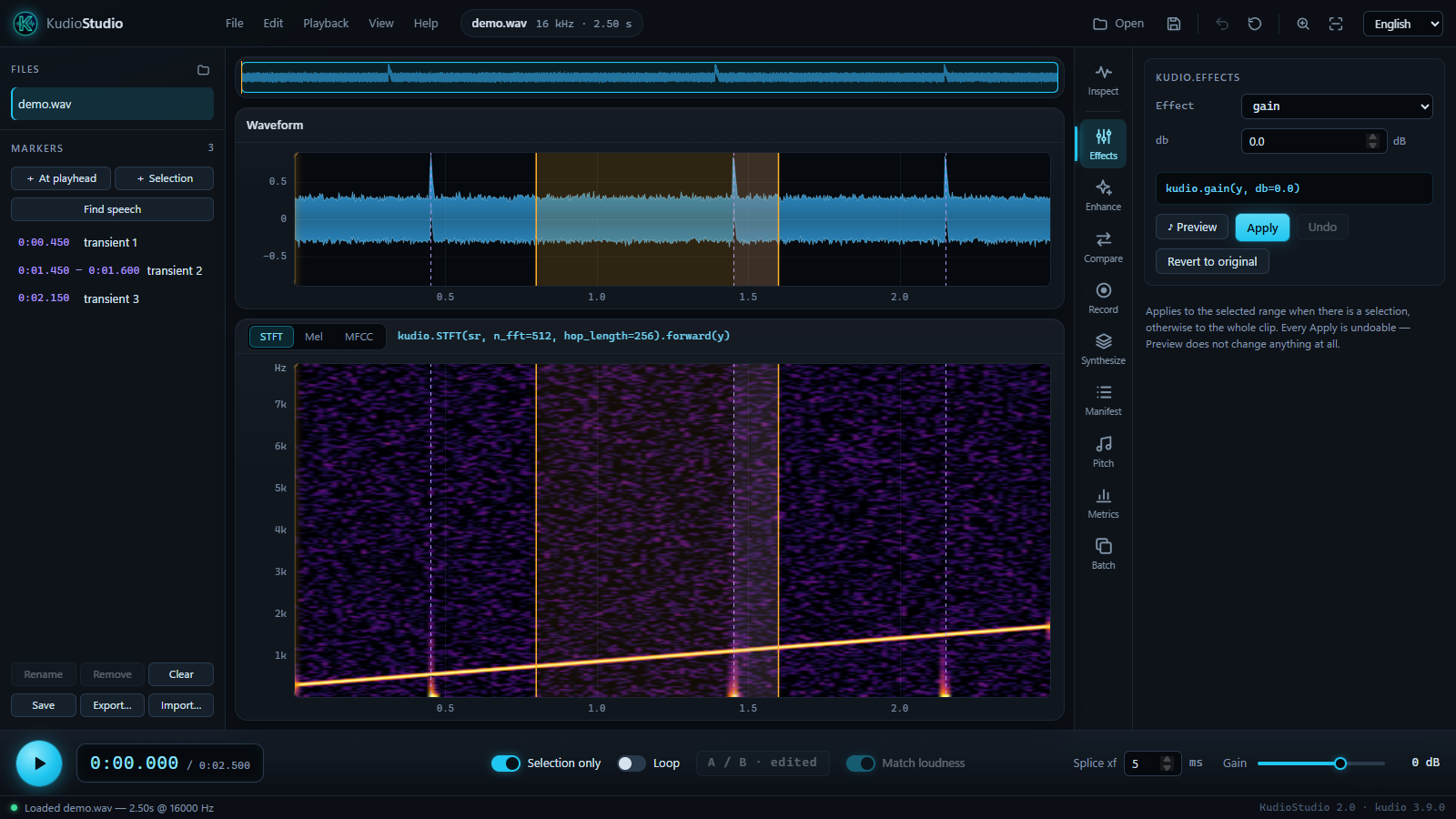
A desktop workbench for the kudio audio toolkit.
Open a clip, look at it, change it, measure it, and build datasets from it,
without writing a script first. Every control maps to one documented kudio
function, and the caption under each panel shows the exact call it will make,
so anything you work out here translates straight into code.
The user guide is at recklight.github.io/KudioStudio: every panel, every control, and the reasons behind them.
pip install kudiostudio
kudiostudio
KudioStudio needs Python 3.10 or newer and kudio 4.2.0 or newer, which pip installs with it. The window is drawn by the web view the system already has, through pywebview: WebView2 on Windows 10 and 11, WebKit on macOS. Linux needs GTK or Qt for pywebview and PortAudio's library for sound; without a web view, the same page opens in the default browser. Getting started has the details.
The heavy parts are extras:
| Extra | Adds |
|---|---|
pip install "kudiostudio[eval]" |
STOI and SDR |
pip install "kudio[pesq]" |
PESQ, and CSIG, CBAK and COVL, which are built on it. It builds from source and needs a C compiler, so it is in neither [eval] nor [all] |
pip install "kudiostudio[dnsmos]" |
DNSMOS opinion scores (the weights are not bundled) |
pip install "kudiostudio[enhance]" |
learned denoising on PyTorch, through kudioenhance |
pip install "kudiostudio[audio]" |
recording until you press Stop, on Linux and macOS (PyAudio; Windows has it already) |
pip install "kudiostudio[all]" |
all of the above except PESQ |
kudiostudio clip.wav           # open a file on start-up
kudiostudio manifest.json      # a corpus manifest opens in the Manifest panel
kudiostudio --browser          # the same page in the default browser
kudiostudio --lang zh_TW # the interface in Traditional Chinese| Panel | What it is for |
|---|---|
| Inspect | the analysis view (STFT, mel, MFCC), the selection, and the Levels readout with true peak and a loudness curve |
| Effects | one kudio effect at a time on the selection or the whole clip, heard before it is applied |
| Enhance | statistical denoisers and learned models |
| Compare | every denoiser on the same clip, ranked, each row a click from your ears |
| Record | a fixed-length take, or one that runs until you stop it, drawn as it arrives |
| Synthesize | a noisy dataset from clean and noise folders, rooms and phone lines included |
| Manifest | that dataset read back: missing files and the noise × SNR coverage |
| Pitch | the f0 contour over the spectrogram, and the voiced spans as markers |
| Metrics | what is wrong with a recording without a reference, and scores with one |
| Batch | a whole folder converted, normalised or denoised, with the files that missed named |
| Survey | every file of a folder checked, as a table to sort and filter, with the folders' spectra and a timeline of the takes |
| Claude | the clip's figures read back in words by Claude, on your own API key, with next steps |
Around them: cut, copy and paste with a crossfade at every join, A/B against the file as it was opened, markers that outlive the session, and the whole edit history written out as a Python script that makes the same samples (Editing and markers). The window's size, its fonts and text colours, the bit depth Save As writes and a few more are in Edit → Settings… (Settings), and a right click on either plot offers what can be done at that point (The right-click menu). Other packages can add panels of their own (Writing a panel).
git clone https://github.com/recklight/KudioStudio.git
cd KudioStudio
pip install -e ".[dev]"
pytest -q
tools/smoke.py runs the end-to-end checks the unit tests cannot, and
pip install -e ".[docs]" then mkdocs serve builds the guide locally.
MIT, see LICENSE.txt.
Find threats in your stack.
OX Radar can check high-priority threats, like critical package CVEs, against your context.
Each incident is marked Detected or Not Detected with a remediation plan and proof all tracked in the Response Center.
The probe returned only these fields for this server — auth requirement, protocol and tool list weren’t observed, so they’re not shown (never guessed).
The publisher’s own links, as the registry reports them. These are not sources for the assessment on this page.
Read the latest findings