lex1dx
lex1dx is fast 1-D k-means clustering. It partitions a one-dimensional array into k contiguous bins of the sorted values, for scalar quantization, binning and histogram design.
It targets a 0.01% relative-excess-SSE (REE) tolerance.
The C++17 core is also used by the R and Scala bindings.
The source repository is github.com/nsram/lex1dx.
Install
From PyPI:
pip install lex1dx
pip install lex1dx[plot]   # optional, for histogram()
From a repository checkout, at the repository root:
pip install .
pip install pytest
pytest
Quick start
athletics20 is 20 men's 100 m times, in seconds, with 12 distinct values.
import numpy as np
import lex1dx

x = lex1dx.datasets.load("athletics20")
r = lex1dx.cluster(x, 4)
print(list(r.bounds))
print(r.sse)
print(list(r.assign([9.58, 9.76, 9.84, 10.0])))
That call uses the default tuned pipeline.
The result has bounds [0, 1, 4, 11, 20].
The bin sizes are [1, 3, 7, 9].
The centers are approximately [9.580000, 9.700000, 9.765714, 9.824444].
The SSE is 0.00399365079365.
assign maps 9.58, 9.76, 9.84, and 10.0 to bins [0, 2, 3, 3].
D is 12 and Dprime is 12.
sig is 0, which means full precision.
presorted is true because the file is already sorted.
On this data the default result matches mode="exact" with either solver, so the REE versus exact is 0.
cluster arguments
lex1dx.cluster(x, k, *, mode="tuned", sig=None, M=None, tolerance=1e-11,
               weights=None, solver="wilber")
x is a one-dimensional finite numeric array.
k is the requested number of bins.
If k is larger than the number of atoms, it is clamped to that number.
On athletics20, cluster(x, 20) returns k=12 and SSE 0.
mode
mode="tuned" is the default pipeline.
It sorts, optionally groups, collapses to M groups, runs a DP, and refines the cuts.
mode="sig5" is an alias for sig=5.
mode="exact" skips Collapse.
The chosen solver then runs on the atoms, after optional grouping.
On athletics20 with k=4, both solver="wilber" and solver="ckmeans" under mode="exact" give the same bounds and the same SSE 0.00399365079365.
sig
sig is an integer in 0..9.
0 means full precision (no grouping).
1..9 groups values to that many significant digits.
sig=None follows mode: 5 when mode="sig5", otherwise 0.
Values of 10 or more are rejected.
Use sig=0 for full precision.
If grouping at the requested sig yields fewer than k groups, and the raw data has at least k distinct values, precision is raised one digit at a time (up to 15, then raw distinct-value atoms) so k is kept.
This is the same k-preserving fallback as v0.1.0.
Result.sig is the sig actually used.
It is 0 if the fallback reached raw atoms.
Result.Dprime is the number of groups after that grouping.
A constructed example makes the fallback visible.
Four tight groups around 0, 1.000012, 1.000017, and 2 would give only three groups at 5 digits.
With sig=5 and k=4, the fallback raises precision to 6.
The result has k=4, Dprime=4, and sig=6.
The bounds are [0, 50, 100, 150, 200].
M and default_M
M=None uses default_M(k) = max(4096, 32 * k).
default_M(4) and default_M(64) are 4096.
default_M(256) is 8192.
M is ignored when mode="exact".
On athletics20 the default M is larger than the 12 distinct times, so Collapse does not reduce the atoms.
On the 2,379-row list, k=8 with default M matches exact (SSE 0.709129743721, REE 0).
With M=8, the SSE is 0.718184561908 and the REE versus exact is 1.27689%.
With M=32, the REE is 0.0820787%.
tolerance
tolerance is the Refine move threshold.
The default is 1e-11.
A move is applied only if it lowers SSE by more than this tolerance times the size of its terms.
weights
weights is an optional non-negative finite vector of the same length as x.
None is the unweighted solver.
The result SSE and centers are then weighted.
sizes remain element counts.
Equal times already act as integer counts.
Clustering the 12 distinct athletics20 times with counts [1, 2, 1, 1, 3, 1, 1, 1, 2, 1, 4, 2] as weights matches clustering the expanded 20 values.
The centers, SSE, and per-bin weight mass agree at k=4.
A different weighting changes the partition.
Clustering those 12 distinct times with no weights (each time has weight 1) gives bounds [0, 1, 4, 9, 12] and SSE 0.00246666666667.
Negative, non-finite, zero-total, or wrong-length weights are rejected.
solver
solver="wilber" is the default.
It is the modified Grønlund kmeans1d wilber-interp DP.
solver="ckmeans" is the Fisher / ckmeans exact DP.
Both solvers are exact and give the same optimum.
Wilber is faster as k grows, because wilber-interp is O(k N) in style while ckmeans is a divide-and-conquer O(k N log N) DP.
ckmeans is the original LEX exact DP and serves as a cross-check.
On athletics20 with k=4 and mode="exact", both solvers agree on SSE.
Result and assign
The result has bounds, sizes, centers, upper, sse, D, Dprime, sig, sweeps, moves, and presorted.
bounds are k + 1 cut indices into the sorted data.
Bin i holds sorted values from bounds[i] to bounds[i+1].
sizes are element counts per bin.
centers are bin means (weighted means if weights were given).
upper is the largest raw value in each bin.
sse is the (weighted) sum of squared deviations from the bin means.
r.k is min(requested k, atoms).
r.assign(x) returns the bin index for each value.
It chooses the first bin whose upper value is at least x, or the last bin if none is.
Order independence
athletics20 is already sorted, so presorted is true.
A shuffled copy gives the same bounds and the same SSE.
On the shuffled copy, presorted is false.
Histogram
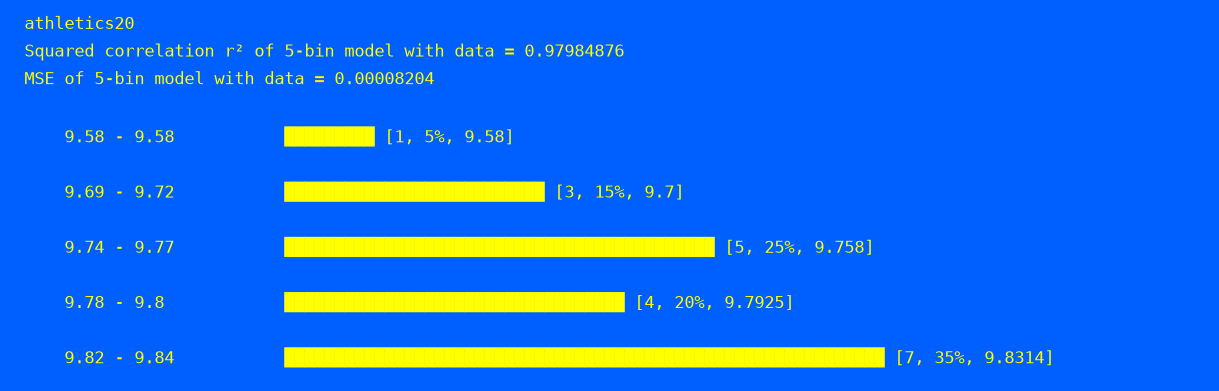
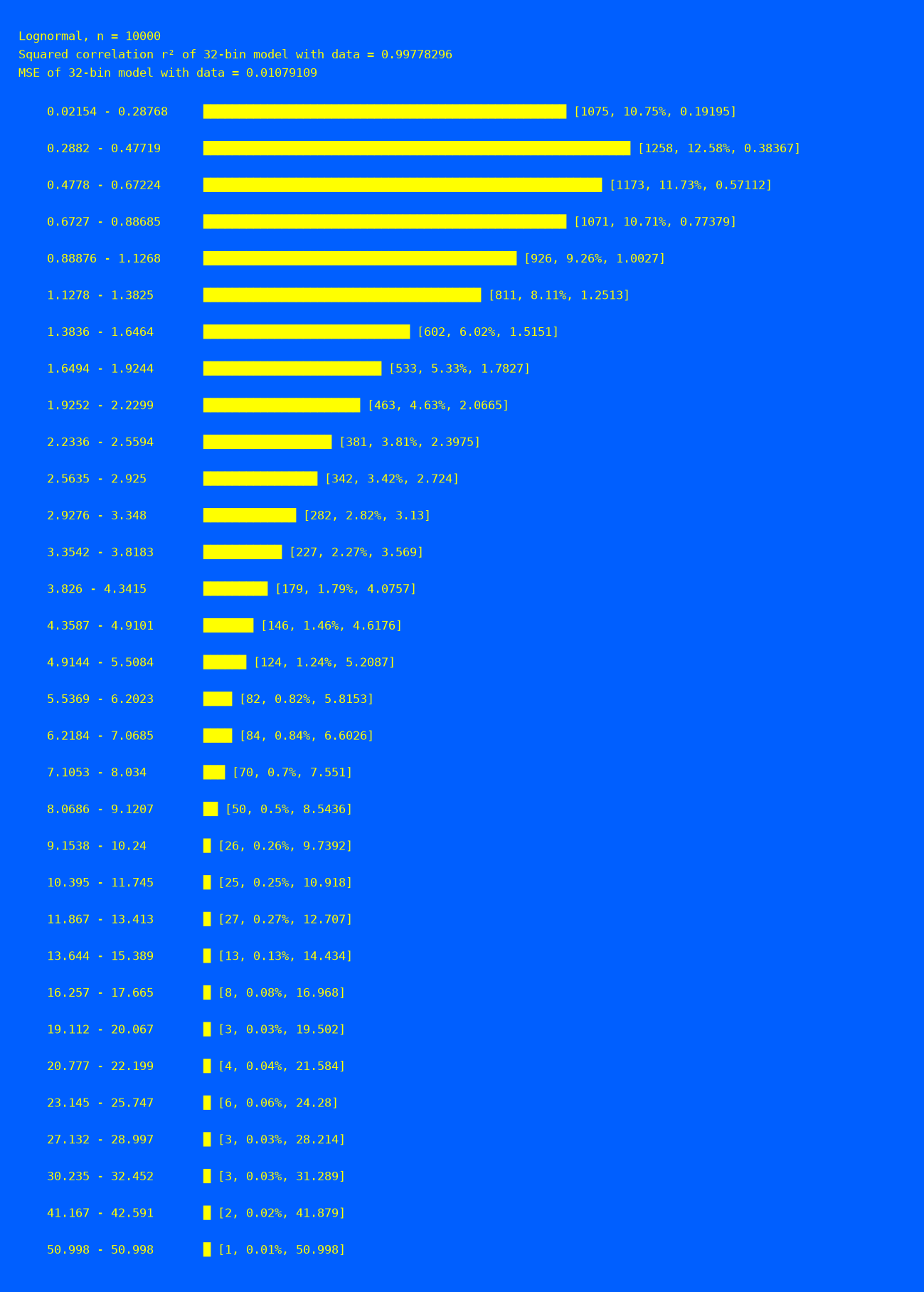
histogram() draws the fitted bins as a horizontal table, one row per bin, from the lowest bin at the top.
Each row shows the bin's minimum and maximum (5 significant digits), a bar proportional to the count, and [n, pct%, mean].
The header reports r² = 1 - SSE/SST and MSE = SSE/N.
x = lex1dx.datasets.load("athletics20")
r = lex1dx.cluster(x, 5)
lex1dx.bin_table(r, x)
lex1dx.histogram(r, x, file="lex1dx_histogram.png", title="athletics20")
The default theme is a blue background with yellow bars and monospace text.
Pass theme="light" for a white background with dark grey bars.
The default is file=None: draw on the current (or a new) figure, return the Axes, and write no file. Pass file= to write a PNG and return that path.
histogram() needs matplotlib. Install it with pip install lex1dx[plot].
athletics20, k = 5:
Lognormal sample, n = 10000, k = 32:
Example data
lex1dx.datasets.names()
# ('athletics20', 'worldathletics-mens-100m-2379')
x = lex1dx.datasets.load("athletics20")
y = lex1dx.datasets.load("worldathletics-mens-100m-2379")
athletics20 has 20 times from 9.58 to 9.84.
worldathletics-mens-100m-2379 has 2,379 times from 9.58 to 10.30, with 58 distinct values.
The 20-row file is the prefix of the 2,379-row list.
Only the time column is kept.
Athlete names and other fields are not included.
Source: World Athletics 100m all-time lists, retrieved January 2024.
Sample Data Attribution: The sample 100m timing datasets (top 20 performances and 2379 all time bests) contain historical athletic performance records compiled from publicly available statistics published by World Athletics (https://worldathletics.org/). These datasets are provided strictly as static benchmark/example inputs for testing and demonstrating the algorithms in this package. This project is not affiliated with, endorsed by, or sponsored by World Athletics.
Precision on a synthetic sample
Athletics times have two decimal places, so they do not show significant-digit grouping well.
The table below uses 10,000 lognormal draws in full double precision.
The generator is numpy.random.default_rng(1).lognormal(size=10_000).
k is 8.
REE is relative excess SSE versus cluster(..., mode="exact", solver="ckmeans").
The exact SSE is 2000.58997032.
import time
import numpy as np
import lex1dx

x = np.random.default_rng(1).lognormal(size=10_000)
k = 8
ex = lex1dx.cluster(x, k, mode="exact", solver="ckmeans")
print("sig  Dprime  SSE  REE")
for d in range(0, 10):
    r = lex1dx.cluster(x, k, sig=d)
    ree = 0.0 if ex.sse == 0 else (r.sse - ex.sse) / ex.sse * 100.0
    print(f"{d:3d}  {r.Dprime:6d}  {r.sse:.12g}  {ree:g}")
| sig |
Dprime |
SSE |
REE |
| 0 |
10000 |
2000.58997032 |
0 |
| 1 |
31 |
2446.90052339 |
22.3089% |
| 2 |
255 |
2003.23173531 |
0.132049% |
| 3 |
1693 |
2000.59035628 |
1.92923e-05% |
| 4 |
6577 |
2000.58997032 |
0 |
| 5 |
9487 |
2000.58997032 |
0 |
| 6 |
9940 |
2000.58997032 |
0 |
| 7 |
9993 |
2000.58997032 |
0 |
| 8 |
9998 |
2000.58997032 |
0 |
| 9 |
10000 |
2000.58997032 |
0 |
Dprime is nondecreasing in sig.
mode="sig5" matches sig=5 on this sample (sig=5, same SSE).
Worked scripts are in examples/cluster_athletics.py.









