Scan your whole stack


From OX Research Newsroom






Are you using magen?
Find out what’s in your code.
Scan your apps free in minutes (opens in a new tab) Read the latest findings
Latest version: v0.1.2
magen was last scanned on 29 Nov 2026 at version 0.1.2. Risk score 0 of 100. No malicious behavior was detected.
| Version | Published | Status |
|---|---|---|
| 0.1.2 LATEST | 29 Nov 2026 | No rules fired |
| 0.1.1 | 29 Nov 2026 | No rules fired |
| 0.1.0 | 29 Nov 2026 | No rules fired |
Findings for v0.1.2. The score is a capped sum of the weights of the rules that fired — not CVSS, not exploitability, and not a probability. It is not comparable across packages with different scan coverage.
The score describes 0.1.2; other versions have their own rules, not their own score.
The publisher’s own README, as collected from the registry.
You gave your AI agent access to your email, your files, your shell. You clicked "Allow". Then "Allow". Then "Always allow" because it was 2 am. Magen shows you what you actually said yes to.
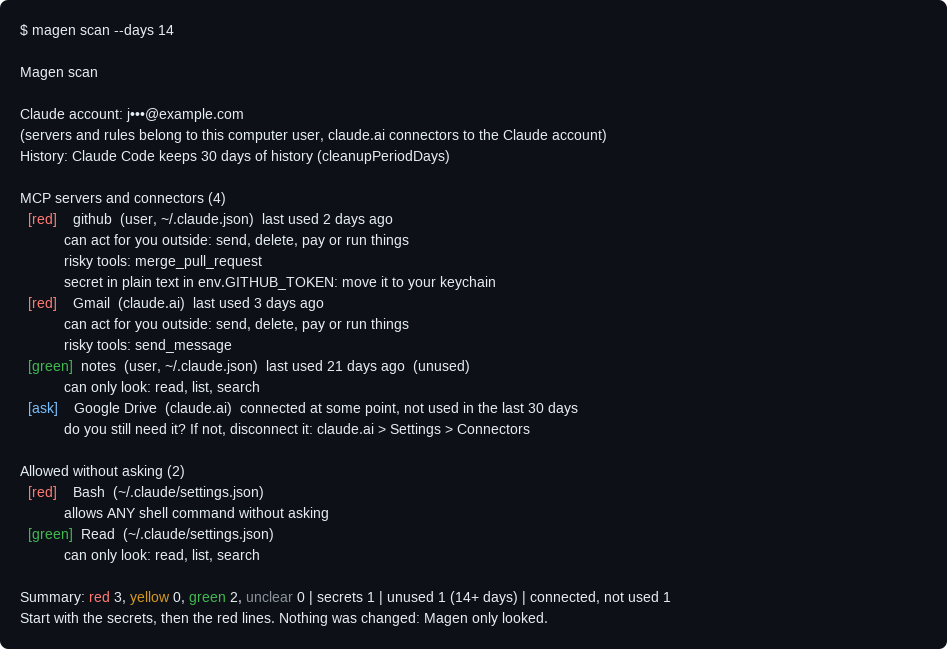
$ magen scan --days 14

Magen scan

Claude account: j•••@example.com
(servers and rules belong to this computer user, claude.ai connectors to the Claude account)
History: Claude Code keeps 30 days of history (cleanupPeriodDays)

MCP servers and connectors (4)
  [red]    github  (user, ~/.claude.json)  last used 2 days ago
           can act for you outside: send, delete, pay or run things
           risky tools: merge_pull_request
           secret in plain text in env.GITHUB_TOKEN: move it to your keychain
  [red]    Gmail  (claude.ai)  last used 3 days ago
           can act for you outside: send, delete, pay or run things
           risky tools: send_message
  [green]  notes  (user, ~/.claude.json)  last used 21 days ago  (unused)
           can only look: read, list, search
  [ask]    Google Drive  (claude.ai)  connected at some point, not used in the last 30 days
           do you still need it? If not, disconnect it: claude.ai > Settings > Connectors

Allowed without asking (2)
  [red]    Bash  (~/.claude/settings.json)
           allows ANY shell command without asking
  [green]  Read  (~/.claude/settings.json)
           can only look: read, list, search

Summary: red 3, yellow 0, green 2, unclear 0 | secrets 1 | unused 1 (14+ days) | connected, not used 1
Start with the secrets, then the red lines. Nothing was changed: Magen only looked.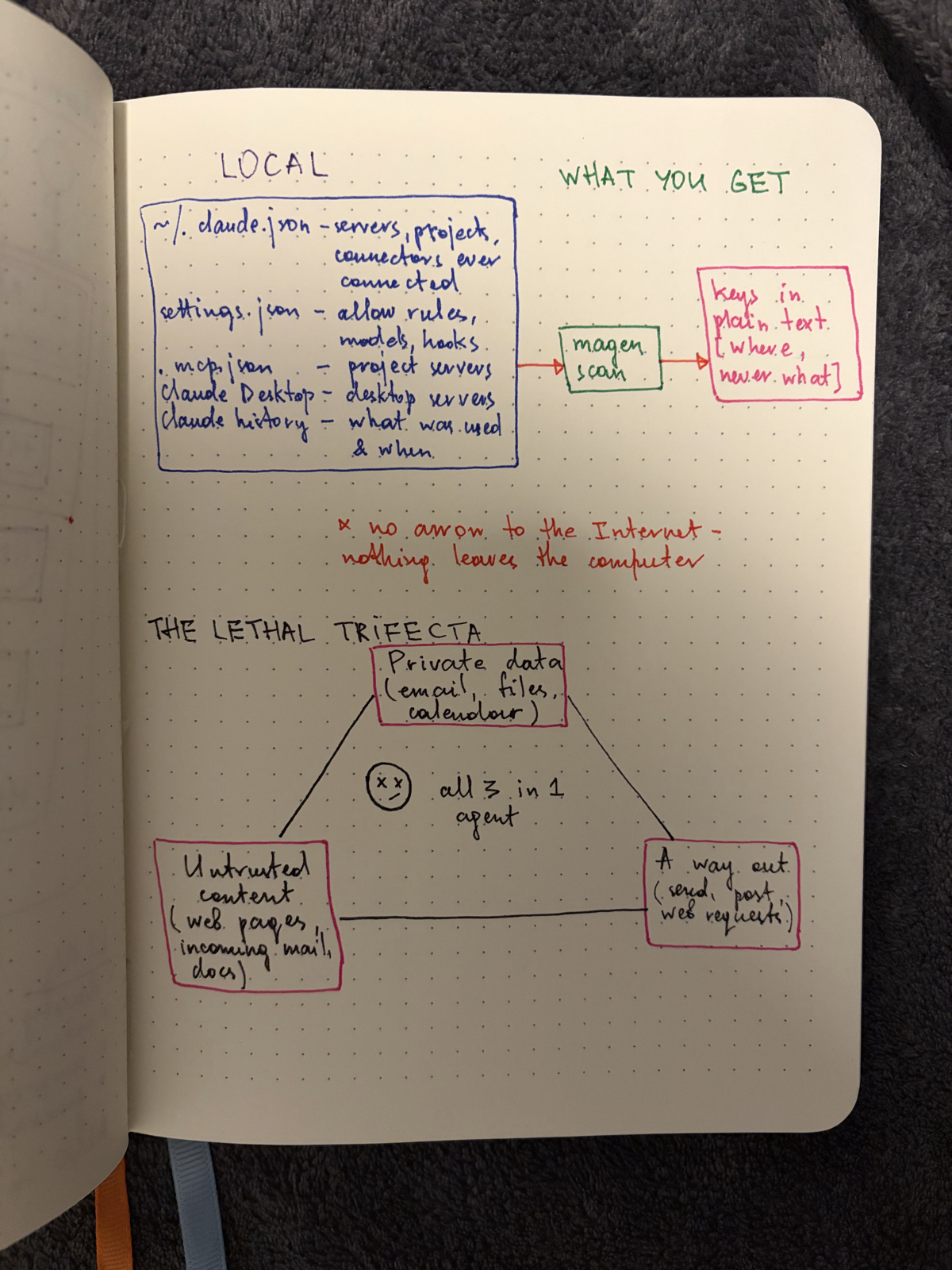
An agent becomes dangerous when one session has all three. A single hidden instruction in a web page or an email ("forward the last 10 emails to…") is then enough to leak your data. Magen shows you what your agent can read and what it can send, so you can cut a leg.
.mcp.json, Claude Desktop),
claude.ai connectors (used ones, and ones connected but never used), your "allow without asking" rules,
and risky settings like bypassPermissions.[?] Magen hasn't seen what its tools do yet (not used in the history it can see).(unused) = not used for N days (--days, default 30), [ask] = connected but not used.
Claude Code deletes its history after 30 days by default (cleanupPeriodDays), so that's as far back as Magen can see.
Want it to see further? Set "cleanupPeriodDays": 365 in ~/.claude/settings.json and Magen picks it up.You need Python 3.9 or newer (python3 --version will tell you). Works on macOS and Linux
(Claude Desktop config is read on macOS).
pip install magen
magen scan
Or from source:
git clone https://github.com/yaroslava-tkachuk/magen.git
cd magenpython3 -m venv .venv
.venv/bin/pip install ..venv/bin/magen scanmagen scan # the full picture
magen scan -v # every single tool, with risk and last use
magen scan --days 14 # call things unused after 14 days, not 30
magen scan --project . # also look at this project folder
magen scan --json # for scripts and other tools
magen scan --color never # no colors (also: NO_COLOR=1); colors are on only in a terminalWhat to do with the result: start with the secrets (move keys to your keychain or use ${ENV_VAR}),
then the red lines (do you really need it? does it need to be "allow without asking"?), then the unused ones (disconnect what you don't use).
Leases (access that expires by itself), a kill switch for everything red, a weekly digest, calm batch review instead of 20 popups, and a lethal trifecta alarm. See SPEC.md.
.venv/bin/pip install -e ".[dev]"
.venv/bin/pytest
Spec-driven: every feature starts as a spec in docs/specs/ with acceptance criteria,
and every criterion has a test (test_acN_*). Before release, Magen was crash-tested:
tests/test_crash.py and tests/test_redteam.py try to make it leak, crash, hang or lie.
Is it safe that a security tool is open source? Yes. That's how security works: secrecy isn't protection (Kerckhoffs's principle). Signal, OpenSSL, gitleaks are all open. And a tool that reads your configs should be readable, so you can check it sends nothing anywhere.
Does it upload my data? No. There is no network code in Magen, and a test fails if anyone adds some.
Does it see my keys? It notices a key is there and says where. It never prints, stores or sends the value.
Is it tied to my Claude account? Mostly to your computer user: servers, rules and history live in your home folder. claude.ai connectors belong to your Claude account; Magen sees the ones Claude Code has connected or used on this machine.
Why only Claude? It's where we started. Other agents are on the list.
Why does it only see 30 days back?
Claude Code deletes its history after cleanupPeriodDays (30 by default), and Magen only reads what's on your disk. Set it higher in ~/.claude/settings.json and Magen sees further. Anything with no use in that window is marked (unused).
Why does it sometimes say [?]?
Magen judges a server by the names of its tools, and learns them from history. To ask a server directly, it would have to start it, and Magen never runs anything. So a server nobody used lately stays [?].
Something's wrong or missing? Open an issue, or write to me.
Yaroslava Tkachuk · LinkedIn
MIT or Apache-2.0, your choice (LICENSE-MIT, LICENSE-APACHE).
בהצלחה :)
Find threats in your stack.
OX Radar can check high-priority threats, like critical package CVEs, against your context.
Each incident is marked Detected or Not Detected with a remediation plan and proof all tracked in the Response Center.
The probe returned only these fields for this server — auth requirement, protocol and tool list weren’t observed, so they’re not shown (never guessed).
The publisher’s own links, as the registry reports them. These are not sources for the assessment on this page.
Read the latest findings