
Scan your whole stack


From OX Research Newsroom






Are you using scion-sdk?
Find out what’s in your code.
Scan your apps free in minutes (opens in a new tab) Read the latest findings
Latest version: v0.14.0
scion-sdk was last scanned on 28 Nov 2026 at version 0.14.0. Risk score 0 of 100. No malicious behavior was detected.
| Version | Published | Status |
|---|---|---|
| 0.14.0 LATEST | 28 Nov 2026 | No rules fired |
| 0.13.2 | 28 Nov 2026 | No rules fired |
| 0.13.1 | 28 Nov 2026 | No rules fired |
| 0.13.0 | 27 Nov 2026 | Not shown |
| 0.12.1 | 27 Nov 2026 | Not shown |
Findings for v0.14.0. The score is a capped sum of the weights of the rules that fired — not CVSS, not exploitability, and not a probability. It is not comparable across packages with different scan coverage.
The score describes 0.14.0; other versions have their own rules, not their own score.
The publisher’s own README, as collected from the registry.












Install Scion SDK as scion-sdk and import it as
scion_sdk. The repository, package, CLI, and API identifiers all use the scion-sdk name.
Create a project and install the SDK:
uv init --bare demo-connector
cd demo-connector
uv add scion-sdk
uv sync
uv run connector-sync --help
The command prints the supervised synchronization options without opening a source session. Continue with the connector tutorial to build and run a one-file MCP connector, observe its health response, add declarative content, certify the live schema, and join source synchronization.
Scion SDK is the ecosystem's source-integration boundary. It turns vendor APIs and domain tools into secure MCP connectors, transports bounded source evidence into Medulla, indexes immutable repository snapshots, and applies authorized changes back to source systems.
Connector packages retain vendor behavior. The SDK owns transport, lifecycle, certification, and effect execution. Medulla owns durable graph records, checkpoints, content identity, and receipts.
IndexRepository boundary without becoming a semantic writer.Start with Build the operator's first connector, then choose the reference that matches the work:
Sibling authorities: Medulla owns durable graph state; Arbora is the one door for admission, auth, served operations, and MCP and A2A serving.
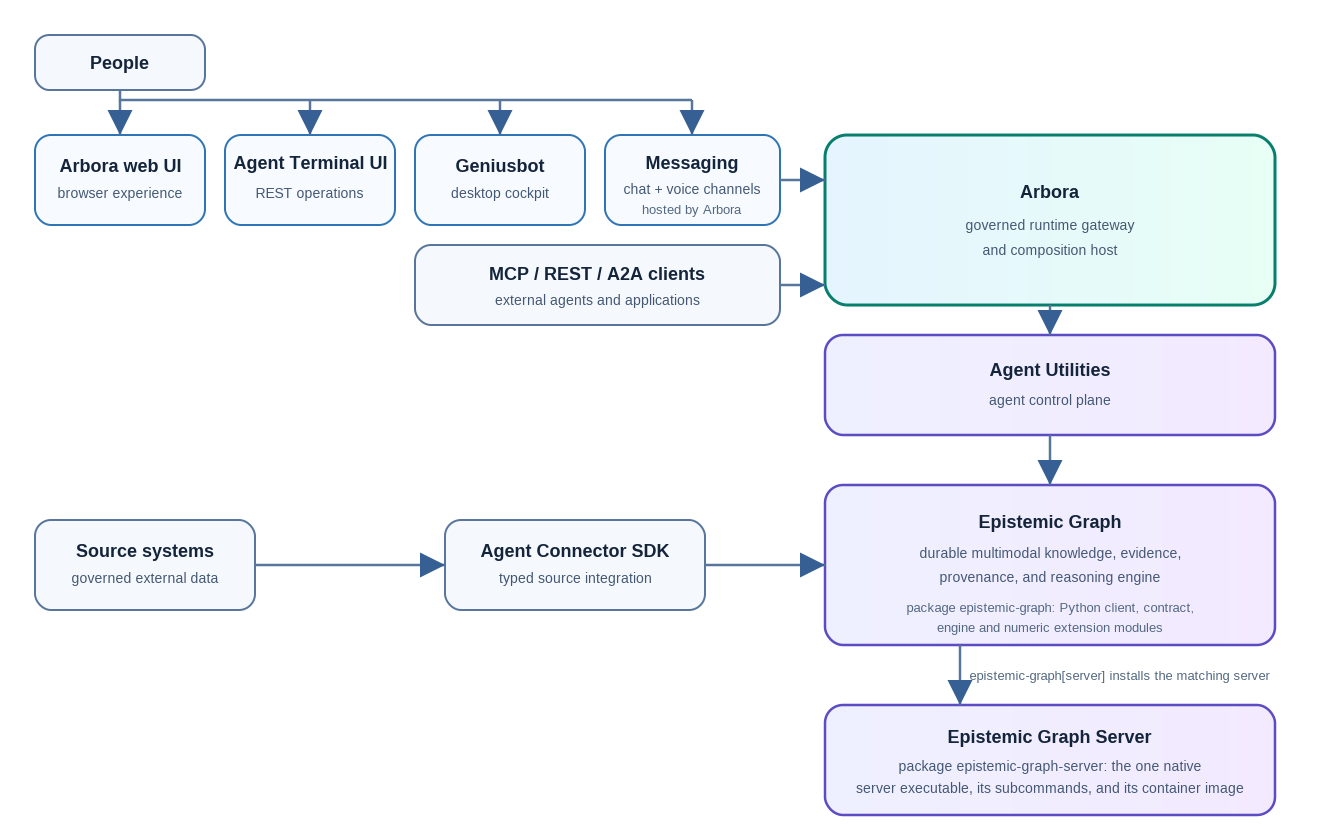
| Boundary | Owned here | Owned elsewhere |
|---|---|---|
| Connector service | MCP lifecycle, exposure policy, content capture, certification | Vendor models and business semantics stay in the connector package. |
| Source ingest | Discovery, bounded extraction, transport, receipt verification | Medulla owns mapping, checkpoints, provenance, and commit receipts. |
| Repository ingest | Authenticated snapshots, stable manifests, bounded object transport | Medulla owns indexing, graph projection, and semantic interpretation. |
| Write-back | Preview, source-version checks, apply, and reconciliation | Medulla owns change sets, authorization decisions, and durable outcomes. |
| Runtime composition | Typed ports and checked dependency requirements | Arbora supplies authenticated identity, clients, and live authority. |
The SDK depends directly on medulla. The Rust serde types in Medulla are the
source of truth. The SDK holds hand-written SourceIngest, ConnectorPack,
IndexRepository, and WriteBack clients, tested on round-trip vectors. The SDK
adds no parallel graph contract. Spec IDs use the SCION- prefix.
Issues and pull requests are welcome. Follow AGENTS.md for ownership, isolation, and validation rules, and run the affected tests and public-surface gates before submitting a change.
Scion SDK is released under the MIT License.
Find threats in your stack.
OX Radar can check high-priority threats, like critical package CVEs, against your context.
Each incident is marked Detected or Not Detected with a remediation plan and proof all tracked in the Response Center.
The probe returned only these fields for this server — auth requirement, protocol and tool list weren’t observed, so they’re not shown (never guessed).
The publisher’s own links, as the registry reports them. These are not sources for the assessment on this page.
Read the latest findings