
Scan your whole stack


From OX Research Newsroom






Are you using tf-eu-guard?
Find out what’s in your code.
Scan your apps free in minutes (opens in a new tab)Latest version: v0.9.0
tf-eu-guard was last scanned on 23 Nov 2026 at version 0.9.0. Risk score 0 of 100. No malicious behavior was detected.
| Version | Published | Status |
|---|---|---|
| 0.9.0 LATEST | 23 Nov 2026 | No rules fired |
| 0.8.1 | 17 Nov 2026 | No rules fired |
| 0.7.1 | 7 Nov 2026 | No rules fired |
| 0.7.0 | 18 Oct 2026 | Not shown |
| 0.6.0 | 17 Oct 2026 | Not shown |
Findings for v0.9.0. The score is a capped sum of the weights of the rules that fired — not CVSS, not exploitability, and not a probability. It is not comparable across packages with different scan coverage.
The score describes 0.9.0; other versions have their own rules, not their own score.
The publisher’s own README, as collected from the registry.


Links: PyPI package · Documentation · Changelog
EU compliance security linter for infrastructure as code (IaC). It scans Terraform source, Terraform plan JSON, and Kubernetes manifests with Checkov, then maps infrastructure misconfigurations to NIS2 (Directive 2022/2555) and GDPR (Regulation 2016/679) requirements. It is built for Terraform security scanning, Kubernetes compliance checks, DevSecOps pipelines, GitHub Actions, SARIF, and audit preparation.
The NIS2 Directive set October 17, 2024 as the deadline for Member States to adopt and publish national transposition measures; applicability and enforcement still depend on national law and whether an entity is in scope. Article 21(2) mandates risk-management measures including access control, encryption, incident handling, backup policies, and secure authentication. GDPR Article 32 imposes similar technical and organizational safeguards for processing personal data.
Most organizations scan infrastructure-as-code with tools like Checkov or tfsec, but the output is generic security findings, not compliance mappings. Security teams must manually trace each finding to the relevant NIS2 or GDPR article, a slow and error-prone process that blocks audit preparation.
tf-eu-guard wraps Checkov, enriches each failed check with the relevant NIS2/GDPR article references, and produces reports structured for developers, security engineers, and auditors.
terraform show -json), and Kubernetes manifests (--iac-type)Note on flags:
--iac-typeselects what to scan (terraform, terraform_plan, kubernetes);--frameworkselects which regulatory regime to report (nis2/gdpr).allalso retains project-policy findings such as the EUSC sovereignty control. They are unrelated.
Requires Python ≥ 3.11. Installs Checkov 3.4.5 as a dependency. uv is optional; plain pip works too.
uv tool install tf-eu-guard(Also available on PyPI: tf-eu-guard; with pip, pip install tf-eu-guard.)
For development (from a clone of this repo):
uv sync --extra dev # or: python -m venv .venv && .venv/bin/pip install -e '.[dev]'uv sync also writes a uv.lock in the repository root. It is a local
artefact (the project's pinned locks are the requirements*.lock files), and
it is gitignored, so do not commit it.
# Scan a Terraform directory
tf-eu-guard scan ./terraform --output dev

# Generate all three HTML reports
tf-eu-guard scan ./terraform --output all

# Filter to GDPR-only findings and output JSON
tf-eu-guard scan ./terraform --output json --framework gdpr

# Markdown summary or CSV (one row per finding and article); also write a summary and counts
# file (key=value, GitHub $GITHUB_OUTPUT format) next to any other --output
tf-eu-guard scan ./terraform --output csv --output-file findings.csv
tf-eu-guard scan ./terraform --output json --summary-file summary.md --counts-file counts.txt

# Fail the build (exit code 1) on HIGH or worse findings — for CI/CD
tf-eu-guard scan ./terraform --fail-on-severity HIGH

# Skip paths (repeatable; Checkov --skip-path semantics: regex or substring of the absolute path)
tf-eu-guard scan . --exclude tests/fixtures --exclude vendor

# Show the registry entry (severity, articles, risk, remediation) for one check
tf-eu-guard explain CKV_AWS_16

# Layer your own registry entries over the bundled ones (repeatable; later wins), then lint them
tf-eu-guard scan ./terraform --registry-dir ./our-registry
tf-eu-guard registry validate ./our-registry
Network behaviour. Scans run Checkov with --skip-download, so no request
is made to the Prisma Cloud platform and reports have no "Documentation" links.
--online allows Checkov to fetch that metadata. BC_*, PRISMA_* and
CKV_IGNORE* environment variables (platform API keys included) are always
removed from Checkov's environment, even with --online. See
docs/limitations.md and SECURITY.md.
Remote modules. Checkov does not download modules, so resources inside
registry or Git modules are not analysed; a stderr warning lists such module
calls, and CKV_TF_1/CKV_TF_2 (module pinning) map to NIS2 Art. 21(2)(d).
--download-external-modules lets Checkov fetch them (network access, third-party
code; Terraform source scans only). The GitHub Action runs with --network none, so
that flag does not work there. --var-file FILE (repeatable) passes Terraform variable
files so values such as a provider region set via var.* resolve.
Secrets. --secrets also runs Checkov's secrets framework (hard-coded credentials,
CKV_SECRET_*, mapped to NIS2 Art. 21(2)(e) and GDPR Art. 32(1)(b), severity HIGH). It
works with Terraform, Terraform plan, Kubernetes and --checkov-json (a secrets element in
the file is merged; none means no secret findings). Reports show the secret type and file
location only: the secret value, code excerpt and Checkov's hash of the secret are never
copied into any output. Parsing errors in the secrets scan fail the run like any other.
Try it: Run
tf-eu-guard scan examples/vulnerable-aws/ --output allto see ~53 mapped findings, ortf-eu-guard scan examples/compliant-aws/ --output devto see zero mapped findings on the compliant fixture.
Plan-mode scanning catches the configuration as it will actually be applied. Generate the plan JSON, then scan it:
terraform plan -out=tfplan.binary
terraform show -json tfplan.binary > plan.json
tf-eu-guard scan plan.json --iac-type terraform_plan --output json
Plan mode runs Checkov against the plan file itself (
checkov -f <plan.json> --framework terraform_plan). It reuses the sameCKV_AWS_*check IDs as source mode (verified: a plan ofexamples/vulnerable-awsmaps 31 findings, all to existing registry entries), minus lifecycle-block checks that plan JSON doesn't store. Findings reportfile_line_range: [0, 0](the whole plan is one JSON line), so reports omit the line reference. A committed fixture lives atexamples/vulnerable-aws-plan/.Note:
--checkov-jsonis a different feature — it reuses Checkov JSON output you already generated (see below). Passing a rawterraform show -jsonplan file to--checkov-jsonis an error; scan the plan file directly as shown above.
tf-eu-guard scan ./k8s --iac-type kubernetes --output allTry it:
tf-eu-guard scan examples/vulnerable-kubernetes/ --iac-type kubernetes --output jsonreturns ~24 mapped findings across pod security context, RBAC, network policy, secrets and resource limits. Kubernetes checks live in the separateCKV_K8S_*namespace, mapped inregistry-kubernetes.yaml.
If you already run Checkov in CI or with custom checks, feed tf-eu-guard the
Checkov output JSON directly (not a raw Terraform plan file; use
--iac-type terraform_plan for that):
# From a file
checkov -d ./terraform --output json --framework terraform --quiet > checkov.json
tf-eu-guard scan --checkov-json checkov.json --output security

# From stdin
checkov -d ./terraform --output json --framework terraform --quiet \
  | tf-eu-guard scan --checkov-json - --output auditor
Limits of pre-generated JSON. tf-eu-guard cannot re-run what Checkov did, so it checks the file instead:
- Parsing errors fail the scan. If
summary.parsing_errorsis above 0 (in any element of a multi-framework array), tf-eu-guard exits with the same runtime-failure code as a source scan, because unparsed files were never checked.--allow-partialdowngrades this to a stderr warning in both modes.- Checkov version. If
summary.checkov_versiondiffers from the installed Checkov, a warning names both versions.- Custom checks. If no
EUGUARD_*check ID appears in the passed, failed or skipped lists, a warning says the residency and secret checks were not loaded and a clean result does not cover them. Regenerate the file withcheckov --external-checks-dir <tf_eu_guard>/checks(the warning prints the path).- The residency flags (
--residency-policy,--allowed-regions) are ignored; the results reflect the policy in effect when Checkov ran.
Use
--framework terraformin Checkov to get a single JSON object. tf-eu-guard also handles the multi-check-type array and extracts theterraformresult automatically.
Checkov results must identify the requested IaC type when
check_typeis present. Arrays are accepted only when they contain a matching element. For compatibility, a single legacy object withoutcheck_typeis interpreted as the requested type. Source scans fail closed on Checkov parsing errors and empty/unsupported directories;.tf.jsonsource files are not supported by the selected Checkov framework (use Terraform HCL or scan a plan with--iac-type terraform_plan).
Symlink boundary: For a source-directory scan, tf-eu-guard resolves every symlink before Checkov runs. A symlinked file or directory that resolves outside the requested scan root (or a broken symlink) is rejected with exit code
2. Symlinks that resolve inside the scan root are allowed; Checkov scans their targets, and directory cycles are visited only once. Plan-file scans are not directory traversals and do not apply this source-root check.
This repo includes a Claude Code skill at .claude/skills/tf-eu-guard/. In Claude Code:
/tf-eu-guard ./terraformOr just ask: "Check my Terraform for NIS2 and GDPR compliance" — Claude runs the scan and summarizes findings by framework and severity.
--evidence-dir DIR writes dev.html, security.html, auditor.html, report.json (object
format), report.sarif, summary.md and manifest.json into a new or empty DIR (otherwise
exit 2), in addition to the normal --output. manifest.json holds created, provenance and
the SHA-256 of every other file. provenance (also in the JSON object and the auditor report)
has tool_version, checkov_version, registry_sha256 and registry_files (overlays by full
path), commit (the HEAD sha; uncommitted changes are not detected; null outside git), the effective options
(no environment variables), resources_scanned and checks (passed, failed, skipped).
The python:3.12-slim image the Action runs in has no git, so provenance.commit is null in the Action.
To attest the bundle in CI, use GitHub artifact attestations on it, for example
actions/attest-build-provenance with subject-path: evidence/*.
Quick terminal output for engineers fixing issues:
tf-eu-guard scan ./terraform --output dev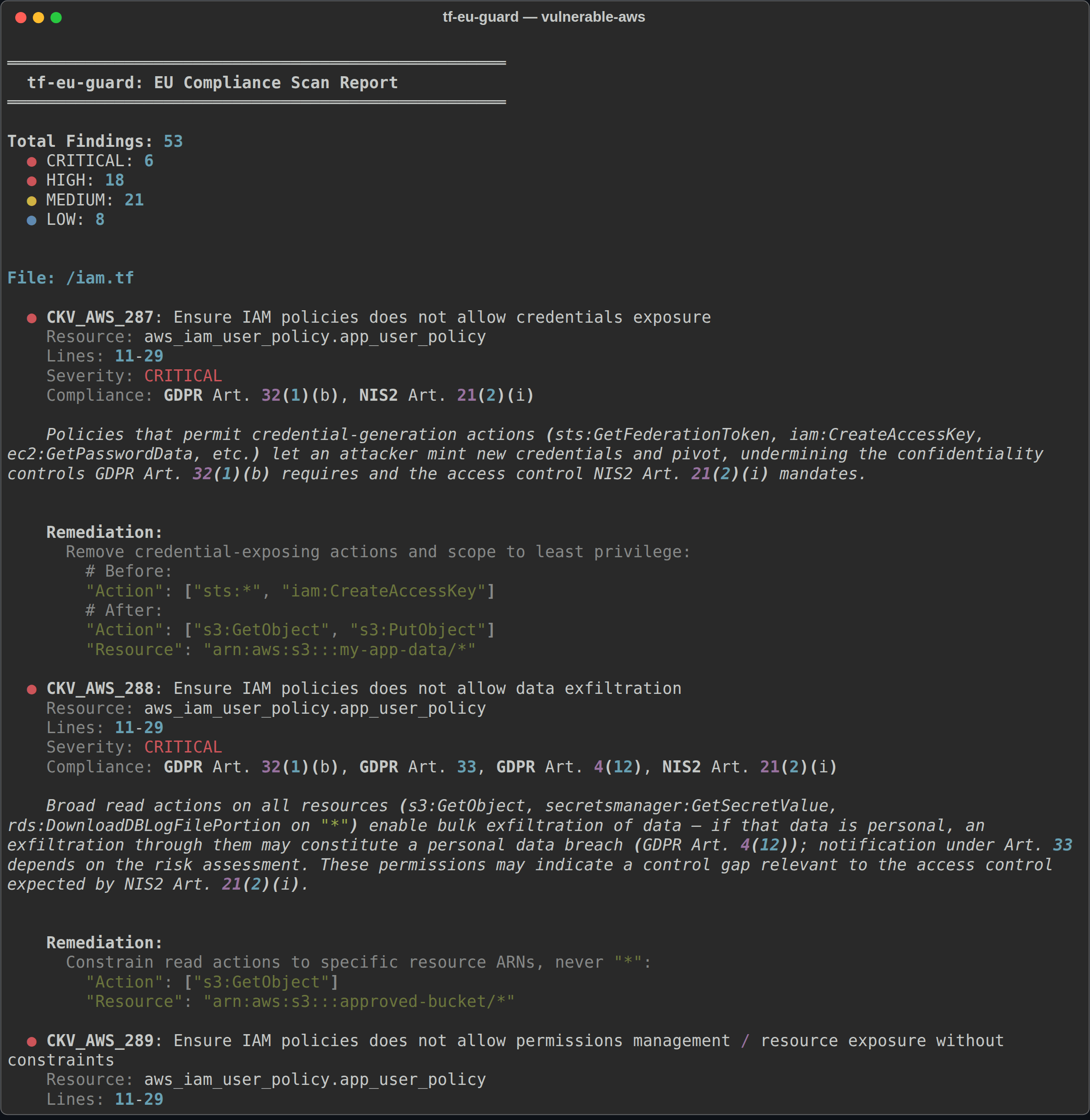
HTML report with severity breakdown and compliance tags:
tf-eu-guard scan ./terraform --output security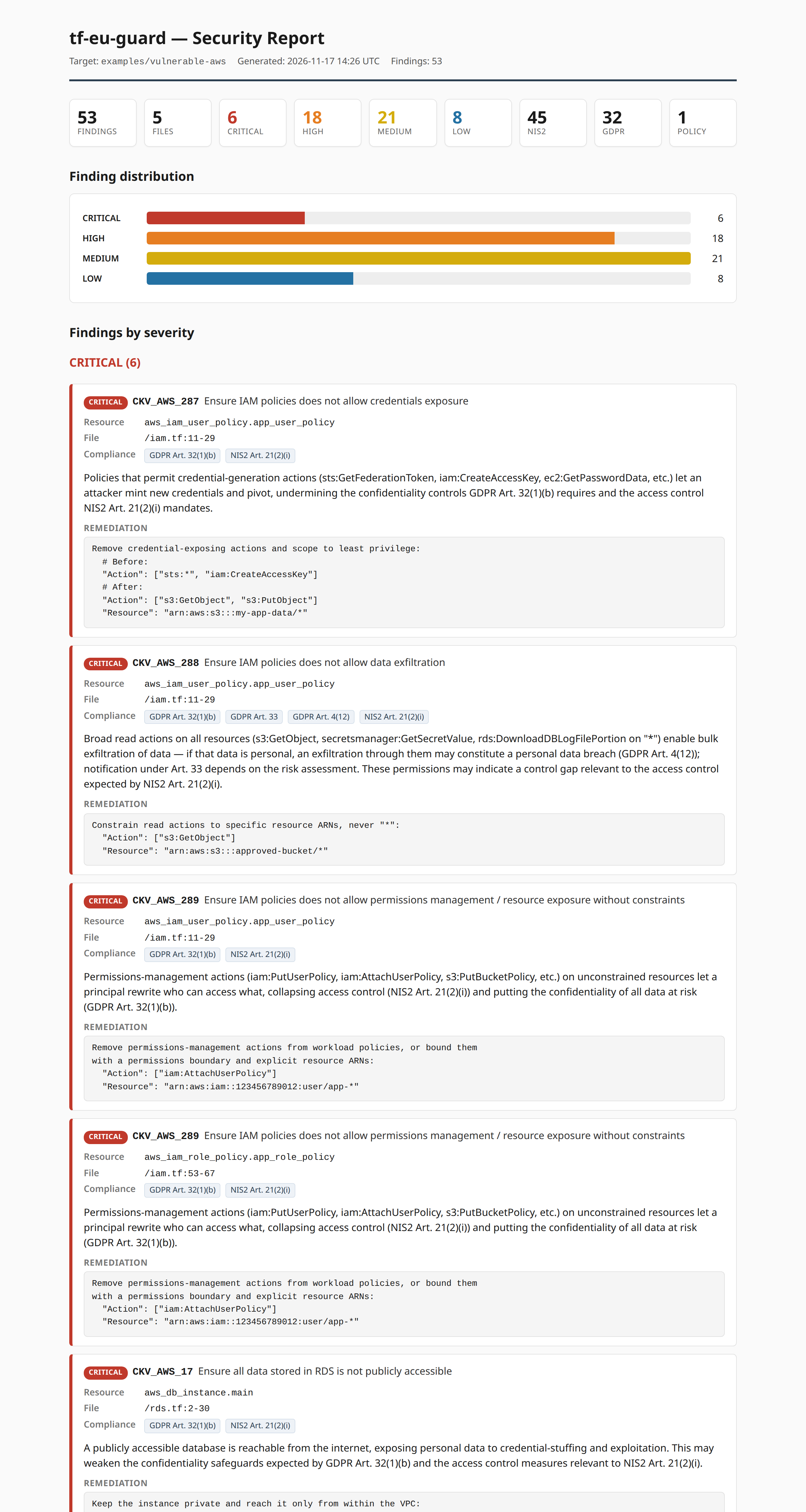
Live HTML version:
docs/screenshots/scan-report.html
Article-by-article view for audit preparation:
tf-eu-guard scan ./terraform --output auditor
Live HTML version:
docs/screenshots/auditor-report.html
Machine-readable output for pipelines:
tf-eu-guard scan ./terraform --output json --framework nis2tf-eu-guard scan ./terraform --output sarif > tf-eu-guard.sarifEmits a SARIF 2.1.0
document, the format GitHub Code Scanning ingests directly. Each finding
becomes a result with ruleId = Checkov check ID, level derived from
severity (CRITICAL/HIGH → error, MEDIUM → warning, LOW/INFO → note),
and a physicalLocation from the finding's file and line range. For mapped
findings, the registry-backed EU context (NIS2/GDPR articles, severity, and
remediation) rides along in properties on both the rule and the result for
other SARIF consumers; Code Scanning itself does not render those custom
properties. What it does show: each rule's help (remediation and the article
list), properties.tags (security, the framework, and article labels such as
NIS2 Art. 21(2)(f), usable as filters), and properties.security-severity
for ranking (CRITICAL 9.5, HIGH 8.0, MEDIUM 5.5, LOW 3.0, INFO 0.0; unmapped
rules carry none and rank by level). Each result has a
partialFingerprints["tfEuGuard/v1"] (sha256 of check ID, resource and
repository-relative file) so alerts stay stable across runs. A finding whose
file is outside the repository gets a file-level location at the repository
root ("." under %SRCROOT%) instead of an empty locations array. Unmapped Checkov
findings are included as note-level results with their Checkov identity,
resource, and location, tagged properties.mapped: false; they carry no
registry remediation or severity.
Find threats in your stack.
OX Radar can check high-priority threats, like critical package CVEs, against your context.
Each incident is marked Detected or Not Detected with a remediation plan and proof all tracked in the Response Center.
The probe returned only these fields for this server — auth requirement, protocol and tool list weren’t observed, so they’re not shown (never guessed).
The publisher’s own links, as the registry reports them. These are not sources for the assessment on this page.