TL;DR
- An API-BOM (application programming interface bill of materials) is a machine-readable inventory derived from code and spec files, mapping endpoints to methods, handlers, and security issues.
- OpenAPI specs capture intent and gateways capture routed traffic, but an API-BOM captures code-level reality.
- Manual documentation and gateway logs leave major Open Worldwide Application Security Project (OWASP) API9:2023 blindspots, including zombie routes and unmapped data flows.
- CycloneDX (ECMA-424) provides an open standard schema for structuring API components alongside software dependencies.
- Mapping code vulnerabilities directly to API endpoints via call-path analysis lets application security (AppSec) teams prioritize by actual reachability.
- Regenerating the API-BOM on every commit means that new routes, including to AI-generated endpoints, are cataloged before deployment.
What Is an API-BOM?
An API Bill of Materials (API-BOM) is a structured, machine-readable inventory that catalogs the internal and external API endpoints declared across an application’s source code, framework configurations, and OpenAPI files. It maps each endpoint directly to its HTTP method, repository, controller function, and exposed security vulnerabilities, serving as a code-level source of truth. An API-BOM is one component of API exposure management, the practice of discovering and inventorying the API endpoints an application exposes and mapping vulnerabilities to them.
Why Do API Inventories Fail?
Organizations rarely lack documentation tools; rather, traditional API documentation processes break down under the weight of modern release velocity. According to Postman’s 2025 State of the API Report (surveying over 5,700 developers, architects, and executives), 55% of respondents report struggling with inconsistent documentation, while 34% report being unable to find existing APIs.
This systemic drift creates critical security blind spots, officially classified under OWASP API9:2023 Improper Inventory Management. OWASP highlights two primary blindspot categories that leave systems exposed:
1. Documentation Blindspots
- Unclear host environment (production, staging, test, or development) and running API version.
- Unclear network access requirements (public, internal, or partners).
- Missing API documentation, or documentation that is never updated.
- Missing retirement plans for each API version (leaving zombie routes active).
- Missing or outdated host inventories.
2. Data-Flow Blindspots
- Unknown data exposure (lack of visibility into sensitive personally identifiable information (PII) and protected health information (PHI)).
- Unmapped third-party data flows and external API callbacks.
- Sensitive data shared with third parties without business justification or approval.
When API inventories depend on manual updates or runtime gateway routing alone, these blind spots let unlisted endpoints slip past security scanning, access governance, and patch management.
Core Concepts: Documenting API Architecture Across the Lifecycle
To build an accurate API inventory, security and engineering teams must operate on a shared set of architectural definitions:
- Endpoint: A specific URL path and HTTP method combination (such as POST /api/v1/users) through which an application receives requests and exposes data or functionality.
- Shadow API: An active endpoint that exists in production code and processes live network traffic, but was never documented in an official inventory, developer portal, or gateway schema.
- Zombie API: An endpoint that was formally documented and governed in the past, but was deprecated or retired on paper while remaining active and reachable in production infrastructure.
- OpenAPI Specification: A machine-readable, standard framework (formerly Swagger) used to define, document, and describe RESTful API interfaces, schemas, and authentication methods.
- Gateway Catalog: An inventory of routes, proxies, and policies actively managed and enforced by an API gateway (such as Kong, Apigee, or AWS API Gateway).
- Software Bill of Materials (SBOM) & Pipeline Bill of Materials (PBOM): An SBOM lists the third-party open-source components, libraries, and dependencies within an application, while a PBOM documents the build pipelines, continuous integration and continuous delivery (CI/CD) tools, and infrastructure steps used to compile and deploy software.
As software supply chain transparency has matured, open specification standards have expanded to encompass APIs alongside third-party software components. CycloneDX (an open Bill of Materials standard published officially as ECMA-424) provides an open schema for representing services, including their endpoints, data flows, and data classifications, in a standardized, machine-readable format.
What Does an API-BOM Capture?
An effective API-BOM captures both code-level definitions and vulnerability context to maintain an accurate record of exposed attack surfaces. At its core, an OX API-BOM field set captures essential operational metrics:
- Endpoint Path and HTTP Method: The precise URI path (such as /v2/accounts/{id}/transfer) alongside its supported HTTP verbs (GET, POST, DELETE).
- Source Origin: Whether the route was discovered in application source code or defined by an OpenAPI specification file in the repository.
- Functions: For endpoints discovered in source code, the functions the API calls.
- Exposed Security Issues: A count of the security issues exposed by the endpoint in each of the three highest severity levels.
- First-Seen Date: The date the endpoint was first detected, which is not necessarily the date it was added to the code, establishing a baseline for tracking inventory drift.
While an API-BOM focuses on the structural code definitions and immediate security posture of an endpoint, OWASP outlines wider runtime inventory expectations. OWASP recommends tracking deployment environment context (production vs. staging), network access controls (publicly accessible vs. internal-only), active running versions, and downstream integrated services (database bindings and third-party SaaS callouts).
A mature API governance model combines the code-centric precision of an API-BOM with these broader runtime operational fields.
API-BOM vs. OpenAPI Specs vs. Gateway Catalogs
Organizations often assume that maintaining an OpenAPI specification or an API gateway catalog provides a complete inventory. However, each asset captures a different layer of visibility across the API lifecycle:
- OpenAPI Specifications: Capture documented intent. A spec defines how an API should behave according to what human developers or automated generators wrote down. It reveals nothing about whether the endpoint is actually deployed, whether it receives traffic, or if undocumented routes exist alongside it in code.
- Gateway Catalogs: Capture routed execution. A gateway catalog lists endpoints configured to proxy traffic through a central gateway (e.g., Kong, Apigee, AWS API Gateway). It misses unrouted microservices, internal service-to-service calls, sidecar proxies, and shadow APIs deployed directly to container infrastructure.
- API-BOM: Captures code-level reality. An API-BOM derives declared endpoints directly from application source code, abstract syntax trees (ASTs), and repository specification files.
| Feature / Capability | OpenAPI Specification | Gateway Catalog | API-BOM |
| Primary Data Source | openapi.yaml / swagger.json | Proxy configurations & ingress rules | Repository source code, ASTs, and spec files |
| Visibility Type | Documented design intent | Explicitly routed runtime traffic | Code-defined structural reality |
| Shadow API Discovery | ❌ Cannot detect | ❌ Cannot detect | ✅ Detects at commit time |
| Zombie API Discovery | ❌ Cannot detect | ⚠️ Detects only if traffic is active | ✅ Detects code/spec divergence |
| Agent-Generated Endpoints | ❌ Cannot detect | ❌ Cannot detect before first call | ✅ Detects at pull request (PR) time |
Because the API-BOM acts as a code-level foundation, it serves as a reconciliation layer. By anchoring continuous inventory tracking in the source code, AppSec teams can attach secondary telemetry sources (such as web application firewall (WAF) traffic logs, eBPF network streams, identity and access management (IAM) permissions, and cloud posture data) directly to the underlying repository, controller function, and codeowner.
How Do You Build an API-BOM from Source Code?
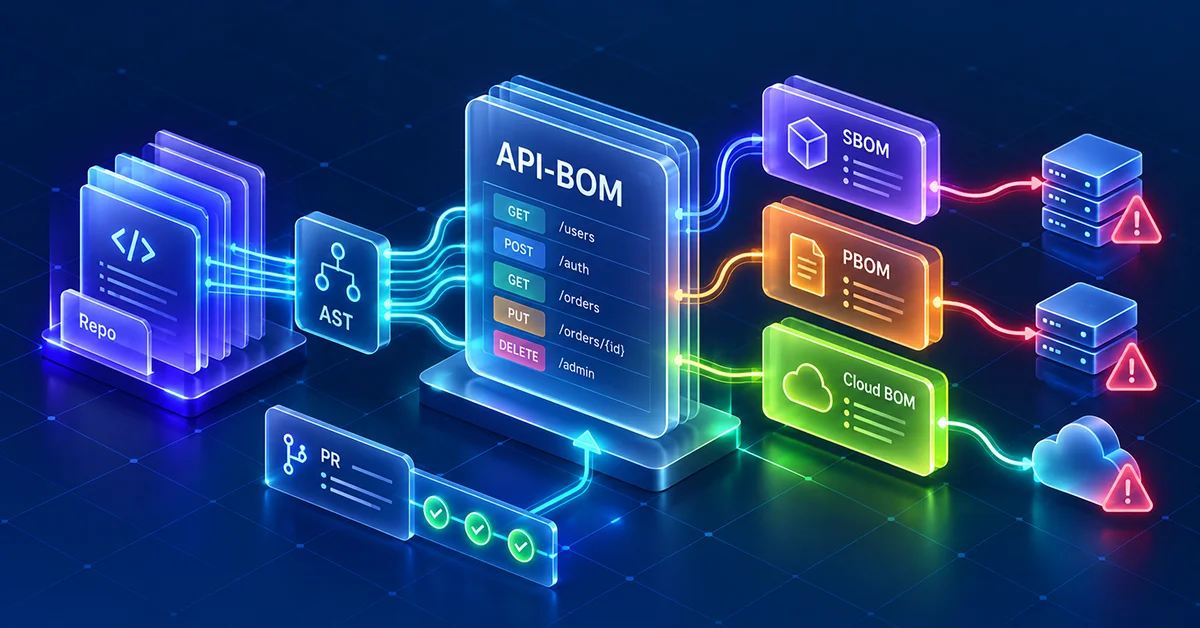
Building an automated API-BOM requires parsing repository source code to extract route definitions, ingesting specification files, and mapping security vulnerabilities directly onto the code paths that expose them.
API-BOM BUILD PIPELINE
1. REPOSITORY & FRAMEWORK PARSING
- Extract route annotations, controllers, & HTTP verbs.
- Supported: Flask, Express, Spring Boot, ASP.NET Core, etc.
2. SPECIFICATION INGESTION
- Parse in-repo openapi.yaml & swagger.json files.
- Reconcile spec endpoints against code-parsed handlers.
3. CODE-TO-ISSUE CORRELATION
- Trace function call paths from handler to issue location.
- Map Code & Open Source security findings to specific endpoints.
Detecting Endpoints in Code
To build an inventory without manual tagging, a code-based discovery engine parses framework-specific route declarations, controller annotations, and specification manifests. Supported frameworks and specification files include:
- Python: Flask, FastAPI, Django, Connexion
- JavaScript / TypeScript: Express.js, NestJS, Koa, Apollo GraphQL
- Java / Scala / Kotlin: Spring Boot, Ktor, Play Framework
- C# / .NET: ASP.NET Core MVC
- Go: Gin
- Specifications: OpenAPI / Swagger specification files (.yaml, .json)
For the complete list of supported languages, web frameworks, and parsing capabilities, view the OX API-BOM documentation.
Correlating Findings to Endpoints
Scanning source code for static application security testing (SAST) or open-source vulnerabilities often produces an unprioritized list of raw security findings. An API-BOM transforms vulnerability management by mapping specific code security and open-source security issues directly to the endpoints that expose them.
This correlation relies on call-path analysis: an issue is classified as exposed by an API when a function call path exists between the API handler function and the function containing the vulnerability. Tying security findings directly to reachable entry points allows AppSec teams to prioritize remediation based on actual exposure risk rather than static vulnerability severity alone.
Scope Limitation
Code-to-issue correlation in an API-BOM requires two conditions: the endpoint must be discovered directly in application source code, and it must be written in a supported language and web framework. Endpoints ingested purely from standalone OpenAPI specification files without backing code access provide schema visibility but cannot support automated function call-path correlation. The same applies to Go endpoints detected in Gin, which are inventoried but not correlated.
API-BOM in the BOM Family
The expansion of software supply chain transparency has led to specialized Bill of Materials formats, each covering a specific layer of the modern application stack:
- Software Bill of Materials (SBOM): Inventories third-party open-source libraries, direct packages, and open-source software dependencies within an application codebase.
- Pipeline Bill of Materials (PBOM): Inventories the build tools, CI/CD pipeline steps, deployment runners, and repository configurations used to compile and ship application code.
- SaaS BOM: Inventories the third-party Software-as-a-Service products an application’s code references, through SDK dependencies and usage, embedded tokens, and direct API calls.
- Cloud BOM: Inventories cloud assets such as virtual machines, storage buckets, and Kubernetes clusters across multiple cloud platforms.
- AI-BOM (or ML-BOM): Inventories machine learning models, training datasets, prompt templates, and AI framework dependencies powering application logic.
A Note on CycloneDX and CBOM (Cryptography Bill of Materials)
In the absence of standardization, acronyms are coined freely, and the same letters can stand for different inventories from one vendor to the next. Where they collide, the open standard takes precedence. OWASP CycloneDX, published by Ecma International as ECMA-424, defines CBOM as the Cryptography BOM, an inventory of the cryptographic assets in a piece of software.
How Do You Keep an API-BOM Current?
An API-BOM cannot operate as a static artifact generated during an annual security audit; it must exist as a dynamically updated control embedded directly in the development pipeline. Because code commits, feature merges, and infrastructure updates occur continuously, an API-BOM must regenerate automatically on every pull request and code merge.
Automated continuous regeneration enables critical AppSec workflows:
- First-Seen Tracking: Every time a new endpoint is merged into a repository, the API-BOM records the date it was first detected and routes the declaration directly to security review before deployment.
- Automated Codeowner Routing: By linking code-defined routes to repository metadata, new endpoints are assigned to the responsible engineering team for schema validation and access control verification.
- Governing Agentic Endpoint Proliferation: AI coding assistants can introduce helper endpoints, routing extensions, or parameter changes to satisfy prompt requirements without human developers specifying those interface changes in project tickets. Continuous API-BOM generation captures these agent-generated routes at PR time, so that unrequested interface expansions are flagged and cataloged before reaching production.
Common Mistakes and Limitations
Organizations adopting API-BOM methodologies frequently stumble into critical operational failure modes by treating the inventory as an isolated artifact rather than a continuous control:
- Treating the OpenAPI Specification as the Ultimate Truth: Assuming that openapi.yaml files accurately reflect production interfaces. Specifications document design intent, whereas code implementations regularly diverge through undocumented parameters, unlisted routes, and emergency hotfixes.
- Relying Solely on a Gateway Catalog: Assuming that an endpoint absent from API gateway configuration manifests does not exist. Gateways remain blind to internal microservices, direct container pod ingress routes, sidecar bypasses, and unrouted shadow APIs.
- Maintaining a Point-in-Time Inventory: Generating an API-BOM as a periodic quarterly report or manual spreadsheet exercise. Because developers merge code and deploy containers multiple times a day, static inventories start drifting with the next merge.
- Equating Code-Defined Endpoints with Live Cloud Exposure: Assuming that discovering an endpoint in source code automatically proves it is reachable or processing traffic in production. Source code establishes the structural existence of an endpoint; determining actual exposure requires verifying whether that code is actively deployed, routed, and accessible across network perimeters.
Framework Coverage Gaps
The primary technical boundary of code-based API-BOM generation lies in framework parser compatibility. An engine’s ability to parse abstract syntax trees (ASTs) and route annotations depends entirely on explicit language and framework support.
When microservices are written in unsupported legacy languages, esoteric frameworks, or custom internal router abstractions, the static analysis engine cannot parse route declarations. In polyglot environments, security teams must explicitly map these parser gaps and supplement code-based discovery with runtime traffic analysis or spec ingestion to maintain comprehensive visibility.
How OX Security Provides Unified Governance Across the Application Stack
The OX AI-Native Application Protection Platform (AINAPP) unifies API-BOM generation into a comprehensive software supply chain inventory alongside the SBOM, PBOM, SaaS BOM, and Cloud BOM. By centralizing code-level artifacts into a single governance engine, OX replaces fragmented security silos with a single view across the Software Development Lifecycle (SDLC).
By maintaining the API-BOM directly alongside the SBOM and PBOM, OX transforms security prioritization:
- Exposure-Driven Risk Prioritization: Rather than treating open-source library vulnerabilities (SBOM) as isolated findings, OX correlates them against code-defined API endpoints. AppSec teams can isolate findings where a vulnerable function sits directly along the call-path of an API handler.
- End-to-End Lineage & Ownership: Endpoints, third-party SaaS integrations, and pipeline dependencies are mapped back to the repositories they come from.
- Automated SDLC Enforcement: Integrating API-BOM generation directly into developer pull requests means newly generated routes, third-party software development kits (SDKs), and schema changes can be evaluated and governed before code ever merges into production.
Ground Your API Governance in Code
Traditional API governance fails because documentation and gateway catalogs measure intent and routed traffic rather than underlying software reality. Relying on manually updated specifications produces outdated records sooner rather than later, while relying on traffic analysis leaves uncalled shadow endpoints and agent-generated routes completely invisible until an adversary targets them.
An API-BOM grounds your API inventory directly in source code, the most direct record of what was built. By continuously deriving endpoint paths, HTTP verbs, and controller functions at commit time, an API-BOM establishes an immediate baseline that captures new routes the moment they are written.
More importantly, an API-BOM connects each endpoint directly to the security risk it exposes, mapping static vulnerabilities and open-source library flaws directly to reachable application entry points. This enables AppSec and engineering teams to shift from managing unprioritized vulnerability backlogs to systematically securing exposed attack surfaces.
To bring code-level transparency to your API surface and unify your software supply chain governance, book a personalized demo with an OX Security expert.
FAQs
A Software Bill of Materials (SBOM) inventories the third-party open-source libraries, packages, and code dependencies compiled into an application. In contrast, an API Bill of Materials (API-BOM) inventories the internal and external API endpoints declared across the application’s source code and specification files, mapping each route to its HTTP method, controller function, and exposed security risks. While an SBOM secures the software supply chain’s software components, an API-BOM secures its exposed application attack surface. For a deeper look into supply chain inventory layers, read our guide on PBOM vs. SBOM.
No, API gateways only catalog endpoints explicitly configured to proxy traffic through them. Gateway catalogs remain blind to internal microservices, direct container pod ingress routes, sidecar proxies, and unrouted shadow APIs deployed directly to infrastructure. Furthermore, gateways cannot detect dormant zombie endpoints or newly merged routes before they process their first live request. Achieving a complete inventory requires a code-based approach that discovers endpoints at commit time and reconciles them against gateway logs. To learn how unmonitored endpoints bypass gateway controls, read our full article Shadow APIs and Zombie APIs: Finding What Your Inventory Missed.
Keeping an API-BOM current when developers use AI coding assistants requires embedding automated BOM generation directly into CI/CD build and pull request pipelines. Because AI agents generate helper endpoints and route extensions directly in source code without creating tickets or manual specification entries, point-in-time scans immediately drift. Automated API-BOM engines parse abstract syntax trees (ASTs) on every commit, capturing agent-generated routes at PR time, assigning a first-seen date, and routing the new interface to codeowners for review before deployment.