TL;DR
- AI agents now write the code, connect to the tools, and take actions on every user’s behalf, mostly outside anything security was built to watch.
- The best AI security is invisible. When it works, the vulnerable code is never written and the risky action never runs, which leaves security with nothing to show management.
- Inventory alone doesn’t fix that. Knowing what’s installed doesn’t tell you what the agent did, or which application it would have hit.
- OX VibeSec protects three layers: the code agents write, the AI tools they run, and every action they take. Every flag or block lands on the record as an OX issue tied to the application it protected.
Ask a security leader what their AI security program prevented last quarter, and the honest answer is usually a pause.
This isn’t because nothing happened. AI coding agents are writing code, pulling in packages, connecting to MCP servers, and acting on real infrastructure every day. The pause comes from a problem of evidence: good prevention leaves no trace. The risk that never got created doesn’t show up anywhere.
That’s fine for the developer, who never noticed a thing. But how do you prove the value?
The security risks of AI agents, in three layers
AI risk doesn’t arrive through one door. It arrives in three places at once.
The code the agent writes. Coding agents optimize for working code, not secure code. Left unguided, they write known vulnerabilities right back into the codebase and pull in dependencies nobody vetted, including malicious ones.
The tools the agent runs. Skills and MCP servers get added the same casual way people add a browser extension. One command connects an agent to a server that can deploy applications or read the filesystem.
Some are malicious, some carry a buried vulnerability, and some are well-intentioned and still dangerous. This is shadow AI in a new form: it enters the organization one install at a time, with zero security review.
The actions the agent takes. Agents don’t just suggest anymore. They run commands, call tools, and touch production. An agent that gets confused can delete something it shouldn’t. An agent fed a poisoned instruction through prompt injection can be turned against the organization it works for.
Why inventory isn’t enough
Most security teams start with an inventory, and that’s the right first step. But an inventory tells you what’s installed. It doesn’t tell you what the agent did with it, which application it would have hit, or how much that application matters.
And even when prevention works, it disappears. The vulnerable code never gets written, so no finding exists. The risky call never runs, so there’s nothing in the queue. Security did its job, and has no evidence it happened.
That’s the gap that matters now: not only stopping AI risk, but proving it was stopped.
How OX VibeSec protects every AI user
OX VibeSec governs all three layers, and puts every finding on the record.
Secure code: guidelines make AI-written code secure.
- Guidance as the code is written: VibeSec classifies the developer’s prompt and serves the agent the right security guideline in real time, so vulnerabilities are prevented rather than flagged after.
- Malicious dependency blocking: Every package an agent adds is checked, and malicious ones are blocked before they enter the build.

Secure AI inventory: see every AI tool, and why it’s risky.
- MCP control: Decide which MCP servers agents can use.
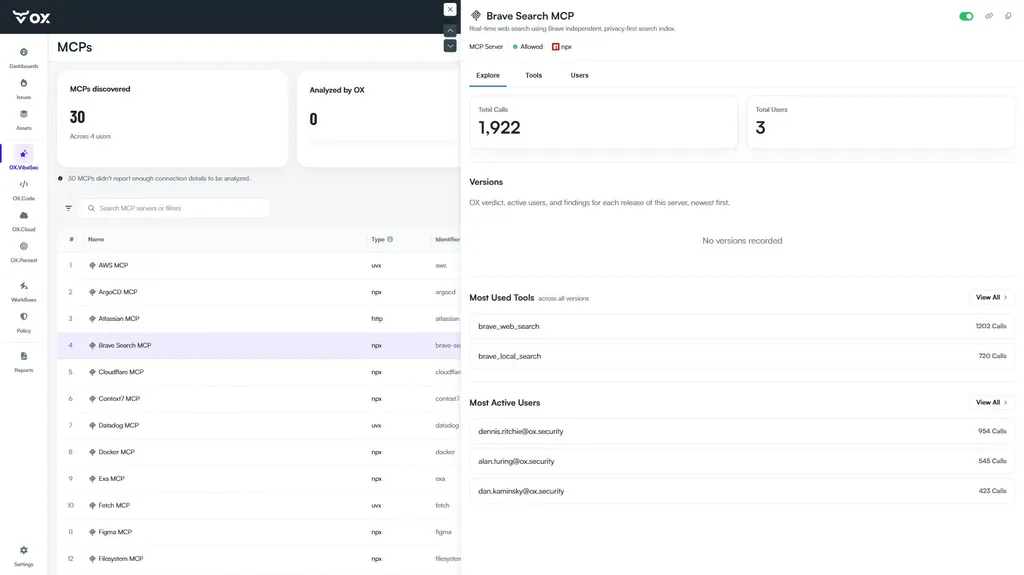
- Skill and MCP Scanning: Every skill is inspected for malicious instructions and hidden behavior, and every MCP server gets a verdict, assessed version by version, with the users exposed.
- Full AI inventory: MCPs, skills, external SaaS (CLI, SDK and API used by agents) and models each with a verdict and the reasoning behind it.
Secure agent activity: guard every agent action in real time.
- Policies at the point of action: Prompts and tool calls across CLIs, SDKs, MCPs and skills are evaluated as they happen, then allowed, flagged or blocked.
- Risky agent behavior: Destructive actions (such as database deletion, file system deletion, etc.), identity abuse, data leakage and unsafe code execution and more.
- External attacks: Prompt injection, agent hijacking and more.

Every block, on the record
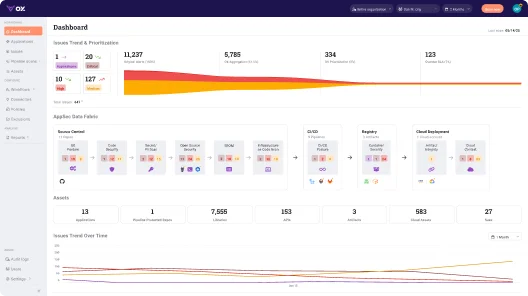
This is the part that changes the conversation with management. Every flag or block across all three layers opens an OX issue in the queue AppSec already works from. Each one shows the application it would have hit, that application’s criticality, the team involved, and whether the action was detected or blocked.
The developer sees a moment. You see the record.
Observe first, enforce on your terms
Teams don’t have to choose between adoption and control. In detect mode, the agent is alerted, the user keeps working, and AppSec gets the issue. When the evidence shows real risk, one toggle switches to prevent mode, and the agent is blocked with the same issue kept as a record of what was stopped.
What that looks like in practice
Picture a vendor’s deployment MCP that can create, update, and delete applications in production infrastructure. Today, VibeSec already tells security which developers are connected to it, which version each one runs, and whether that version carries a known issue, like an older release that exposes access tokens in tool responses.
Now add agent activity. A developer asks their agent to clean up a stale staging environment. The agent, working fast, calls the MCP to delete an application, and the target is a production service tied to a business-critical app.
In detect mode, the agent is alerted and the developer keeps working. AppSec gets an OX issue showing the attempted deletion, the application it would have hit, how critical that application is, and the team involved. After a few weeks of issues like that, the team doesn’t need to be convinced. They flip the toggle, and the next attempt is blocked before it lands.
Either way, there’s a record. That’s what you take to management.
From silent prevention to provable control
The goal isn’t to slow down how anyone uses AI. It’s to make sure that when someone asks what AI security is actually doing, you have a real answer.
Inventory tools tell you what’s installed. OX tells you what the agent did, which application it would have hit, and how much that application matters. And because VibeSec sits at the front of the OX platform, the risk it stops at the prompt connects to the same evidence OX Code, OX Cloud and OX Agentic Pentester use downstream.
Unified AI policies (in beta) will span VibeSec and OX Cloud: one policy, from the user’s laptop to the cloud account.
Want to see what your AI agents are doing across your org? Sign up for a demo of OX Security today.