

TL;DR
- AI security in AppSec expands the scope from scanning application code to also securing pretrained models (as dependencies), vector databases (storing embeddings and sensitive data), inference APIs (exposing model outputs), and agent behavior (automated decision-making and tool use).
- AI-generated code, unverified models, and exposed vector stores are entering production systems, introducing supply chain and data exposure risks.
- The National Institute of Standards and Technology (NIST) classifies pretrained models and vector databases as high-risk components that must be secured like external dependencies.
- Traditional AppSec tools do not correlate code, pipeline, and runtime signals, making it difficult to trace how vulnerabilities are introduced and exposed.
- OX Security is a security platform that correlates these signals into unified attack paths, traces risks to their originating code or configuration, and enforces prevention during AI code generation through VibeSec integrations with tools like GitHub Copilot and Cursor.
You’ve shipped AI features. Your developers are using Copilot, Cursor, maybe internal LLMs. Code is moving faster than ever, and your existing AppSec controls were not built for this.
The McDonald’s McHire breach wasn’t sophisticated. Default passwords. A broken access check. 64 million job applicants exposed. The AI did exactly what it was supposed to. Nobody was watching the system around it.
Sound familiar? Because that system looks a lot like yours.
I’ve spent time working with AppSec teams navigating exactly this: pipelines full of AI-generated code, tooling that wasn’t designed for it, and a growing vulnerability backlog. In this guide, I’ll break down what AI security actually means at enterprise scale: the new attack surface AI creates, the blind spots in your existing tools, and what securing AI-driven development actually looks like in practice.
What is AI security, and what makes it different?
AI security in AppSec focuses on protecting the code, configurations, queries, and dependencies created or selected by AI during the application lifecycle. Each of these can increase the application’s attack areas. These AI-generated elements behave like application code but often change faster and bypass traditional review steps. This makes AI security an important AppSec concern rather than a secondary infrastructure issue.
What makes AI security different from classic application security is the nature of the risks. Traditional AppSec focuses on code, dependencies, and configurations. AI introduces new risks not only in the deployed service but also throughout the development pipeline.:
- model behavior that can be misdirected by crafted inputs
- vector databases that store embeddings, attackers can poison
- agentic actions that combine tools and external systems in ways developers do not always anticipate
Effective AI security across pipelines relies on three principles:
- Provenance validation across models, artifacts, and training dependencies.
- Exploitability-aware triage that maps findings to real attack paths rather than long CVE lists.
- Prevention at creation time, ensuring unsafe logic, prompts, or configurations never enter CI/CD.
These fundamentals define the minimum controls needed to secure AI-driven pipelines as they progress through fast, cloud-native build and deployment cycles.
Why Traditional AppSec Thinking Breaks Down When AI Enters the Pipeline
Your pipeline was designed around predictable inputs — human-written code, known dependencies, repeatable builds. AI blew that assumption apart in four specific ways:
1. AI-generated code merges before anyone reads it LLM-generated functions, SQL queries, and API wrappers land in pull requests at a pace no manual review process can match. By the time your scanner flags something, it’s already in your build.
2. Pipelines amplify risk automatically Model artifacts get pushed to registries without integrity checks. Inference APIs ship without threat modeling. A single poisoned artifact can propagate from build to production without a single human touchpoint.
3. Your existing tools are flying blind SAST doesn’t understand agent decision paths. SCA can’t tell you if a vector database was poisoned. Secret scanners miss prompt injection buried three layers deep in a data store.
4. Visibility breaks across the full chain Without lineage across code → model → image → API → runtime, your team only sees isolated symptoms — never the full attack path.
The result is a blind spot that runs the entire length of your pipeline, from the moment a developer accepts a Copilot suggestion to the inference endpoint serving your customers. That’s not a gap you close by adding another scanner.
Where DevSecOps Pipelines Break Under AI Workloads
Cloud-native pipelines were built around deterministic processes: repeatable builds, predictable code changes, and stable artifacts. They were not built to handle AI systems that generate code, create new model artifacts, or change their inference behavior over time. As AI becomes part of everyday development, DevSecOps teams encounter new failure points where existing controls lose visibility and context. The sections below outline where these breakdowns occur and how they spread through automated pipelines.
1. Unvalidated AI Code and Auto-Generated Patterns Entering Pipelines
Newer LLMs generate complete functions, SQL queries, and API wrappers that land in pull requests without the scrutiny developers apply to their own code. These suggestions often include unsafe logic, unbounded inputs, hard-coded paths, or outdated libraries. Under time constraints, many merges happen before deeper review, which allows insecure patterns to enter the pipeline unchecked.
OX’s AI Security Agent breaks this chain by identifying and blocking these unsafe patterns at the moment they are created, before they move into the build system or contaminate downstream artifacts.
2. Model Artifacts and Training Assets Missing Integrity Checks
Cloud-native pipelines now handle model artifacts the same way they handle container images: automatically built, versioned, and pushed to registries. The problem is that many pipelines lack PBOM or SBOM validation, leaving no visibility into how a model was trained, what data influenced it, or whether an artifact was tampered with during packaging.
OX closes this gap by correlating PBOM and SBOM data with pipeline events, giving teams a verifiable lineage for every model and enabling early detection of anomalous or suspicious artifacts before they progress further in the pipeline.
3. AI-Driven APIs and Agents Deployed Without Threat Modeling
Inference APIs expose far more than static endpoints exposing the model’s internal behaviour, allowed tools, and data flows. When deployed without threat modeling, these interfaces create opportunities for stored prompt injection, privilege escalation, or unintended actions triggered by malicious input. Traditional scanners rarely see these risks because they occur inside model behaviour, not code.
- Inference endpoints expose prompt interfaces and embedded toolchains, creating points where attackers could manipulate inputs or exploit connected tools.
- Stored prompt injection is hard to detect once it’s buried in logs, data stores, or inputs.
4. SAST: Analysing First-Party Code
Static Application Security Testing remains important in AI-augmented development pipelines because it provides deterministic checks on the code that developers and models generates. As AI-generated snippets introduce new logic paths, SAST becomes the first line of defense for detecting issues before they enter the build stage.
5. SCA: Mapping Third-Party and Open-Source Risk
Software Composition Analysis helps teams understand the libraries and dependencies flowing through code, containers, and model pipelines. This now includes AI/ML libraries, training frameworks, vector-store clients, and base images. The difficulty lies in scale: SCA often provides extensive vulnerability lists without clarifying which issues can actually be reached or exploited in runtime.
The 2026 AI Threat Landscape that DevSecOps Must Adapt To
AI has altered the threat model inside cloud-native environments. Attacks now target model behaviour, prompt interfaces, vector databases, and the artifacts flowing through CI/CD systems. These threats evolve faster than traditional security workflows, forcing DevSecOps teams to adjust how they detect and interpret risk.
Daily AI-Powered Attacks
The Trend Micro State of AI Security Report (1H 2025) notes that 93% of security leaders expect daily AI-driven attacks. These attacks automate reconnaissance, exploit generation, and evasion, compressing the time defenders have to react.
This changes the constraint: it’s no longer just detection accuracy, but continuous validation of attack paths. OX Security addresses this with its Agentic Pentester, which validates these emerging attack paths through continuous human-like simulation, mapping how an issue can actually be exploited and tracing it back to the exact repository, file, and commit where it originated.
Prompt Injection and Stored Prompt Risks
Prompt injection is no longer limited to user-facing text fields. Attackers now embed instructions inside logs, documents, datasets, and vector-store entries. Trend Micro reports that stored prompt injection can bypass safety controls entirely once the model fetches the poisoned content.
- Hidden instructions can alter model output or workflow logic.
- Attacks persist across pipeline stages and environments.
Insecure Vector Databases and Model Stores
Vector databases have become an attractive target because they often ship with open ports or weak authentication. Trend Micro’s 2025 research found over 200 exposed Chroma or similar vector DB instances allowing unrestricted read/write access.
- Exposed DBs lead to poisoning, unauthorized updates, or embedding manipulation.
- Compromised vectors directly influence inference quality and behavior.
Outdated Libraries in AI Supply Chains
AI systems depend on large stacks of ML libraries, training utilities, and transitive dependencies. Trend Micro highlights that many AI supply-chain components remain years out of date, yet appear in production systems without scrutiny.
- Unpatched ML frameworks introduce silent model-level vulnerabilities.
- Complex dependency trees hide issues that traditional scanners rarely identify.
What DevSecOps Must Fix for AI-Driven Development
AI workloads reveal problems early, which they then amplify as they pass through automated build systems. Effective controls must understand how AI-generated logic behaves across code, model artifacts, images, and inference workloads. The points below highlight where pipelines lose context and where the most meaningful fixes begin.
1. Validate AI Code Before It Reaches CI
Many vulnerabilities begin at the moment an LLM generates a suggestion. AI-generated suggestions may appear correct, but often include unsafe assumptions, weak validation, or misconfigured API usage that pass initial review and enter the pipeline. This is where traditional AppSec breaks, by the time code reaches CI, the risk is already embedded.
This AI-native AppSec approach, powered by OX VibeSec, enforces guardrails directly inside AI coding assistants, preventing insecure patterns at the moment of generation and ensuring code is secure before it ever reaches version control.
2. Introduce PBOM/SBOM for AI Models and Dependencies
Model artifacts behave like supply-chain assets. Without knowing where they came from or how they were built, teams cannot rely on the final output.
- Generate PBOM/SBOM records that describe provenance, dependencies, and version history.
- Track training data influence, licensing requirements, and any transformations applied in the pipeline.
- OX unifies SBOM and PBOM and ties them to pipeline events, giving each model or image a verifiable lineage.
This shifts model handling from trust-based to evidence-based.
3. Add Runtime-Aware Checks to Inference APIs
Inference endpoints introduce behaviors that traditional scanners cannot interpret, such as prompt chaining, tool invocation, and model-driven decision logic. To manage this, teams need controls that go beyond static validation:
- Validate input boundaries and privilege rules at the code level
- Monitor runtime behavior of inference services (e.g., unexpected tool use, response deviations)
- Correlate runtime behavior with code, model artifacts, and configurations
- Detect divergence early, before it becomes an exploitable condition
Without this linkage, runtime issues remain isolated signals with no clear path to remediation.
Here, platforms like OX Security extend CNAPP capabilities by correlating runtime observations with code and pipeline context, allowing teams to trace exposures back to their origin instead of treating them as standalone runtime alerts.
4. Harden Cloud-Native Deployments of Models
Models eventually run inside containers, serverless functions, or managed gateways. Each of these layers introduces its own risks, ranging from outdated ML libraries to insecure runtime parameters. Treating these deployments like any other production workload is necessary, but they require ML-specific context for issues that general scanners overlook.
OX brings together container scanning, IaC evaluation, and runtime telemetry to identify the weaknesses that have operational impact, not just those that appear in static scans.
How OX Fixes AI Security Gaps Across Code, Pipelines, and Runtime
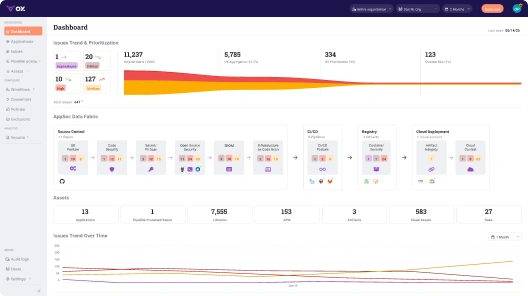
OX Platform acts as a Unified Control Plane, replacing fragmented tools with a Unified AppSec Platform that centralizes critical processes to eliminate blind spots from AI coding to runtime. The PBOM (Pipeline Bill of Materials) ties it all together, tracking every component, dependency, and configuration change across the pipeline in real time, giving DevSecOps a complete view of how AI-generated changes evolve across environments and where exposure becomes real.
1. AI-Native Security Engineering: Stop Unsafe AI Code Before It Reaches Your Pipeline
Unsafe AI-generated logic appears first in the IDE, not in production. OX shifts security left by enforcing guardrails directly in AI-powered coding workflows, which:
- Blocks insecure patterns, risky prompts, and unsafe queries as they are written.
- Enforces organizational policies inside IDEs and AI coding tools.
- Reduces downstream pipeline noise by blocking flawed logic from entering CI in the first place.
2. AI Data Lake for Contextual Decision Making
Understanding AI-driven risk requires unifying signals scattered across development and deployment. They need a unified foundation that brings all signals together and interprets them in context. This is exactly what an AI Data Lake provides.
With this foundation in place, developers can:
- Aggregate code activity, pipeline metadata, SBOM/PBOM entries, image scans, API endpoints, and runtime behaviour.
- Assess exploitability, reachability, and business impact, and not just detect a vulnerability.
- Drive exposure-based prioritization so teams address the issues that truly matter to production.
3. Trace Every Runtime Exposure Back to the Code That Caused ItEnd-to-End Correlation Across Code → Pipeline → Image → API → Runtime
AI risk changes as artifacts move through build and deployment (code → pipeline → image → API → runtime), and understanding this evolution requires full lineage across the SDLC. OX provides this continuity by linking commits, model artifacts, container images, deployments, and runtime behaviour, revealing where unsafe code, flawed model logic, and cloud misconfigurations intersect.
By correlating these elements end to end, OX highlights complete attack paths rather than isolated alerts, making it clear where a weakness originates and at what point it becomes genuinely exploitable.
4. Unified View for SAST, SCA, SBOM, PBOM, and Inference Risk
Managing AI and software risk becomes far more complex when findings are spread across separate tools and dashboards. To make sense of these signals, teams need a unified layer that brings traditional security data and AI-specific insights together.
OX provides that unified view by:
- Consolidating SAST findings, Software Composition Analysis, artifact provenance (SBOM/PBOM), and model/inference-layer risks.
- Highlighting AI-specific issues such as prompt injection, agent misuse, and model tampering.
- Eliminating tool silos to reduce triage overhead and strengthen response accuracy.
| Pillar | Primary Function | What It Does |
| OX VibeSec | Prevention | Stops insecure AI-generated code at the moment of creation, before it reaches CI |
| OX Code | Detection | Pinpoints risk across code, dependencies, and pipeline artifacts with exploitability-aware triage |
| OX Cloud | Remediation | Traces runtime exposure back to its origin in code or configuration, eliminating risk at the source |
| OX Agentic Pentester | Validation | Continuously simulates real attacker techniques to confirm which findings represent genuine attack paths |
Example Workflow: Stepwise Hardening of an AI Model Pipeline with OX
The following scenario demonstrates how AI-generated vulnerabilities are detected and stopped as they travel through a cloud-native development workflow. Each step corresponds to a real action taken inside the development environment, with screenshots captured directly from the process.
Step 1: Getting started with OX Security
- Log in to OX Security and create an organisation if one does not exist.
- Log in to OX Security and connect your source control provider (GitHub, GitLab, Bitbucket, or Azure Repos).
- Step-by-step guide to get started. Link
Step 2: Install and configure the OX Security VS Code extension
- Open Visual Studio Code → Extensions.
- Search for “OX Security”.

- Install the extension and enable Auto Update.
- Follow the official setup guide and configure the extension using the API key created on the platform.
Step 3: Detect/Block Unsafe AI‑Generated Code Directly Inside the IDE
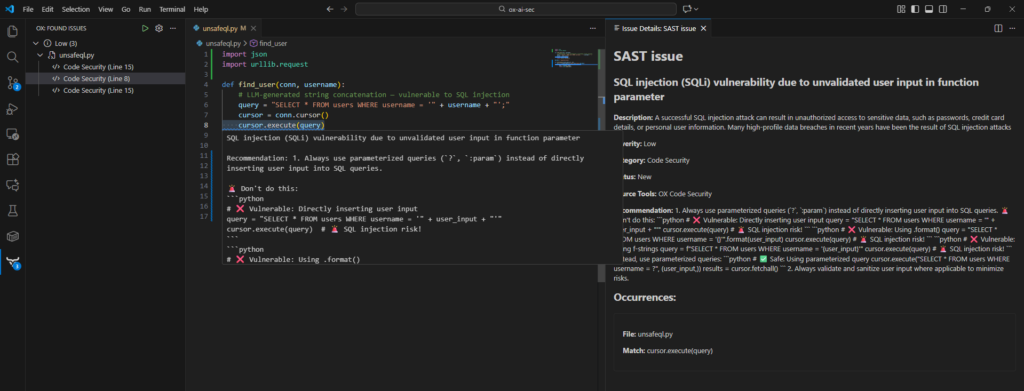
As you write code or paste AI-generated snippets, the OX Security extension performs real-time static analysis, automatically flagging unsafe patterns and highlighting the exact lines where the issues occur.
Common risks identified include:
- SQL injection vulnerabilities, such as unsafe string‑based query construction
- Information leakage, including secrets or tokens embedded in code
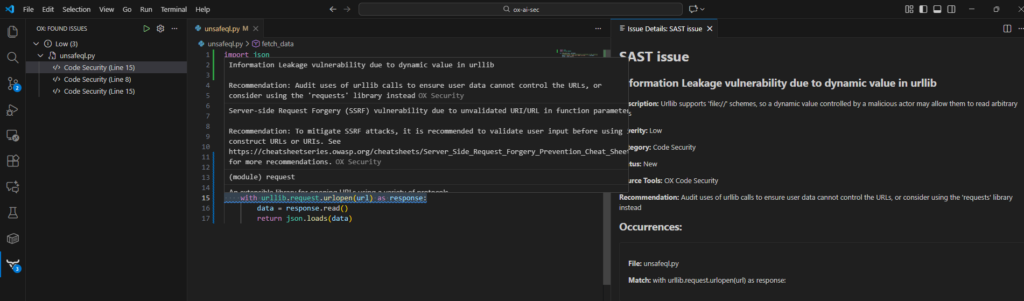
These warnings appear instantly in the editor, ensuring vulnerable code is caught long before it reaches production.
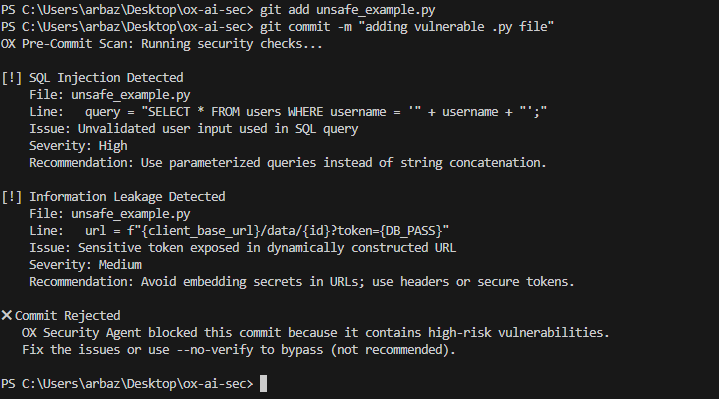
Attempting to commit the file activates policy-based blocking. The pre-commit scan shows:
- Detailed diagnostics of the SQL injection vector
- A warning about dynamic URL secret exposure
- A rejected commit status, blocking unsafe logic from entering the repository
Step 4: PBOM Validation: Securing the Code Journey
Configure the CI pipeline to perform PBOM (Pipeline Bill of Materials) validation. While a standard SBOM lists ingredients, the PBOM tracks the full code journey, providing verifiable lineage for every AI-generated artifact before it advances in the pipeline.
- Create the CI workflow
For example, using GitHub Actions, create a .github/workflows/ci.yml file:
name: CI Demo
on: [push]
jobs:
  build:
    runs-on: ubuntu-latest
    steps:
      - uses: actions/checkout@v4
      - name: Build minimal image
        run: |
          docker build -t ox-demo:pr-${{ github.run_id }} .
      - name: Install syft
        run: |
          curl -sSfL https://raw.githubusercontent.com/anchore/syft/main/install.sh | sh -s -- -b /usr/local/bin
      - name: Generate SBOM
        run: |
          syft packages ox-demo:pr-${{ github.run_id }} -o json > sbom.json
      - name: PBOM validation (simulate fail)
        run: |
          # simple validation script: fail if SBOM contains 'openssl' or if no 'provenance' field
          if grep -q "openssl" sbom.json || ! grep -q "provenance" sbom.json; then
            echo "PBOM validation failed: missing trusted provenance or risky dependency found"
            exit 1
fi- Commit and push your branch to the repository.
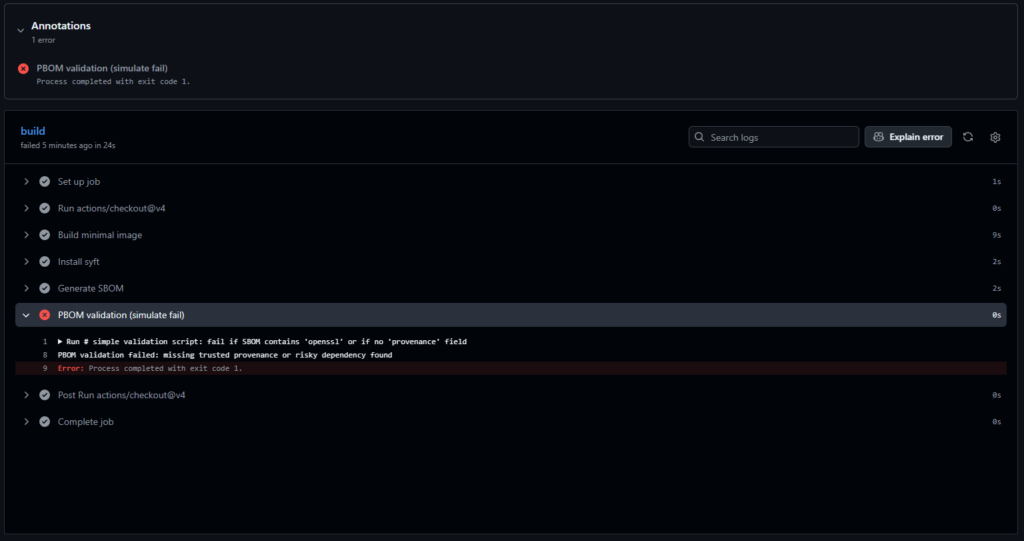
- The CI workflow runs automatically on the pushed branch.
- The PBOM/SBOM validator checks the model artifact for required provenance metadata.
- If metadata is missing or incomplete, the workflow marks the validation step as failed, ensuring unverified artifacts do not advance in the pipeline.
Step 5: PBOM/SBOM Enforcement in the Model Registry (OX Control)
- Enable PBOM/SBOM generation in CI (OX integrates automatically with GitHub Actions, GitLab CI, Jenkins, or any pipeline).
- Connect your model registry (S3, GCS, MLflow, HuggingFace Spaces, container registry, etc.) through the OX integration panel.
- OX enforces PBOM verification automatically when artifacts arrive.
Step 6: Data-Store Hardening: Vector Database & Embedding Risks (OX Detection)
- Connect vector DB credentials or cluster endpoints in the OX integrations page.
- Enable the AI Data Store Monitoring module.
- OX automatically records unauthorized writes, poisoning attempts, and schema deviations.
Step 7: Runtime Protection for AI Inference APIs (OX Runtime Module)
OX flags and blocks suspicious runtime prompts that attempt to bypass model safeguards.

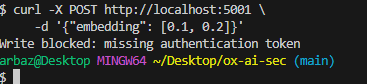
- Deploy OX Runtime Agent or connect logs/events via OX’s API gateway integration.
- Enable inference monitoring for deployed models.
- View prompt-level alerts directly in the OX dashboard.
OX then correlates these runtime anomalies back to code changes, PBOM lineage, and model configurations.
Best Practices for AI Security in Application Pipelines
AI-driven development introduces new areas of exposure: models, vector stores, prompts, agent actions, and inference workloads, all of which evolve as code moves into containers and runtime systems. Security practices must account for this movement and provide context across every stage of delivery.
The following practices represent the controls teams rely on to keep pipelines predictable and safe.
1. Shift security left by validating AI-generated changes before CI/CD
AI-generated logic introduces risky patterns that move quickly into automated pipelines. Running checks inside IDEs ensures unsafe queries, weak validations, and credential misuse never enter CI.
OX embeds its AI Security Agent at this stage, blocking insecure patterns at creation and lowering the noise that usually appears later in builds.
2. Maintain accurate PBOM/SBOM data for every model and container
Models and containers behave like supply-chain components; teams need clear lineage, dependency trees, and metadata to trust what they deploy.
OX automatically generates and unifies PBOM and SBOM information across pipelines and runtime, allowing teams to validate provenance at every stage.
3. Monitor for runtime drift across model workloads and containers
Cloud-native environments evolve after deployment. Libraries, permissions, and behaviour may drift from the defined build.
OX traces code → pipeline → image → runtime, revealing deviations that highlight tampering or misconfiguration, while filtering out noise unrelated to real exposure.
4. Correlate vulnerabilities back to their originating commit or team
Remediation is only efficient when ownership is obvious. A finding tied to a specific change, pipeline run, or model artifact moves faster through triage.
OX links every issue to its exact source: repository, commit, model version, or pipeline event, giving teams clarity and accountability.
5. Automate repetitive security actions for consistency at scale
Common issues like outdated base images, unpinned tags, or unsafe defaults should be corrected automatically.
OX provides no-code automation workflows that can open pull requests, block builds, or enforce policies, helping organizations operate secure pipelines across hundreds of services.
6. Prioritise findings based on exposure, not volume
AI-powered systems generate extensive results, where just a few issues have real impact.
OX’s AI Data Lake correlates code, artifact metadata, API endpoints, and runtime signals to highlight the vulnerabilities that are actually exploitable or reachable, enabling focused remediation.
Conclusion
Today, AI systems are responsible not only for generating production-ready code but also for choosing dependencies and influencing how applications behave at runtime. Components such as models, prompts, and inference pipelines now travel through the same development and deployment workflows as traditional source code. Securing this environment requires visibility from the moment an AI-generated change appears in the IDE to the moment it runs as an inference service in production.
This article outlines the failure points introduced by AI-generated code, model-packaging pipelines, exposed vector data systems, and inference APIs. It describes how these elements shift risk across build and deployment workflows and the threat patterns shaping 2026, along with the operational gaps DevSecOps teams must correct to maintain dependable, secure delivery pipelines.
Many weaknesses originate from the fragmentation of traditional tools such as SAST, SCA, image scanners, and pipeline validators, which operate independently and cannot recognize how unsafe prompts, tampered model artifacts, misconfigured containers, or overly permissive API gateways combine to create an exploitable condition. Organisations need a platform that observes every stage of the AI-enabled pipeline and evaluates risk based on actual exposure, not a stack of unrelated alerts.
OX provides this capability by enforcing policy at code creation, generating and validating PBOM and SBOM data during builds, mapping changes across images and deployments, and analysing runtime behaviour through a unified AI Data Lake. Instead of isolated findings, teams see complete attack paths and understand where risk originates and how it propagates.
As we move into 2026, the organisations that succeed will be the ones that see AI-powered development as the new normal and rely on constant awareness instead of one-time checks. Development will move faster, AI components will get more complex, and more parts of the system will be exposed. Teams that catch issues early, track the source of every artifact, and connect signals across code, pipelines, images, APIs, and runtime will be able to release reliable software at scale. With exposure-aware security platforms like OX, this becomes possible without slowing delivery.
)