Summary
90% AppSec alert noise reduction via OX code-to-runtime mapping.
A leading Mobility-as-a-Service (MaaS) transformed its security operations by moving from reactive, high-noise scanning to a unified platform that maps runtime exposures directly back to the source code. Facing a swamp of low-context vulnerabilities that threatened to stall innovation, the organization adopted an AI-native approach to secure its application lifecycle. By establishing a complete Pipeline Bill of Materials (PBOM) and moving beyond legacy scanners, they eliminated 90% of irrelevant alert noise and empowered their engineering teams to address risks at the moment of creation. The security leadership team highlights the operational shift:
“OX has had a significant impact on our security operations. We’ve seen a dramatic reduction in wasted time and resources spent on irrelevant vulnerabilities, allowing us to focus on the threats that truly matter”.
The Catalyst
The "Swamp" of Low-Context Alerts
The MaaS provider faced significant difficulties with excessive, low-context vulnerabilities and ineffective prioritization from their previous static code analysis tool. Their security operations were bogged down by irrelevant alerts and inefficient resource allocation.
As engineering teams embraced AI-driven development (VibeCoding) to accelerate the delivery of mobility services, the volume of security debt skyrocketed. This created a massive operational bottleneck, where manual triage consumed critical resources and obscured the true risk posture of their software supply chain. Without a unified control plane, the organization was trapped in a reactive cycle, chasing “ghost” vulnerabilities while critical risks remained hidden in the noise.
The Strategy
Unifying Security Engineering with a Code-to-Runtime Plane
To regain control, the provider adopted OX Security’s unified platform to integrate various analysis tools and offer intelligent, context-aware prioritization of vulnerabilities. This strategic switch enabled more focused and effective risk management by moving from “finding bugs” to prevention at the point of origin.
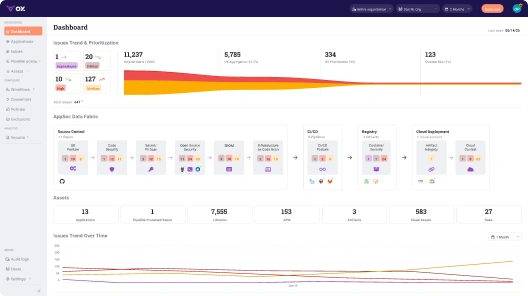
By implementing OX VibeSec and OX Code, they established a comprehensive PBOM that ensured every component of their software supply chain was verifiable and secure. This move allowed the team to move beyond legacy scanning categories, providing a single source of truth that unified security data from the developer’s desktop through to the production environment.
The Transformation
Mapping Runtime Exposure back to the Source
The turning point was OX’s ability to provide environment-aware context that maps runtime exposures back to the exact line of code in real time. Instead of treating security as a post-deployment hurdle, the platform bridged the gap between production environments and the codebase.
This transformation enabled Vibe Security, allowing the team to pinpoint reachable, high-impact risks with surgical precision. By tracing vulnerabilities from the cloud back to the source, the security team moved from a state of “alert fatigue” to one of actionable intelligence. Developers no longer had to guess which fixes mattered; they were provided with the exact context needed to remediate risks before they could be exploited, effectively stopping security debt at the point of origin.
The Results
Intelligent Prioritization and Hardened Defenses
By moving to an integrated, AI-native approach, the MaaS leader achieved measurable gains in operational efficiency and security posture:
- Improved Efficiency: Significant reduction in irrelevant alerts and false positives, cutting overall noise by over 90%.
- Enhanced Security: Better prioritization of critical vulnerabilities based on contextual, environment-aware information.
- Optimized Resource Allocation: More effective use of security resources by targeting only high-impact, reachable vulnerabilities.
- Drastic Reduction in MTTR: Tracing production risks back to the source in seconds allowed the organization to slash their mean time to remediate (MTTR) critical vulnerabilities.
Key Takeaways
Strategic Lessons for Security Leaders
- Visibility Must Be End-to-End: A unified platform that connects code to runtime is essential for identifying hidden risks in modern, AI-native software supply chains.
- Visibility Must Be End-to-End: A unified platform that connects code to runtime is essential for identifying hidden risks in modern, AI-native software supply chains.
- Context is the Ultimate Filter: To stop “chasing ghosts,” organizations must move beyond generic scanning to environment-aware intelligence that predicts real risk.