The world of application security (AppSec) evolves with every passing year. In 2025, organizations will face new challenges as the attack surface grows wider and threats become more sophisticated. As software development accelerates, balancing innovation and security will remain at the forefront for AppSec and DevOps teams. Here are my five predictions for application security trends and priorities in 2025.
1. Comprehensive Attack Surface Management Will Become Table Stakes

As organizations increasingly adopt cloud-native architectures and microservices, the application attack surface will continue to expand. Traditional tools and approaches that focus on static vulnerabilities won’t suffice.
In 2025, we’ll see organizations demand comprehensive attack surface management (ASM) solutions that map not just application vulnerabilities but also dependencies, APIs, containers, and cloud environments. These solutions will effectively correlate risk across development and runtime environments, providing full-stack visibility.
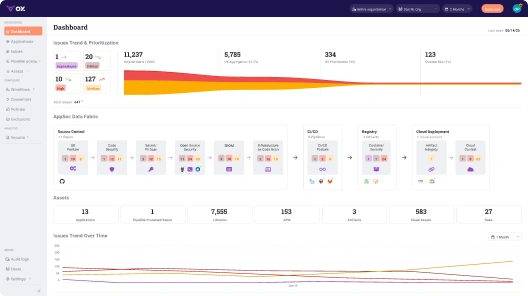
The move toward context-aware application security posture management (ASPM) tools will also accelerate. These platforms will enrich vulnerability data with contextual insights like reachability, exploitability, and business impact, helping teams focus on the critical 5% of vulnerabilities that matter most. ASPM will shift from a “nice-to-have” capability to an essential part of any organization’s security toolkit.
2. Secure Development Practices Will Gain New Urgency

Developers are already stretched thin with tight deadlines and fast development cycles. Adding too many security checks to their workflows has historically been perceived as a disruption. But in 2025, organizations will double down on integrating security into development processes — not as an afterthought but as an embedded, seamless practice.
While “DevSecOps” is still far from a reality for most organizations, the concept of “secure-by-default development” will start to take hold, facilitated by a new wave of technologies that are more developer-friendly yet security-conscious. These tools (OX Active ASPM included, of course) will integrate security guardrails directly into developer IDEs and CI/CD pipelines, providing automated feedback and actionable insights in real-time. These more-streamlined tools will reduce security-developer friction and help developers fix flaws as code is written rather than having issues surfaced late in the development cycle when deadlines are looming and tensions are high.
Automation will also play a larger role in DevOps’ workflows, as tools’ automated capabilities prove more trustworthy. Tasks like dependency scanning, secret detection, and secure configuration checks will be fully automated, allowing developers to focus on deploying apps rather than interpreting security findings. This emphasis on frictionless security will help organizations bridge the gap between AppSec and development teams.
3. Regulatory Pressure Will Drive Supply Chain Security

The software supply chain is a growing target for attackers, and 2025 will bring heightened regulatory scrutiny to secure it. Governments worldwide are introducing mandates to ensure organizations take responsibility for securing their software supply chains. The U.S. Executive Order on Improving the Nation’s Cybersecurity and the EU’s Cyber Resilience Act are just the beginning of what’s likely to be a long line of regulations.
Organizations will need to adopt measures like Software Bill of Materials (SBOMs), strict dependency management, and automated artifact integrity checks to meet compliance requirements. Real-time monitoring of supply chain components — including open-source libraries, APIs, and CI/CD workflows — will be a priority for organizations that want to avoid being in the mainstream media headlines as a software supply chain attack victim.
Expect to see vendor offerings combine visibility and governance into the proverbial “single pane of glass.” This integrated offering will help enforce secure development processes across the entire supply chain and provide audit-ready reports that demonstrate alignment with compliance requirements.
4. AI and ML Will Redefine Threat Detection

Artificial intelligence (AI) and machine learning (ML) have already transformed how we approach threat detection, but 2025 will be the year when AI-driven security truly takes center stage. With the volume of vulnerabilities and alerts continuing to grow, AI will become essential for prioritizing risks and automating responses.
Next-generation AppSec tools will use ML algorithms to detect patterns in developer behavior, identify anomalous activity in CI/CD pipelines, and predict which vulnerabilities are most likely to be exploited. For example, AI will help answer questions like:
- “Which code paths are most likely to lead to exploitation?”
- “What’s the potential blast radius of this vulnerability?”
Additionally, AI-powered auto-remediation will mature. Simple issues, like fixing misconfigurations or removing outdated dependencies, will be resolved autonomously, freeing up human teams to focus on complex challenges. However, organizations will also need to adopt robust oversight mechanisms to ensure AI tools don’t inadvertently introduce new risks.
5. Collaboration Will Take Center Stage in Risk Management

In 2025, we’ll see a continued push toward eliminating friction between AppSec, DevOps, and cloud security teams. Today’s fragmented workflows — where each team works independently with its own tools — create inefficiencies and increase the likelihood of critical risks slipping through the cracks.
Organizations will adopt unified platforms that centralize visibility and provide shared insights across teams. ASPM tools will play a pivotal role here, offering contextualized views of vulnerabilities and enabling real-time collaboration between teams.
Beyond tools, security teams should continue efforts to build cultures of collaboration. Rather than forcing security-centric tools and processes onto developers, security teams should focus on incentivizing DevOps to adopt secure practices, showing along the way how security-conscious coding actually increases velocity and improves adoption and usability.
Preparing for 2025
Application security in 2025 will be defined by proactive measures, context-aware tools, and seamless collaboration. Organizations that invest in visibility, automation, and secure development practices will be best positioned to protect their applications in an increasingly complex threat landscape.
As the software ecosystem evolves, two things remain clear: security cannot afford to be reactive, and security teams cannot continue to be seen as the internal adversary. Teams that embrace these trends and prioritize a holistic approach to AppSec can stay ahead of attackers (a.k.a., the true adversary) and build the resilient applications needed to succeed in the digital age.
Prepare for 2025 and try OX for free!