
TL;DR
- Runtime security tools observe and control workloads in production, monitoring containers, processes, and network activity to detect and manage risks that cannot be fully assessed before deployment.
- Most tools rely on low-level signals such as syscalls, anomalies, and policy violations. While effective at identifying suspicious behavior, these signals often lack clarity around which application is affected, who owns it, and whether the activity represents an exploitable risk.
- According to the 2025 State of Cloud Runtime Security survey of over 300 SecOps leaders, 63% of organizations use more than five cloud runtime security tools, yet only 13% can correlate alerts across systems, and 89% say current processes fail to detect active threats effectively.
- In large enterprises, runtime findings typically remain isolated from code scanners, CI pipelines, and dependency analysis. This forces AppSec teams to pivot across multiple tools to understand impact, ownership, and remediation paths.
- This gap has driven the need for runtime security that connects live signals with application context. lead with OX Cloud + Runtime Sensor as the named runtime products, with the correlation capability framed as the differentiator vs the other 4 tools in the article.
- This article reviews five runtime security tools used by enterprises in 2026 and explains where traditional runtime tooling falls short and how OX addresses those gaps.
Runtime security tools are critical for enterprise security teams because they provide visibility where real risk occurs: inside production environments. Organizations at scale operate thousands of containerized workloads across multiple Kubernetes clusters, clouds, and regions – exactly the environments where cloud-native security practices are foundational, not optional – and static analysis alone cannot reveal how applications, APIs, and dependencies actually behave once live. Runtime security tools address this gap by observing workloads in production and monitoring activity in real time.
The main challenge is prioritizing runtime alerts and converting them into security decisions that truly reduce risk. Most runtime security tools generate large volumes of low-level signals, including syscalls, policy violations, and anomaly detections. According to the Frost Radar’s Cloud/Application Runtime Security 2025 report, enterprises struggle to prioritize these findings because the alerts often lack application context, ownership information, and clarity about exploitability. As Kubernetes adoption grows and production environments become more heterogeneous, runtime alert volume continues to increase without improving security outcomes.
Runtime signals often appear inside Kubernetes clusters and production APIs, while critical context about source code, CI pipelines, container images, APIs, and dependencies remains siloed. AppSec teams expend significant effort manually correlating these alerts to understand impact, ownership, and business risk, slowing remediation and increasing exposure.
OX Cloud, part of the OX Platform, addresses this problem at the runtime layer. The OX Runtime Sensor – an eBPF-based component deployed on Kubernetes clusters, Linux hosts, and AWS EC2/ECS environments – observes which third-party libraries are actually loaded in memory in production, while OX Cloud correlates those runtime signals with source code, CI/CD pipelines, container images, APIs, and dependencies in a unified view. This enables runtime alerts to be assessed based on exploitability, reachability, ownership, and business impact, transforming runtime monitoring from a stream of low-level signals into governance-grade evidence that supports auditability and enterprise risk management.
What Application Runtime Protection Means
Application runtime protection focuses on understanding and managing risk based on how applications behave in production, rather than just monitoring infrastructure. By observing runtime activity, security teams can connect events to the applications, teams, and business outcomes they affect, helping prioritize the alerts that truly matter in large, complex environments.
Key aspects include:
- Monitoring execution behavior: tracking API usage, dependency loading, and runtime control flow to see how applications operate in real time.
- Linking events to impact: connecting runtime signals to application ownership and business risk, so teams can focus on what matters most.
In short, runtime events are meaningful only when they map to the applications, teams, and risks they affect.
Application vs Infrastructure Runtime Monitoring
Infrastructure runtime monitoring observes hosts, containers, and operating system behavior. It tracks processes, system calls, file access, and network activity, which can reveal suspicious activity but often cannot explain why it is important.
Application runtime protection builds on this foundation by looking at how requests move through services, which APIs are called, and which execution paths are actually reached. This additional context helps teams identify which application is affected, who owns it, and how the observed behavior maps to real business risk.
Limits of Signal-Only Detection
Most runtime security tools still rely heavily on signal-based detection.
- Syscall-only approaches miss abuse of legitimate application logic
- Anomaly detection struggles in environments with frequent deployments
- Alerts often lack exploitability or business impact context
The result is a flood of alerts that often lack clear context and are difficult for teams to prioritize effectively.
Visibility Beyond Detection
Effective runtime protection identifies what is affected, why it matters, and who is responsible, connecting runtime activity to the specific service, owning team, and the code or dependency that triggered it.
This level of insight enables faster remediation, reduces investigation time, and ensures runtime risk is traceable and auditable.
How Runtime Threat Detection Transformed After 2026
Runtime threat detection has advanced to keep pace with how systems operate at scale, with security teams continuing to monitor threats in real time. New methods are being adopted for collecting and interpreting data that accommodate containerized, highly dynamic environments.
From Static to Behavioral Detection
Static signatures remain useful for known threats, but often miss new execution paths and changing workloads. Behavioral and policy-driven detection evaluates how processes, containers, and services behave over time. Policies define expected behavior in production, improving coverage and providing a richer view of application activity.
Container and eBPF Adoption
For enterprises running Kubernetes at scale, container runtime security is crucial, enabling teams to detect and respond to threats as they occur in production. Tools now use eBPF to monitor process execution, network activity, and file access within containers, providing detailed visibility into application behavior without changing code or container images.
The Persistent Prioritization Challenge
Even with better visibility, runtime alerts often don’t show whether a threat is exploitable or how it affects application logic. Security teams must manually link these signals to source code, pipelines, and ownership data stored in separate systems. As a result, valuable runtime data rarely turns into actionable security decisions, leaving a critical gap in enterprise runtime security programs.
Key Takeaways
- Behavioral detection complements static signatures: Policies capture complex runtime activity.
- eBPF provides deep, code-independent visibility: Crucial for containerized Kubernetes environments.
- Prioritization remains critical: Alerts need context on application logic and business risk for actionable security decisions.
Key Capabilities to Expect from Runtime Security Tools in 2026
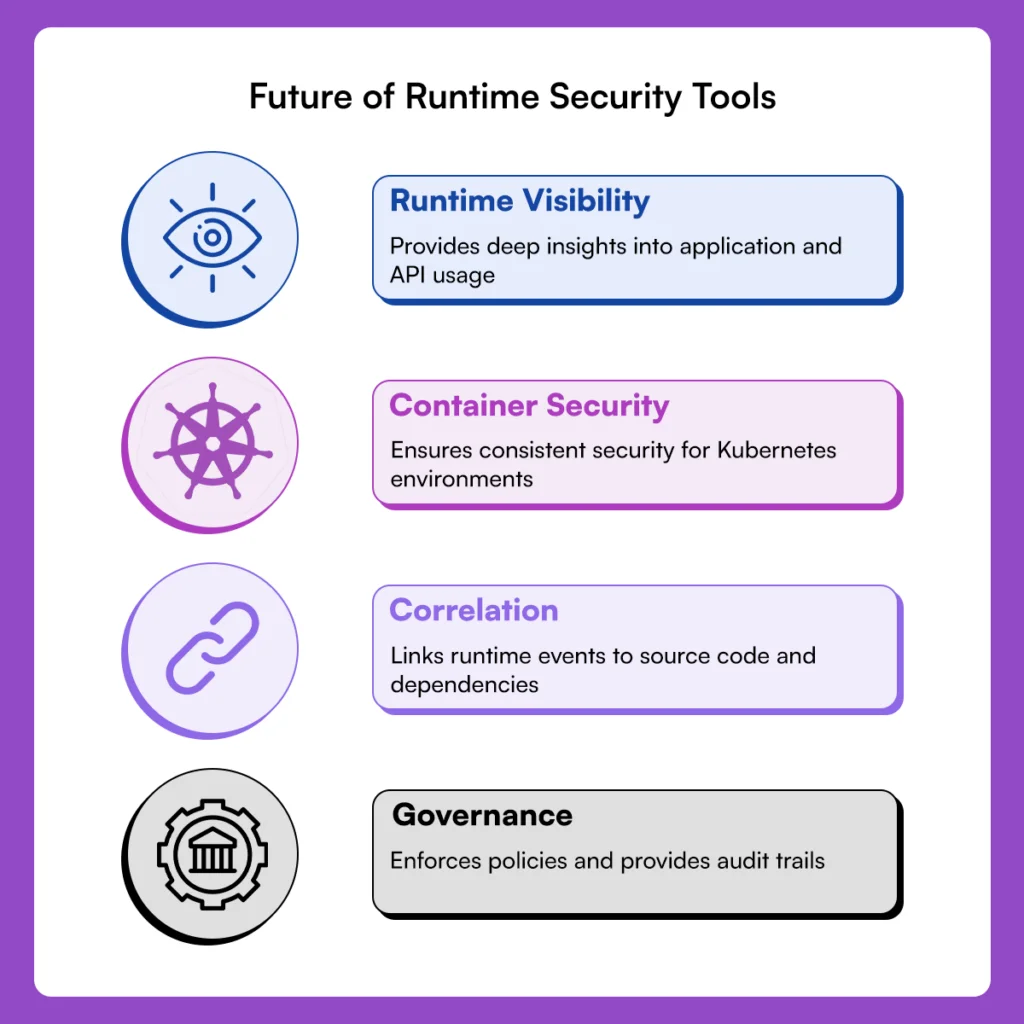
Enterprise security teams evaluate runtime security tools for their ability to transform production activity into actionable risk decisions while providing deep visibility. At scale, simply observing runtime events is insufficient: tools must provide context, correlation, and governance across multiple clouds, pipelines, and clusters.
Runtime Visibility with Application and API Context
Advanced runtime security tools go beyond low-level signals, showing which applications or services are affected and how their APIs are used. They track execution paths, highlight risky logic, and clarify ownership and impact, helping teams focus on the threats that truly matter.
Tools that integrate application context, as OX does through its correlation model, help security teams move beyond generic alerts and focus on impact.
Key capabilities:
- Identify the application or service involved in a runtime event
- Track API usage and execution paths
- Highlight risky behavior versus expected application logic
- Reduce investigation time through clear ownership and impact
Container Runtime Security at Kubernetes Scale
Tools must operate across multi-cluster Kubernetes environments without disrupting the workloads. They need to adapt to frequent deployments, ephemeral containers, and hybrid cloud environments while ensuring consistent security coverage.
Highlights:
- Support large, multi-cluster Kubernetes environments
- Observe container activity non-intrusively
- Maintain coverage for frequent deployments and ephemeral workloads
- Ensure consistent monitoring across cloud providers and hybrid environments
Correlation Across Code, Pipelines, and Dependencies
Linking runtime events to source code, CI/CD pipelines, and dependencies allows teams to perform root-cause analysis rather than reacting to low-level alerts. This correlation ensures security decisions are precise and actionable.
OX’s approach of linking runtime activity to upstream artifacts illustrates how correlation enables enforceable security decisions from runtime data.
Key capabilities:
- Map events directly to source code and repositories
- Identify pipelines or container images that introduce risk
- Connect behavior to open-source and internal dependencies
- Enable root-cause analysis, not just alerting
Governance, Auditability, and Risk Reporting
Beyond detection, runtime security tools must help security leadership demonstrate effective risk management and compliance. They should provide traceable evidence, enforce consistent policies, and present dashboards that reflect real production behavior.
Key benefits:
- Provide traceable evidence for audits and compliance
- Enforce consistent policies across teams and environments
- Provide risk posture insights tied to actual production activity
- Enable leadership to report security impact and progress confidently
Top 5 Runtime Security Tools for Application Runtime Protection in 2026
1. OX Security
Overview
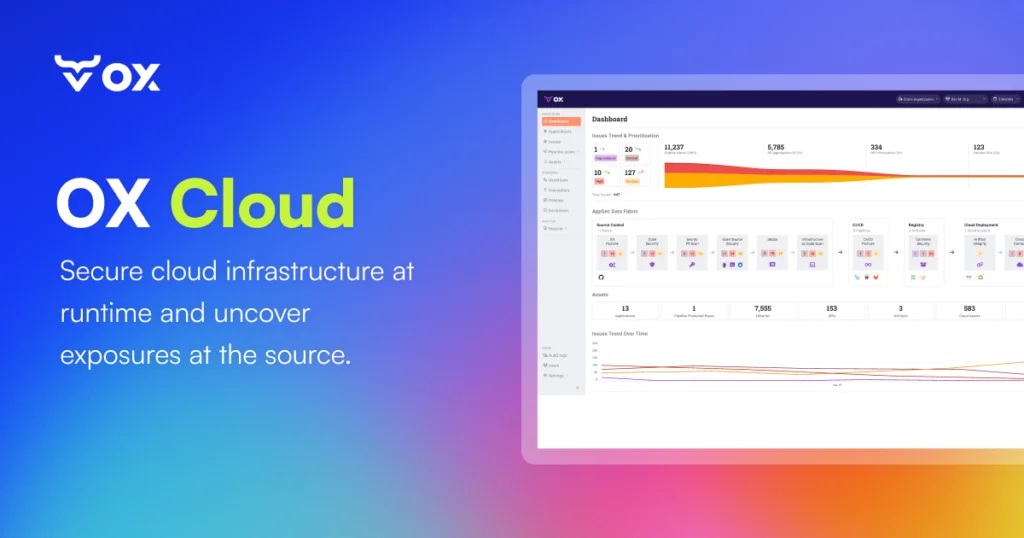
OX Cloud, part of the OX Platform, provides application-centric runtime security. The OX Runtime Sensor runs as an eBPF-based DaemonSet on Kubernetes (also Linux hosts, AWS EC2, AWS ECS) and detects which third-party libraries are actually loaded in memory at runtime – feeding reachability evidence into prioritization across the SDLC. Instead of treating runtime as an isolated detection layer, OX connects runtime behavior to upstream artifacts such as source code, CI pipelines, container images, APIs, and dependencies. This allows runtime events to be evaluated in the context of exploitability and ownership.
Key Features and Strengths
- OX Runtime Sensor uses eBPF to observe library loading at the kernel level on Kubernetes, Linux, EC2, and ECS – no code changes, no sidecars, no application restarts.
- OX Cloud correlates runtime activity with source code, CI pipelines, container images, APIs, and dependencies, and adds attack path mapping, drift detection, CSPM, and API exposure analysis.
- Runtime findings are prioritized based on exploitability and reachability, with library-loading evidence surfaced as a severity factor on the Active Issues page.
- AppSec and runtime data are presented in a single view, lowering investigation time and tool hopping.
- Governance and audit evidence are generated from real production behavior, not inferred controls.
Best For
- Enterprise AppSec and Product Security teams
- Organizations operating large, distributed microservices across multiple clusters and clouds
Pros
- Runtime alerts include clear ownership and application context.
- Prioritization focuses on issues that can actually be exploited in production.
- The platform supports policy enforcement and auditability at enterprise scale.
Pricing / Licensing
- OX follows an enterprise pricing model.
- Evaluation and trial options are available for large organizations.
2. Falco

Overview
Falco is an open-source runtime security tool that detects suspicious behavior at the container and host levels. It is maintained under the CNCF ecosystem and commonly used in cloud-native environments.
Key Features and Strengths
- Falco detects unexpected behavior by monitoring system calls at runtime.
- Detection rules are policy-driven and can be customized for different environments.
- The project benefits from a large open-source community and ecosystem support.
Best For
- Platform engineering and SRE teams
- Organizations seeking open-source runtime detection
Pros
- Provides detailed low-level detection of container and host activity with minimal performance impact.
- Integrates smoothly with Kubernetes and other cloud-native platforms.
Cons
- Limited application and API-level context
- Requires significant tuning to reduce noise in dynamic environments
Pricing / Licensing
- Falco is free and open-source.
- Optional commercial support through vendors
3. Aqua Security

Overview
Aqua Security provides enterprise runtime protection as part of a broader cloud-native security platform. Its runtime features focus on enforcing policies and controlling container behavior in Kubernetes environments.
Key Features and Strengths
- Aqua enforces runtime policies to restrict container behavior.
- The platform integrates tightly with Kubernetes and container registries.
- Runtime controls support compliance and regulatory requirements.
Best For
- Aqua is commonly used by regulated enterprises with strict runtime policy needs.
- It fits security teams focused on enforcement and compliance.
Pros
- Aqua provides mature and well-documented runtime controls.
- Commonly used across enterprise environments.
Cons
- Operational complexity increases at a large scale
- Runtime signals often require additional context for AppSec prioritization
Pricing / Licensing
- Aqua uses an enterprise subscription pricing model.
4. Sysdig Secure

Overview
Sysdig Secure provides runtime security based on deep system telemetry and observability. It emphasizes visibility and forensic analysis across containerized workloads.
Key Features and Strengths
- Sysdig captures detailed runtime telemetry from containers and hosts.
- The platform supports runtime forensics and post-incident investigation.
- Kubernetes-native architecture enables deep workload visibility.
Best For
- Infrastructure-focused security and operations teams
- Organizations prioritizing runtime visibility and forensics
Pros
- Sysdig provides extensive low-level runtime visibility.
- The platform is effective for detailed incident analysis.
Cons
Pricing / Licensing
- Less alignment with application-level risk ownership
- AppSec correlation often requires external tooling
- Enterprise SaaS pricing, based on the number of nodes or hosts being monitored
5. Cilium Tetragon

Overview
Cilium Tetragon is an eBPF-based runtime observability and enforcement tool designed for advanced Kubernetes environments. It provides fine-grained control over process and network behavior at the kernel level.
Key Features and Strengths
- Tetragon uses eBPF to observe process and network behavior with high precision.
- Policies can be defined to enforce runtime controls at the kernel level.
- The tool integrates well with cloud-native networking stacks.
Best For
- Tetragon is best suited for advanced platform engineering teams.
- It fits organizations with strong Kubernetes and Linux expertise.
Pros
- Provides highly detailed runtime visibility at the container and host level.
- Maintains low performance overhead through its eBPF-based design.
Cons
- High operational and learning complexity
- Limited built-in application security context
Pricing / Licensing
- Open source
- Enterprise support options available
Runtime Security Tool Comparison Table
Runtime security tools are often grouped together, but they serve very different purposes once deployed at scale. The table below compares how leading tools approach runtime security across context depth, prioritization, and enterprise governance.
| Tool | Primary Runtime Focus | Application Context | CI / Pipeline Correlation | Exploitability Prioritization | Governance & Auditability | Enterprise Readiness |
| OX Security | OX Cloud runtime protection with eBPF-based OX Runtime Sensor | Strong application, API, and dependency context tied to runtime behavior | Native correlation across code, pipelines, images, APIs, and runtime | Yes, prioritizes based on reachability and real production exposure | Built-in policy enforcement, evidence, and audit trails | Designed for large enterprises with complex pipelines |
| Falco | Container and host runtime threat detection | Limited, infrastructure-level signals only | No native pipeline or code correlation | No, alerts based on rule matches | Minimal, relies on external tooling | Suitable with tuning, but requires significant effort at scale |
| Aqua Security | Container and workload runtime enforcement | Moderate, focused on container behavior | Partial correlation within the platform | Limited, policy-driven rather than exploitability-driven | Strong compliance and policy features | Enterprise-ready with operational overhead |
| Sysdig Secure | Runtime visibility and forensics | Limited, primarily system-level context | No native AppSec correlation | No, prioritization left to operators | Reporting focused on operations and incidents | Strong for infra teams, weaker for AppSec ownership |
| Cilium Tetragon | Kernel-level runtime observability | Very limited, low-level execution focus | None | No, provides signals, not risk assessment | None built-in | Requires advanced platform expertise |
Insights from the Comparison
The comparison highlights a common challenge: most runtime security tools observe activity but don’t explain risk in application terms. By correlating runtime behavior with the software lifecycle, teams can transform alerts into enforceable, auditable decisions at scale.
How OX Enables Enforceable Runtime Security
Runtime security becomes meaningful only when it can be enforced, audited, and governed across the full software lifecycle. Traditional runtime security tools detect activity but lack controls to manage risk from AI-assisted development, automated pipelines, and fast-moving production environments.
OX Cloud, combined with the OX Runtime Sensor, treats runtime security as part of application security governance rather than an isolated detection layer. The Runtime Sensor supplies the live signal – which dependencies are actually loaded in production – and OX Cloud connects that signal to attack path mapping, drift detection, CSPM, API exposure analysis, and the upstream artifacts (code, pipelines, images) that introduced the risk.
Mapping Runtime Findings Back to Code, Pipelines, and Images
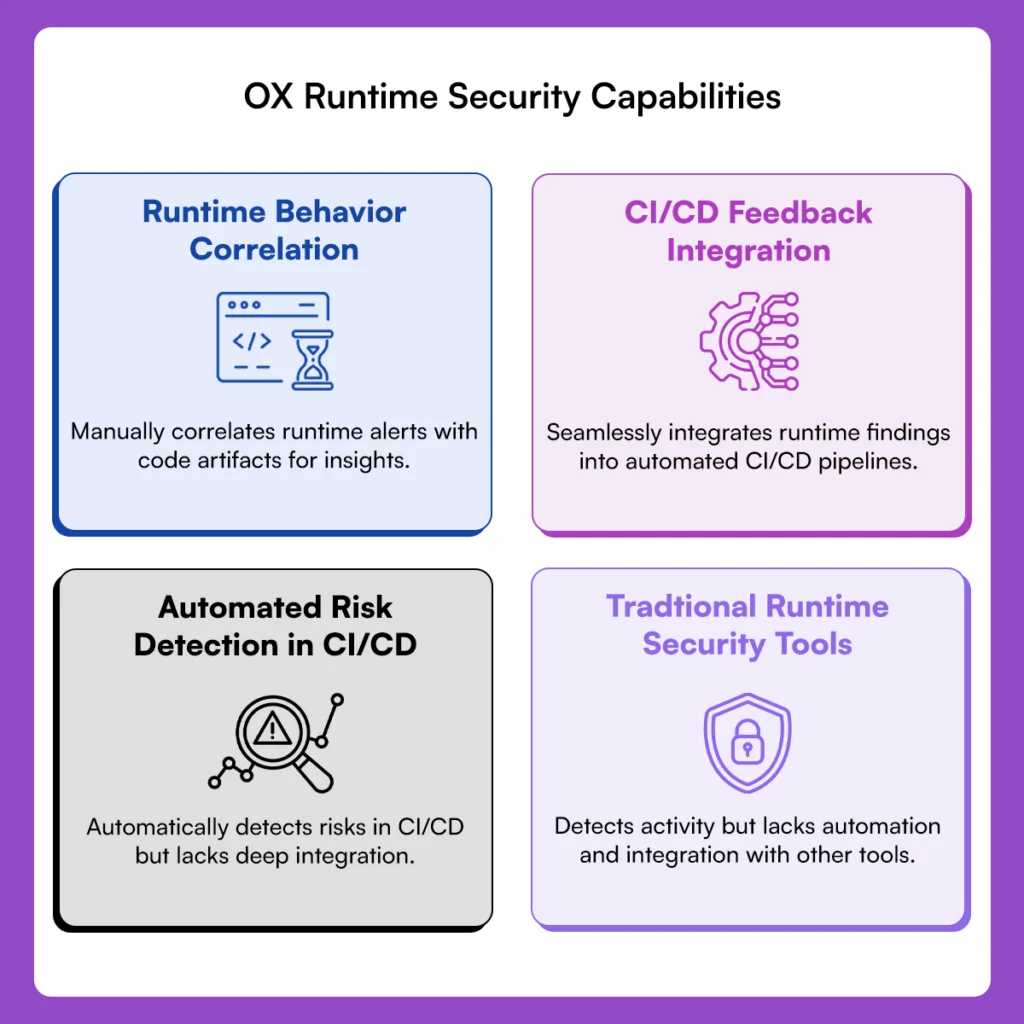
OX correlates every runtime alert to the artifacts that introduced it into production, providing actionable, auditable evidence. Each finding is automatically mapped back to the artifacts that introduced it into production:
Key capabilities:
- Runtime Behavior Correlation: Tracks risks down to the exact source code, repository, and dependency.
- Automated Risk Detection in CI & Containers: Identifies pipelines and container images that carry risks into production automatically.
- Explicit Ownership: Clearly shows which team is responsible, eliminating the need for manual investigation.
Mitigating Exploitable Issues Before and After Deployment
OX evaluates runtime signals based on exploitability, focusing on whether behavior is reachable, exposed, and capable of real impact. Findings at runtime inform preventive controls earlier in the pipeline, and policies can block or flag risky patterns before similar code is deployed again.
Key capabilities:
- Runtime Signal Evaluation: Assesses runtime signals based on reachability, exposure, and potential impact.
- CI/CD Feedback Integration: Feeds runtime findings back into CI/CD pipelines to enforce preventive controls.
- Risk Blocking & Flagging: Blocks or flags risky patterns before code is promoted to the next stage.
- Ongoing Exposure Reduction: Reduces repeat exposure through feedback loops.
Unified Risk Posture Across Tools and Environments
When runtime security, code scanning, and pipeline controls operate independently, enterprises struggle to prioritize real risk. OX unifies these insights into a single risk posture, analyzing runtime findings alongside vulnerabilities, dependencies, and pipeline behavior.
Key capabilities:
- Contextual Risk Evaluation: Evaluates runtime findings alongside known vulnerabilities, dependencies, and pipeline activity.
- Risk Prioritization by Exposure: Prioritizes risks based on actual production exposure rather than tool-specific severity.
- Enterprise-Wide Risk Visibility: Provides leadership with a clear, organization-wide view of application risk.
Built for Runtime Security Governance at Enterprise Scale
OX enforces consistent security policies across repositories, pipelines, container images, and runtime activity. Runtime behavior becomes traceable evidence for compliance and audit reviews, enabling AppSec leaders to demonstrate control over AI-generated code and automated changes without slowing delivery.
Key capabilities:
- Consistent Policy Enforcement: Enforces security policies consistently across repositories, pipelines, images, and runtime.
- Traceable Runtime Behavior: Enables traceable runtime behavior for compliance and audit reviews.
- AI & Automation Management: Enables AppSec leaders to manage AI-generated code and automated changes without slowing delivery.
By connecting runtime security to governance mechanisms, OX enables enterprises to treat runtime risk as an enforceable, auditable security program rather than a reactive detection signal.
Example Workflow: Runtime Security from Code to Production with OX
This walkthrough shows how runtime security is enforced when it is treated as part of the application lifecycle rather than an independent detection layer. The example follows a single application from development through CI pipelines and into production runtime, using OX to maintain visibility and control at every stage.
Step 1: Getting started with OX Security
- Log in to OX Security and create an organisation if one does not exist.
- Log in to OX Security and connect your source control provider (GitHub, GitLab, Bitbucket, or Azure Repos).
- Step-by-step guide to get started. Link
This step establishes the foundation for runtime security by ensuring that every production workload can be traced back to its source.
Step 2: Install and configure the OX Security VS Code extension
- Open Visual Studio Code → Extensions.
- Search for “OX Security”.
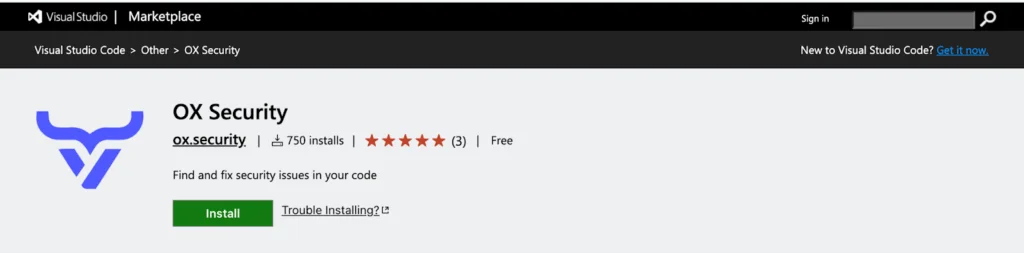
- Install the extension and enable Auto Update.
- Follow the official setup guide and configure the extension using the API key created on the platform.
This ensures that risky patterns are identified before they become runtime exposure.
Step 3: Catch Risky Code Before It Reaches Production
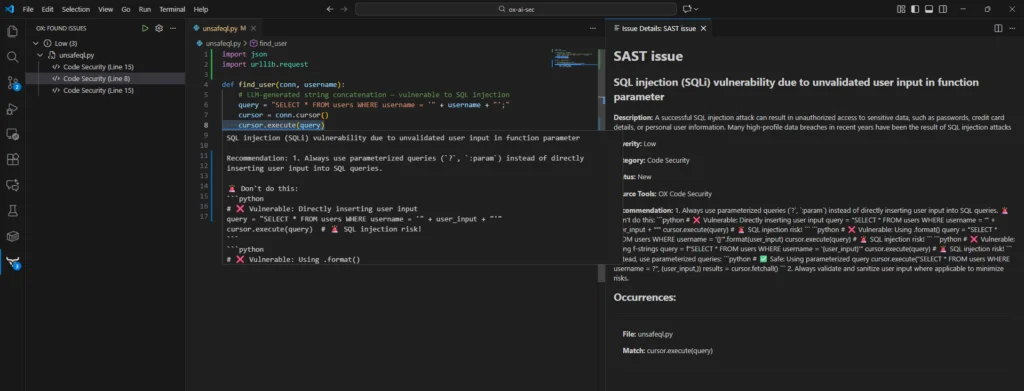
As developers write or paste code, including AI-generated snippets, OX analyzes it directly in the editor. Issues such as unsafe SQL query construction or embedded secrets are flagged immediately.
Common issues identified at this stage include:SQL injection vulnerabilities, such as unsafe string‑based query construction
Information leakage, including secrets or tokens embedded in code
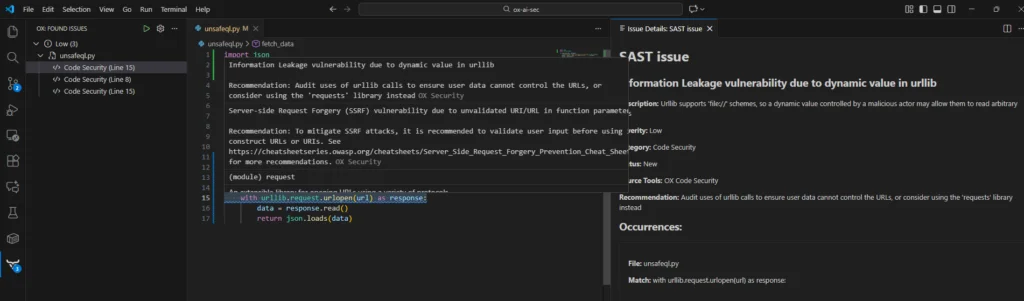
These warnings appear instantly in the editor, ensuring vulnerable code is caught long before it reaches production.
When a developer attempts to commit unsafe code, policy enforcement is applied:
- The pre-commit scan displays detailed diagnostics
- The commit is rejected if policy violations exist
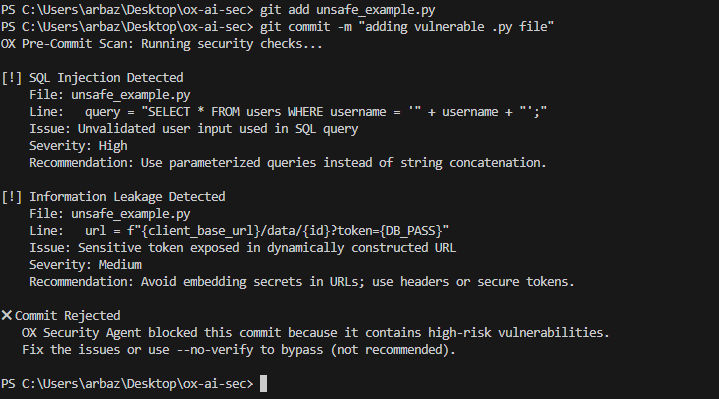
This prevents vulnerabilities from ever reaching the pipeline, decreasing downstream runtime exposure.

Step 4: Enforce Supply-Chain Controls in CI
This step introduces explicit supply-chain controls into the CI pipeline by generating an SBOM and enforcing PBOM requirements before artifacts can advance.
- Generate an SBOM for the built artifact
- Verify that provenance metadata exists and meets trust requirements
- Block the build if provenance is missing or dependencies violate policy
This ensures that only verified artifacts progress toward deployment, limiting what can reach runtime.
- Create the CI workflow
For example, using GitHub Actions, create a .github/workflows/ci.yml file as shown in the template below:
name: Secure Build with SBOM and PBOM Validation

on:
  push:
    branches: [ main ]

jobs:
  build:
    runs-on: ubuntu-latest
    steps:
      - name: Checkout source
        uses: actions/checkout@v4

      - name: Build container image
        run: |
          docker build -t ox-demo:${{ github.sha }} .

      - name: Install SBOM generator
        run: |
          curl -sSfL https://raw.githubusercontent.com/anchore/syft/main/install.sh \
          | sh -s -- -b /usr/local/bin

      - name: Generate SBOM
        run: |
          syft packages ox-demo:${{ github.sha }} \
            -o json > sbom.json

      - name: Validate provenance (PBOM check)
        run: |
          if ! grep -q '"provenance"' sbom.json; then
            echo "PBOM validation failed: provenance metadata missing."
            exit 1
          fi
          if grep -q '"openssl"' sbom.json; then
            echo "PBOM validation failed: restricted dependency detected."
            exit 1
          fi
How This Fits into Runtime Security Enforcement
When a developer commits and pushes code, runtime security enforcement begins long before the application is deployed.
- The CI workflow runs automatically and builds the application artifact.
- The artifact is analyzed for provenance, dependency integrity, and policy compliance before it is eligible for deployment.
- SBOM and PBOM validation ensure that only verified components and trusted build outputs move forward.
If validation fails, the pipeline stops, and the artifact is blocked, so untrusted or high-risk components never reach runtime.

Step 5: Review the Application’s Security State
At this stage, the repository and CI pipeline are already connected to OX.
- Log in to the OX platform and navigate to Applications.
- Select the application associated with the connected repository.
OX presents a consolidated application view. Security signals from IDEs, CI, and artifact analysis are unified into a single summary.

This replaces scattered scanner outputs with a clear picture of what exists in the application before it runs.
Step 6: Run a Full Posture Scan Across the Lifecycle
Trigger a posture scan to stitch together code findings, pipeline activity, artifacts, and deployed environments. This is where runtime security gains context.
In the OX UI, open your application and click “Run Posture Scan”.
Rather than listing vulnerabilities, OX evaluates how issues propagate toward runtime and which ones are actually reachable.
Step 7: View Runtime Risk in Lifecycle Context
Once the repository and CI pipelines are connected, OX builds a unified Secure SDLC dashboard that shows how controls are applied across development, build, and runtime stages.The unified dashboard that shows vulnerabilities, PBOM coverage, and security posture across the software supply chain.
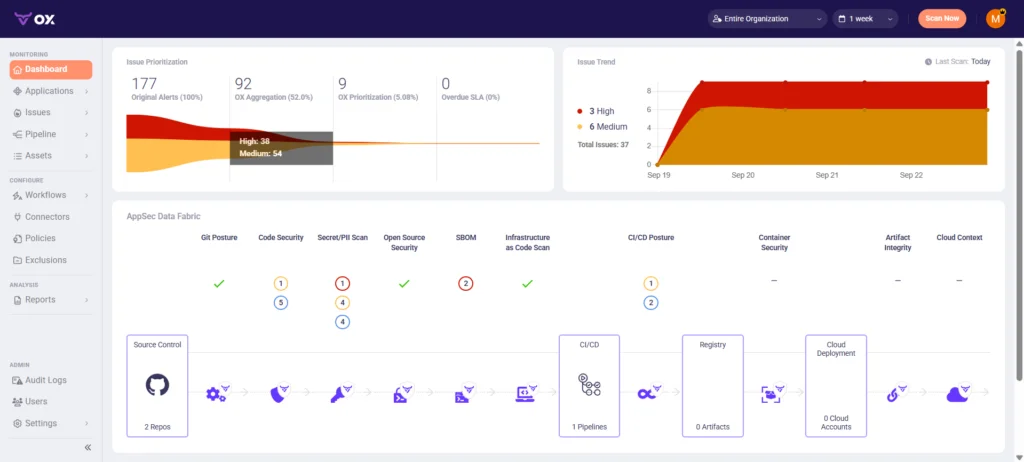
This allows teams to confirm that runtime security is supported by earlier controls, not operating in isolation.
Step 8: Analyze Risk and Prioritize Fixes Based on Reachability and Impact
All pipeline scans and security signals generated highlight issues that create downstream runtime risk instead of treating all findings equally.
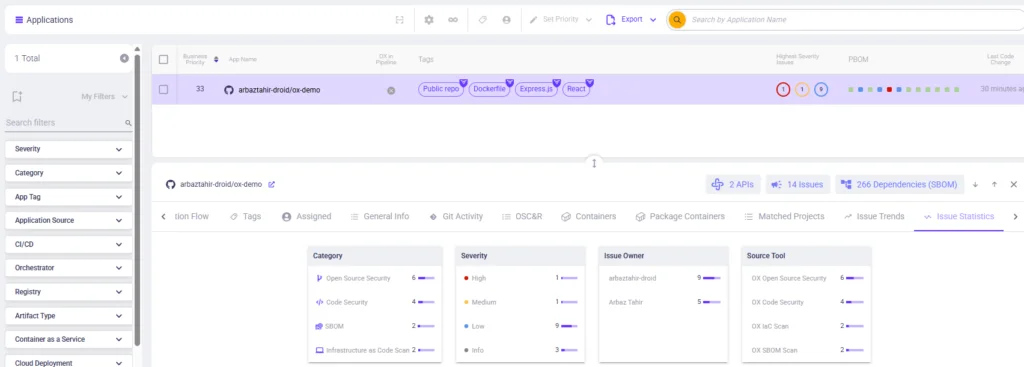
This shifts runtime security from alert response to risk reduction.
Step 9: Trace Attack Paths Across Code and Runtime
- Go to Applications → [Your App] → Attack Path / Reachability.
- Use filters like Reachable, Exploitable, and Business Impact in the UI.

The attack path graph shows how issues connect across code functions, dependencies, CI artifacts, and deployed services and APIs
This makes runtime exposure explainable and auditable.
Conclusion
Runtime security tools play an important role in helping enterprises observe what happens inside production environments. They provide visibility into containers, processes, and network activity that cannot be assessed before deployment. As organizations scale their use of Kubernetes, automated pipelines, and AI-assisted development, runtime becomes the point where risk is finally visible.
This article shows that runtime security tools are effective at detection but struggle to translate signals into clear application-level risk. Low-level alerts often lack ownership, exploitability context, and traceability back to how the risk enters production. In large organizations, this gap appears during incidents and audits, when teams must explain not just what happens, but why it matters and who is responsible.
OX addresses this by embedding runtime security in the application context and governance. By correlating runtime behavior with source code, pipelines, container images, APIs, and dependencies, OX helps security teams to prioritize exploitable risk, enforce policies consistently, and provide auditable evidence of control. Enterprises that connect runtime security to application ownership and lifecycle context are better positioned to reduce production risk without slowing delivery.
FAQs
Most runtime security tools focus on detecting low-level activity, such as syscalls or container behavior, without explaining which application is affected or who owns the risk. In large organizations with shared platforms and distributed teams, this lack of context makes prioritization difficult. OX Security addresses this by correlating runtime findings with code, pipelines, images, and ownership, turning detection into clear application risk decisions.
OX evaluates runtime findings based on exploitability, reachability, and production exposure rather than alert volume. By connecting runtime behavior to application logic and dependencies, OX highlights risks that can actually be exploited, allowing teams to focus remediation efforts where they matter most.
OX links runtime activity back to the exact pipeline runs and container images that introduced the behavior into production. This correlation enables root-cause analysis and prevents the same risk from re-entering production through future builds or deployments.
Yes, but only when runtime findings are traceable and contextual. OX provides audit-ready evidence by showing how runtime risks were detected, evaluated, and governed across the application lifecycle. This allows organizations to demonstrate control using real execution data rather than manual reports.