






Scan your whole stack








Latest version: v0.35.8
io.github.The-Pixel-Boys/shield-kya was last scanned on 26 Nov 2026 at version 0.35.8. Risk score 50 of 100 (medium). High-severity rules fired. The AI review did not flag it.
| Version | Published | Status |
|---|---|---|
| 0.35.8 LATEST | 26 Nov 2026 | 2 rules fired |
| 0.35.7 | 17 Nov 2026 | 2 rules fired |
| 0.35.6 | 16 Nov 2026 | 1 rule fired |
| 0.35.5 | 16 Nov 2026 | Not shown |
| 0.35.3 | 15 Nov 2026 | Not shown |
Findings for v0.35.8. The score is a capped sum of the weights of the rules that fired — not CVSS, not exploitability, and not a probability. It is not comparable across packages with different scan coverage.
The same file reads a local credential store, such as SSH private keys, browser data, a crypto wallet or a keychain file, and references a host flagged as data-collection infrastructure or a hardcoded public IP address. This is the pattern of credential stealers.
HIGHThe score describes 0.35.8; other versions have their own rules, not their own score.
The publisher’s own README, as collected from the registry.
@shield-agent/kyaStops your coding agent from deleting, leaking or dropping things. Records everything else.
npm i -g @shield-agent/kya@latest && kya start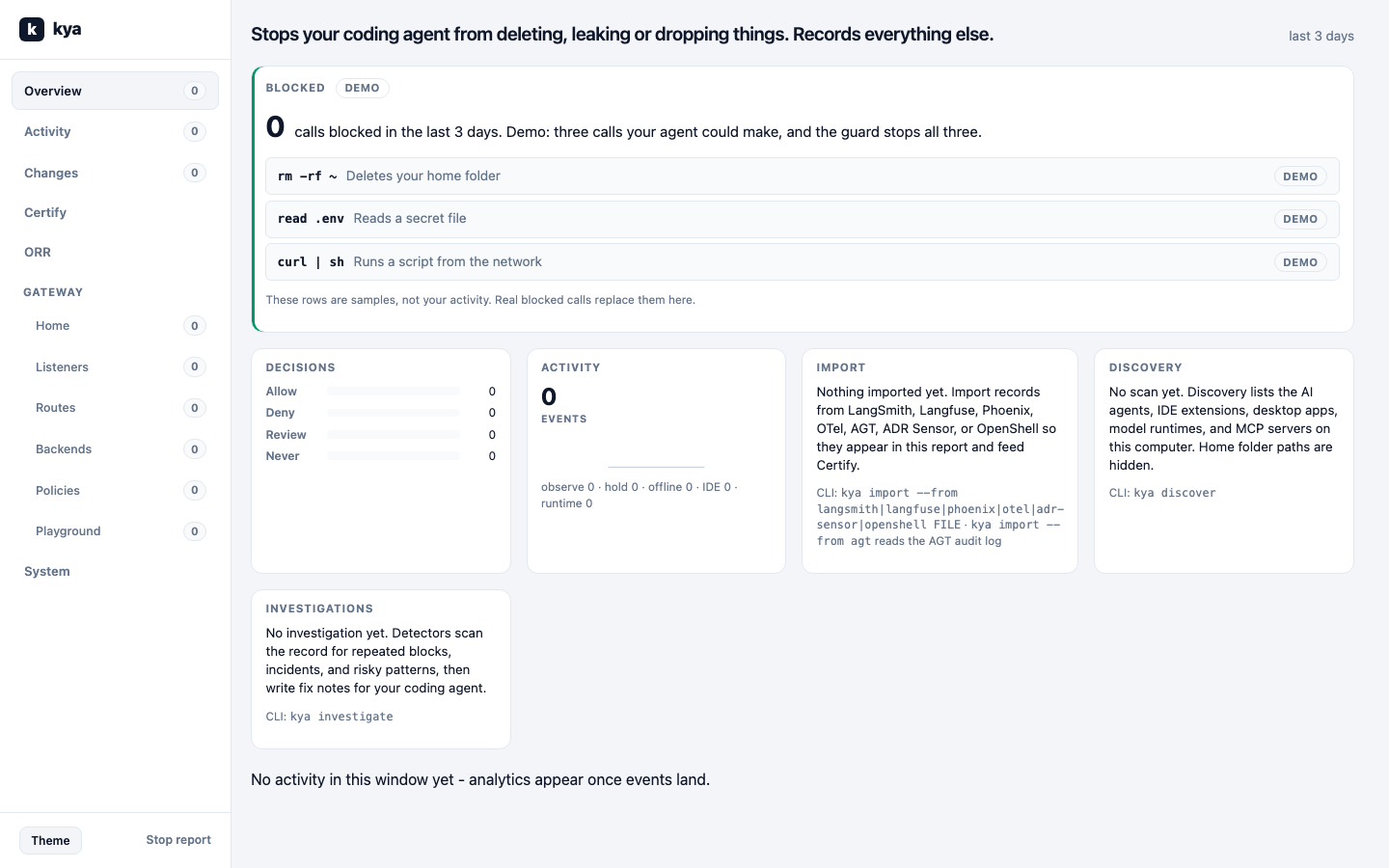
KYA blocks a short list of destructive commands, secret reads and exfiltration by default (list below), and records every other tool call on a local dashboard. One command. Free forever under MIT. The limits are in LIMITATIONS.md.
# Permission denied (EACCES) on Linux? No sudo and no install needed:
npx @shield-agent/kya@latest start
Requires Node.js 22+ (24 recommended). Restart Cursor / Claude Code / Codex once so MCP loads. Hosted desk: shield-agent.com.
The deny list is the never-list (docs/never-list.md) plus the guard pack (docs/guard-pack.md). A deny exits 2 and names its rule id. In plain words:
rm with recursive and force flags on /, your home directory, a parent of it or of the project folder (rm-root-home, and rm-recursive-home-or-system); find ... -delete on home or system folders.terraform destroy and terraform apply -destroy (terraform-destroy); DROP TABLE, DROP DATABASE, DROP SCHEMA and TRUNCATE inside a database client (sql-drop); docker volume rm, docker volume prune, docker system prune --volumes and docker compose down -v (docker-volumes); kubectl delete namespace and kubectl delete --all -A (k8s-delete-ns); aws ec2 terminate-instances, aws s3 rb --force, aws s3 rm --recursive, aws rds delete-db-instance, gcloud projects delete, gcloud sql instances delete, az group delete (cloud-delete); railway volume delete and a volumeDelete call (railway-volume-delete); supabase db reset --linked (supabase-reset-linked); rm -r .git at the project root (rm-git-dir); dropDatabase() in mongosh (mongo-drop-database); FLUSHALL and FLUSHDB on a remote Redis (redis-flush); fly volumes destroy and fly apps destroy (fly-destroy); vercel remove (vercel-remove); gh repo delete and gh api -X DELETE repos/... (gh-repo-delete). Four more commands are routine on a local database and not on a remote one, so the hook asks the person instead of denying (Claude Code only; other hosts deny): DELETE FROM with no WHERE (sql-delete-all), prisma migrate reset (prisma-migrate-reset), prisma db push --accept-data-loss (prisma-accept-data-loss) and rm -rf of the project folder (rm-project-wipe). See guard-pack.git-force-push); --force-with-lease is allowed except on main, master, release* and prod*, where it is denied too (git-force-push-protected-branch); deleting main or master (git-delete-default-branch); git reset --hard with git clean -fdx (git-hard-reset-clean).~/.aws/credentials, gcloud, Azure, kubeconfig, Docker, Railway, GitHub CLI, npm, PyPI, netrc and git credentials, .env files (not .env.example), *.pem, *.key, /etc/shadow, macOS keychains, browser login and cookie stores, and security find-generic-password -w (secret-read-*, keychain-password-dump).secret-write-*). The trail row never holds the text.curl, wget, nc, ncat, socat, scp or rsync (exfil-*).mkfs, dd to a block device, a fork bomb, chmod -R 777 or chown -R on home or system folders, a download piped into a shell.Config keys (shellNeverList, secretsGuard, exfilGuard, guardAllow) are read from ~/.kya/config.json only; a project file cannot lift a deny. Details, examples and limits: docs/guard-pack.md.
Moves and renames, edits, and deletes inside the project folder: they are recorded in the audit trail, not blocked. Anything an agent does outside the hook's view: a script it writes then runs, commands built at run time, ssh host "rm -rf ~". Built-in shells of tools that have no hook and do not route through KYA (Cursor, for example, is MCP only). Hosted mode (--plane-config) applies the never-list and the plane's policy, not the guard pack. It is a seatbelt, not a sandbox: the guard pack denies this class of command, and the audit trail records what happened either way.
kya uninstall undoes kya start and kya connect. It removes only the keys KYA added, deletes the files KYA created if they are unchanged, and prints what it left alone. kya uninstall --dry-run shows the plan and changes nothing. kya uninstall --project undoes this directory only. KYA's own data (the trail and report files) is not part of the undo; see docs/uninstall.md.
kya help lists the six commands a new user needs. kya help --all lists every command in four groups, and kya help <command> shows one command. Nothing was removed or renamed.
| Group | Commands | More |
|---|---|---|
| Guard | kya start, kya uninstall, kya stop, kya connect, kya doctor, kya hook, kya wrap, kya gate, kya serve-mcp, kya init, kya update, kya version, kya sandbox, kya telemetry, kya posture |
install, hosts and hooks, gateway |
| Report | kya receipt, kya map, kya export, kya dash, kya investigate, kya alerts, kya discover |
activity record, alerts |
| Team and hosted | kya team, kya login, kya logout, kya eval-tool |
reference, hosted console |
| Compliance and evidence | kya certify, kya orr, kya import |
compliance and evidence |
The report opens on Blocked, Activity and Connected tools. Certify, Gateway, System, ORR and cost showback sit behind More in the left menu.
npm install -g @shield-agent/kya@latest, then follow llms-install.mdGenerated from sdks/kya/features.json by pnpm sync:features. Do not edit by hand. Full list with docs links: docs/features.md.
Find threats in your stack.
OX Radar can check high-priority threats, like critical package CVEs, against your context.
Each incident is marked Detected or Not Detected with a remediation plan and proof all tracked in the Response Center.
The probe returned only these fields for this server — auth requirement, protocol and tool list weren’t observed, so they’re not shown (never guessed).
The publisher’s own links, as the registry reports them. These are not sources for the assessment on this page.
 Read the latest findings