Scan your whole stack


From OX Research Newsroom






Are you using fermix?
Find out what’s in your code.
Scan your apps free in minutes (opens in a new tab) Read the latest findings
Latest version: v0.1.1
fermix was last scanned on 29 Nov 2026 at version 0.1.1. Risk score 0 of 100. No malicious behavior was detected.
| Version | Published | Status |
|---|---|---|
| 0.1.1 LATEST | 29 Nov 2026 | No rules fired |
Findings for v0.1.1. The score is a capped sum of the weights of the rules that fired — not CVSS, not exploitability, and not a probability. It is not comparable across packages with different scan coverage.
The score describes 0.1.1; other versions have their own rules, not their own score.
The publisher’s own README, as collected from the registry.
Fermix supports slogdet / slogpf / det / pf for float32, float64, complex64, and complex128 matrices on NVIDIA GPUs, written in JAX with Pallas (Triton) kernels. The codes are generated by Claude Code.
Designed for quantum Monte Carlo in fermionic systems: a large batch of moderate-size matrices (n ~ 32-8192), forward and backward.
Requires jax >= 0.7.1; the float64 / complex128 kernels need jax >= 0.9.2.
pip install fermiximport jax, jax.numpy as jnp
from fermix import slogdet, slogpf, det, pf
A = jax.random.normal(jax.random.key(0), (4096, 128, 128), jnp.float32)
sign, logabs = slogdet(A) # like jnp.linalg.slogdet, but faster
S = A - jnp.swapaxes(A, -1, -2)
sign, logabs = slogpf(S) # Pfaffian of the skew-symmetric batchSimply replace slogdet / slogpf / det / pf in your program by the functions in fermix.
All functions accept any leading batch dimensions, any matrix size, the four dtypes float32 / float64 / complex64 / complex128
(the 64-bit ones need jax_enable_x64), and are jit/vmap/grad/jvp compatible. Conventions follow jnp.linalg.slogdet.
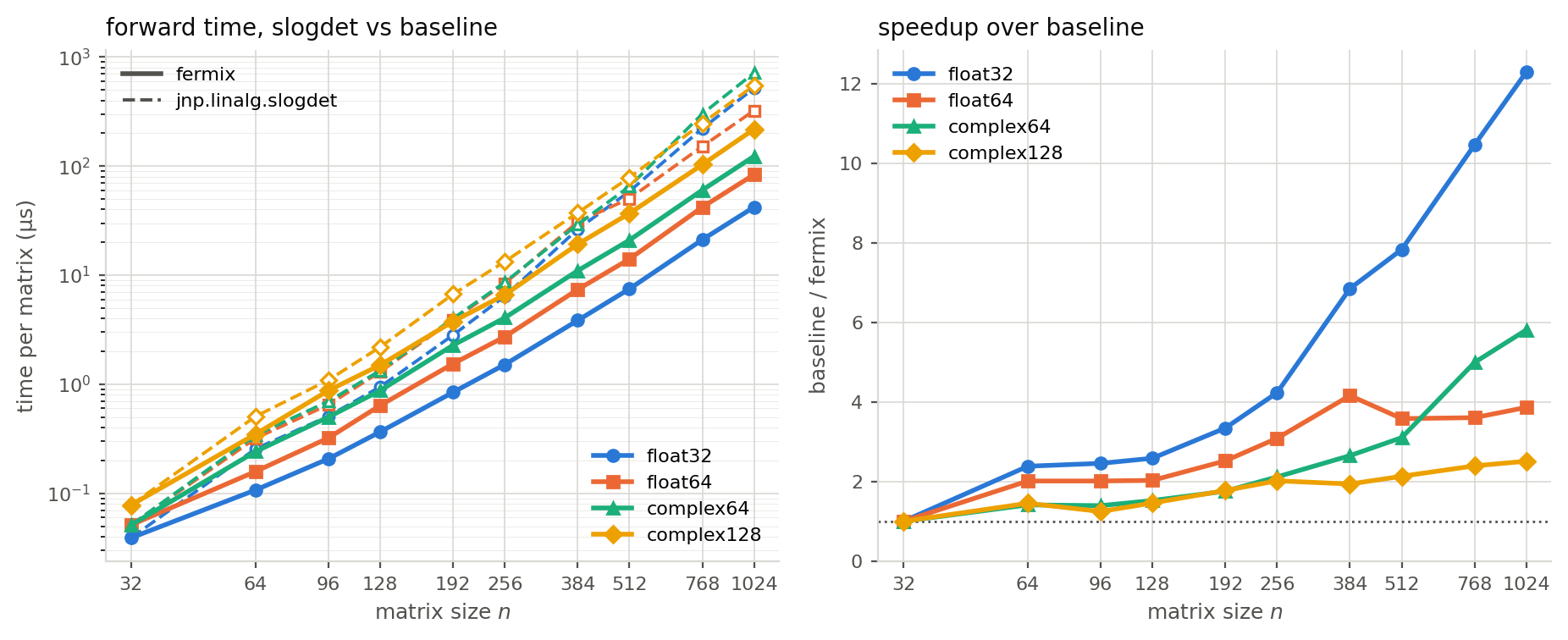
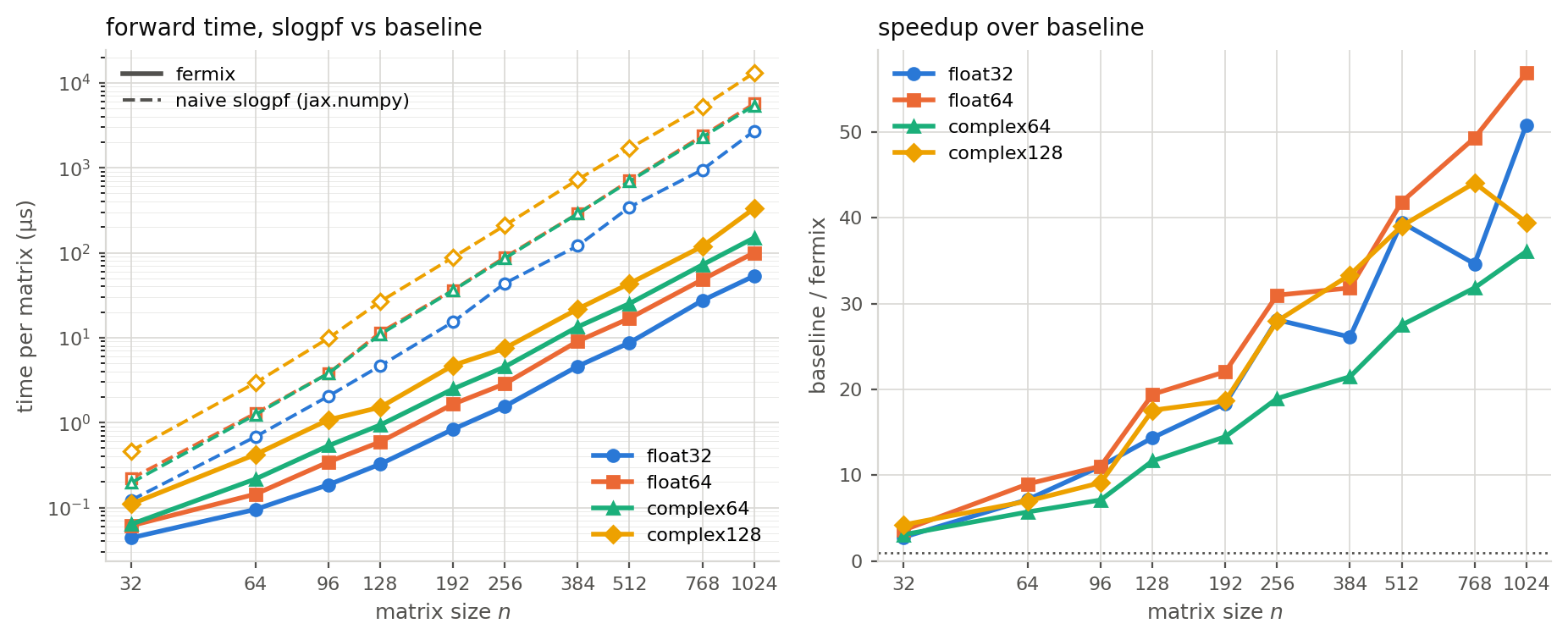
Forward time per matrix on one H200 GPU against jnp.linalg.slogdet and a naive batched Parlett–Reid slogpf written in
jax.numpy (the generic fallback path). The time costs of det and pf are similar.
FermixFallbackWarning and runs a much slower generic jax.numpy path;
dtypes other than the four supported ones raise TypeError.fermix._common.TUNES); only the A100-80GB and the H200 have measured tables, other GPUs use the closest one.prec selects the block-GEMM algorithm: "tf32x3" (default, tensor cores at fp32-level accuracy) or "ieee"
(exact fp32, ~5 % slower); the 64-bit dtypes always run IEEE fp64.jax_compilation_cache_dir) makes it a one-off.det and pf overflow the 32-bit dtypes for large or badly scaled matrices, and so do their gradients; use slogdet and slogpf there.@software{fermix,
author = {Chen, Ao},
title = {{fermix}: Fast batched determinants and Pfaffians in {JAX}},
year = {2026},
version = {0.1.1},
url = {https://github.com/ChenAo-Phys/fermix}
}Find threats in your stack.
OX Radar can check high-priority threats, like critical package CVEs, against your context.
Each incident is marked Detected or Not Detected with a remediation plan and proof all tracked in the Response Center.
The probe returned only these fields for this server — auth requirement, protocol and tool list weren’t observed, so they’re not shown (never guessed).
The publisher’s own links, as the registry reports them. These are not sources for the assessment on this page.
Read the latest findings