living-architecture
A Claude Code plugin + CLI for agents writing Python and TypeScript code




-
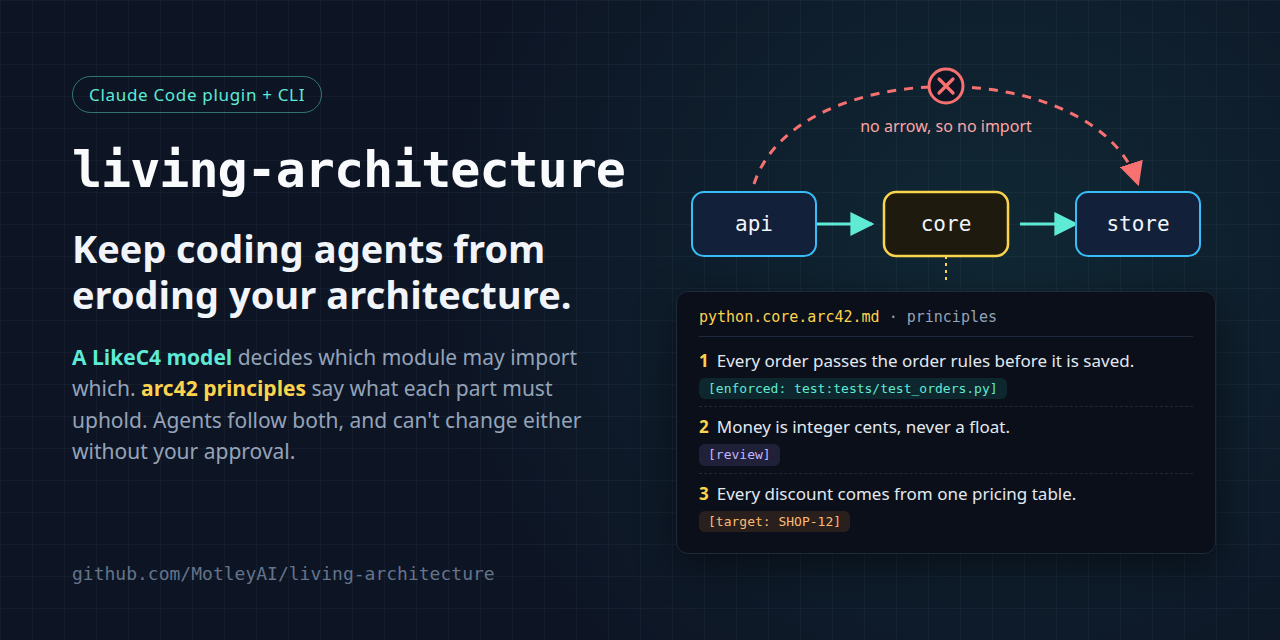
Normative principles attached to a
LikeC4 architecture model, which also serves as an import whitelist.
-
Enforced by a complete
PR workflow that generates OpenSpec changes, whose archives double as
ADRs.
Introduction
Every PR an agent writes can be reasonable on its own while the codebase still drifts, one random decision at a time.
Putting every rule for every component into CLAUDE.md bloats context to the point where they are all ignored anyway.
Random agent decisions from one PR are treated as design patterns by the next session, with the codebase gradually growing
bizarre structure no one wanted. And six months later, nobody can say why the code is the way it is.
The plugin, la, prevents architectural drifts via these interlocking components:
- Principles attached to the parts of your code. A LikeC4 model maps your packages to
elements, and each element carries its own arc42 file of normative principles, each tagged
with how it is enforced. Every stage of a change starts by reading the principles of what it touches, and
changing a principle needs your approval.
- A complete PR workflow.
/la:pr interviews you into a Codex-reviewed plan, writes the failing tests,
implements until they pass, then loops deterministic checks (lint, typing, share of comment lines in the code, and more),
CI, Codex, CodeRabbit and Sonar until every gate is clean.
Each stage ends at a hard stop and resumes from the branch name alone.
- A decision record for every PR. The plan is a validated OpenSpec change. Before the PR merges, it is archived in
the same PR as the code, with the decisions and the alternatives
rejected: an ADR you never had to write.
- An architecture that is enforced, not just drawn. The model's arrows are also a whitelist for which modules can import which,
and
la-arch-check fails when the real imports disagree.
For the details, see How it works and
Living architecture in questions and answers.
For an example of a project using this, look at SLayer, here is a juicy example of a real-world principles document.
Install
# the plugin (installing la also installs trmv, the type-rename-move plugin it depends on)
/plugin marketplace add MotleyAI/living-architecture
/plugin install la@living-architecture

# the commands (la-*, trmv-*), pinned to the same version as the plugin, from your repo's ecosystem
uv tool install living-architecture==0.15.0 --with-executables-from type-rename-move   # Python repos (Python >= 3.11)
npm install -g living-architecture@0.15.0 type-rename-move@0.15.0                      # TypeScript/JavaScript repos (Node >= 22)
The repo ships two packages that release together: type-rename-move (the trmv-* commands and the trmv
plugin: verified renames and moves and the type-check gate) and living-architecture (the la-* commands and the
la plugin), which depends on it. Each comes as a PyPI package and an npm package of the same name, with identical
behaviour. Each serves its own ecosystem natively, needs nothing from the other in a single-language repo, and calls
the other for the other language's files in a mixed repo
(details). Skills check
that the installed commands match the plugin before they run; a plugin update within the same minor version needs no
reinstall.
Upgrading
- Update the plugin:
claude plugin marketplace update living-architecture, then
claude plugin update la@living-architecture (third-party marketplaces don't auto-update by default), then
/reload-plugins in any open Claude Code session.
- Rerun the install command above at the new version.
- When
la-doctor asks, run la-arch-migrate once per repo and commit the result.
With only trmv, update trmv@living-architecture in step 1 and rerun its install command in step 2. A skill's
preflight catches a gap between these steps and prints the fix.
From 0.13: renames and moves are now the trmv package and plugin: trmv-refactor, trmv-compliance,
trmv-mock-lint, trmv-typecheck and the trmv: skills. la-typecheck stays as a deprecated alias until 0.16.0.
Just renames and moves
To get verified renames and moves without the architecture workflow, install only trmv:
/plugin install trmv@living-architecture
uv tool install type-rename-move==0.15.0      # Python repos
npm install -g type-rename-move@0.15.0        # TypeScript/JavaScript repos
Then run /trmv:init in the repo: it writes trmv.yaml with the test and type-check commands.
Quick start
In the repo you want to onboard, run:
/la:init
It detects your tracker, test, lint and type-check commands, Codex, Sonar and any existing OpenSpec or
architecture setup, then proposes a living-architecture.yaml and asks only about what it cannot detect. It then
offers to set up OpenSpec, record the type-check baseline and build the architecture with /la:arch-init, which
starts from a model measured from your code and then interviews you about the target structure and the
principles.
Just enforce the architecture
You don't need the PR workflow or OpenSpec to hold an agent to the model and its principles: decline OpenSpec in
/la:init, which will ask you to build the model with /la:arch-init; then point the agent at the
/la:living-architecture
skill, for example in your CLAUDE.md or AGENTS.md.
The skill has the agent read the principles of every part of the code it touches before changing it, and run three
checks before it finishes: la-arch-check holds the imports to the model's arrows and checks the principles' tags,
likec4 validate checks the model itself, and trmv-typecheck runs basedpyright (or tsc) against a baseline that
only shrinks.
To run the same checks in CI, see
Running the checks in CI.
Use the PR workflow that enforces architecture and creates OpenSpec
Start each change on a branch named after its issue with:
/la:pr
This will guide you through each of the stages of the PR workflow; at the end of each stage it will tell you to
call /clear and start the next stage by calling /la:pr again.
Skills
| Skill |
Purpose |
la:init |
Onboard a repo: detect its tools, write living-architecture.yaml, then set up OpenSpec and build the first architecture model and its principles with la:arch-init |
la:pr |
Run a change through plan → failing tests → implementation → review |
trmv:init |
Onboard a repo to trmv alone: detect its test and type-check commands, write trmv.yaml, record the type-check baseline |
trmv:rename-move |
Rename or move Python or TypeScript code, proven complete by the type checker |
These skills call helper skills that you can also run on their own; see
Skills.
How it relates to other tools
- Import-boundary checkers (import-linter for Python;
dependency-cruiser,
eslint-plugin-boundaries and
Nx module boundaries for TypeScript) check imports
against rules in a config file. In
la the rules are the same diagram the agent reads, they must match the code
in both directions, one model covers Python and TypeScript, and the import law is only the backbone that the
principles and the specs hang on. If all you need is layer rules for one language, those tools are lighter.
- OpenSpec on its own gives you the spec format and the archive.
la drives it: the plan stage writes and
validates the change, the later stages hold the code to it, and the review stage archives it with the PR.
- ADRs written by hand tend to stop being written. Here the decision record is a by-product of planning the
change, so every PR has one.
Prerequisites
Always: git, bash, gh (authenticated) and jq.
Per repo language (trmv-doctor and la-doctor check them):
| Language |
Needs |
| Python |
Python >= 3.11; the PyPI packages; basedpyright in the project env for the type-check gate |
| TypeScript |
node (>= 22) and npx; the npm packages; tsc in node_modules for the type-check gate |
The rest is optional. /la:init detects what you have, asks before turning on anything it can't find, and
records the choice in living-architecture.yaml:
| Gate |
Needs |
tracker: linear |
the Linear MCP server |
tracker: github |
nothing beyond gh |
openspec: true |
npx (the OpenSpec CLI) |
architecture: true |
npx (the LikeC4 CLI) |
reviewers.codex: true |
the Codex MCP server (mcp__codex__codex) |
| Sonar on your PRs |
the SonarQube MCP server |
Background
The ideas behind the plugin, and how it came out of the SLayer codebase,
which uses it:
Documentation









