lothc




Lord Of The Http Clients — a fast, Rust-backed, typed HTTP client for Python,
with first-class optional support for pydantic and msgspec as both decode and encode
targets.
Installing
uv add 'lothc[pydantic,msgspec]'
(Any subset of the extras works — the base package alone gets you bytes/dict support.)
Quickstart
import asyncio
from lothc import HTTPClient
from pydantic import BaseModel


class Pokemon(BaseModel):
    id: int
    name: str


async def main() -> None:
    async with HTTPClient(base_url="https://pokeapi.co/api/v2/") as client:
        response = await client.get("pokemon/pikachu", into=Pokemon)
        print(response.status, response.data)  # 200 id=25 name='pikachu'


asyncio.run(main())
Why?
pyreqwest is a genuinely great Rust-backed HTTP
client, and the inspiration for lothc. Its API is a builder (client.get(url).build() before you
can .send()), so lothc gives it the requests/httpx call shape, and adds its own native
transport, faster still. pyreqwest stays lothc's transport on Windows, for HTTP/2 and with
native="off".
Where other clients' .json() returns an unvalidated dict, lothc decodes straight into a
validated pydantic or msgspec type.
Fast
On Linux and macOS, lothc's own native transport (the default) runs async get(into=Struct) at
about 2.2x bare pyreqwest under load: 97,501 requests a second, each decoded into a validated
msgspec Struct. On its pyreqwest transport (Windows, http2=True, or native="off"), lothc
stays close to pyreqwest's own throughput.
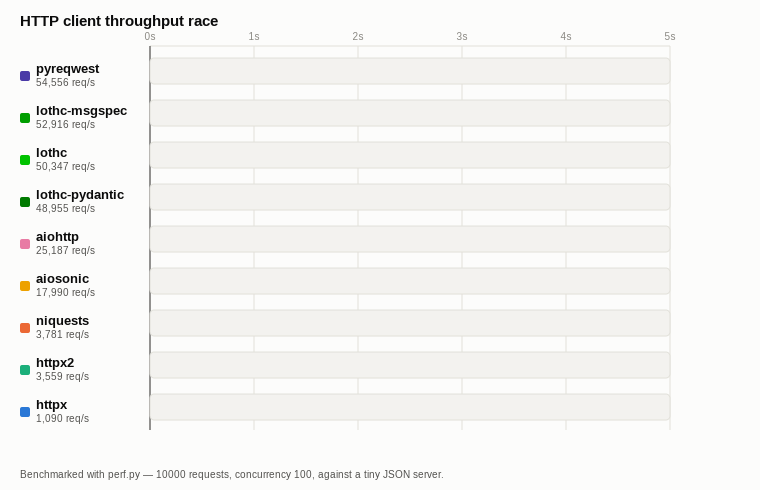
50,000 requests at concurrency 100 on an AWS c8a.xlarge, validation included.
Full numbers.
Highlights
|
|
| Typed decoding |
into= any type expression (Pokemon, list[Pokemon], ...) gives back a validated pydantic BaseModel or msgspec Struct, not a dict. |
| Two clients, one API |
HTTPClient (async) and SyncHTTPClient (sync) — identical surface. |
| Every verb |
get, post, put, patch, delete, head, options, download (each returning a Response: .data, .status, .headers) — see Verbs. |
| Typed params, headers & forms |
A BaseModel/Struct for query params or headers (with None-field omission), or a body sent urlencoded (data=) or as a real multipart form (form=), a file's content read from disk or streamed from an iterator, never held whole — see Verbs. |
| Precise static types |
Every verb is paired @overloads, not a cast-laden generic — your editor knows the exact return type. |
| SSE & streaming |
Spec-compliant SSE — automatic reconnect with Last-Event-ID, server retry: honored, typed decode (discriminated unions included) — plus raw or NDJSON-typed stream_get/stream_post — see SSE / Streaming. |
| Retries with real backoff |
max_retries/retry_methods/retry_statuses, Retry-After-aware, and a retry= rule that can decide each retry — see Retries. |
| Request hooks |
request_hook= wraps every attempt at a request, retries and SSE reconnects included, in your own context manager, which can add headers and sees the status: a tracing span per attempt — see Request hooks. |
| Authentication |
Static bearer_token, a per-request-refreshed bearer_auth, basic_auth, or default_headers for anything else — plus a ready-made OAuth 2 client-credentials provider (OAuthProvider: mint, leeway-based renewal, refresh-then-mint fallback, optional on-disk token cache) — see Authentication. |
| Cookies, redirects, proxy |
cookie_store, follow_redirects/max_redirects, proxy= — see Networking. |
| A real error hierarchy |
HTTPTransportError/HTTPTimeoutError/HTTPConnectionError for no response, HTTPResponseError and your own subclasses, chosen by status and body, for 4xx/5xx (or raise_for_status=False to get those back as a Response), HTTPDecodeError for a body that doesn't decode — see Error handling. |
Development
See Development.
License
lothc is MIT. It's built on
pyreqwest (Apache-2.0), which is built on the Rust
crate reqwest (MIT or Apache-2.0). Thanks to both.








