Prometheus

A fire you own doesn't go out.\
Not a local model. A local agent.
Pre-1.0 · known limits: oara.ai/docs/limits/
Prometheus is an AI agent that runs as a daemon on hardware you own, and keeps working after you close the laptop. It keeps its own schedule, runs background work and can message you on Telegram when a task finishes, remembers you in files you can read, and checks the file edits it claims against the disk. It talks to the inference servers you already run (llama.cpp, Ollama, LM Studio, vLLM), or to a cloud model on your own key.
If Prometheus is useful to you, or any of this code helps your own project, a ⭐ on the repo helps other people find it.
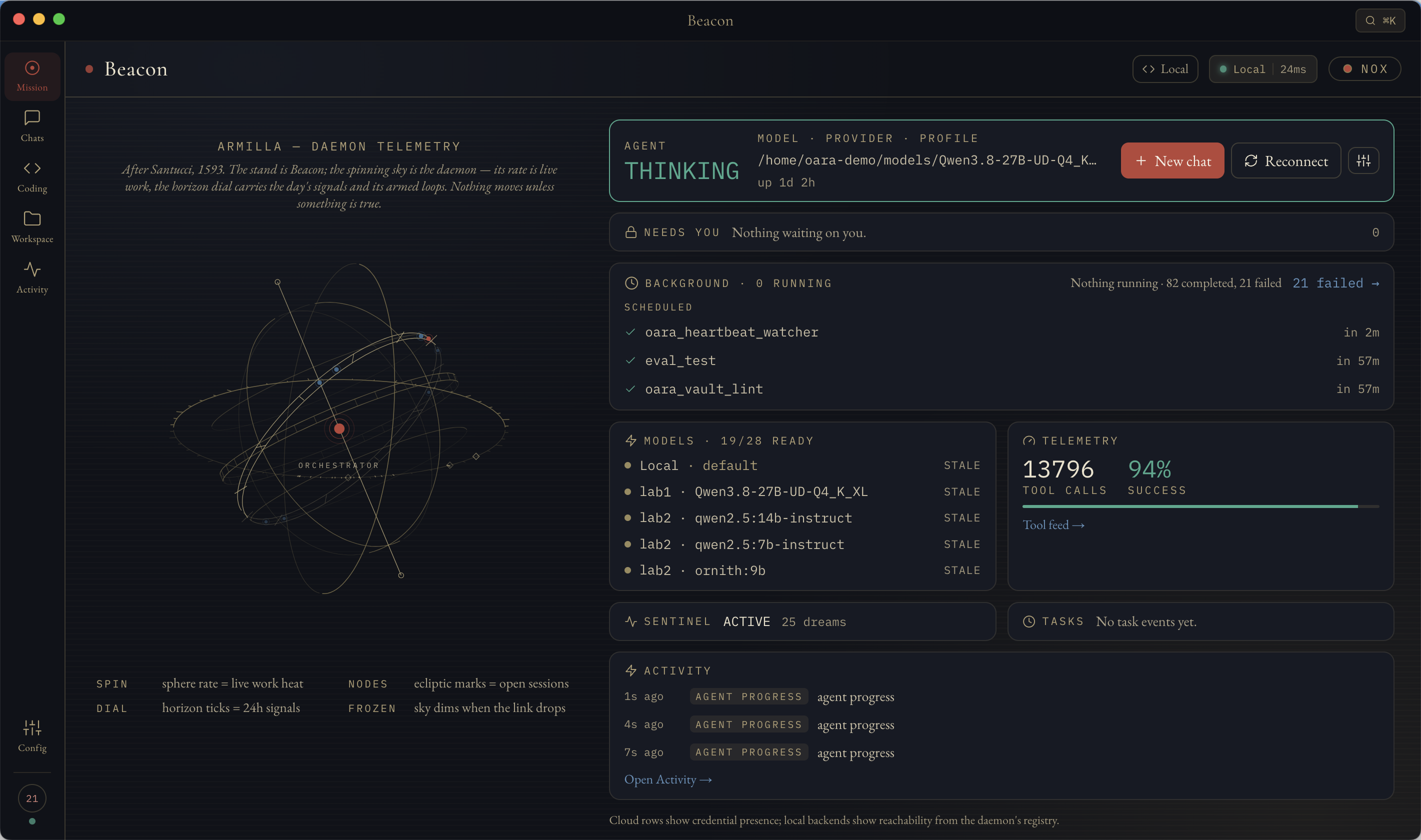
The counters in this screenshot are one rig's, not a benchmark. SENTINEL shows as active because that rig turned it on; it ships off.
Prometheus is two pieces that pair with a 6-digit code:
- The daemon — an always-on Python agent runtime that you can run as a systemd user service on Linux: cron and background tasks stored on disk, chat gateways (Telegram, plus Slack and Discord gateways on the same command layer, not yet run in production; all off until a token is added), lossless memory, a registry of every local inference box you own, opt-in coding runs in a sandboxed clone, a security gate, a Model Adapter Layer that repairs open models' tool calls, and a bearer-token REST + WebSocket control plane — plus an OpenAI-compatible
/v1 surface so anything that already speaks OpenAI can talk to it.
- Beacon — free to use, closed source, in beta. Its native desktop cockpit (macOS / Linux): chat with live tool timelines and
@-references, Mission Control, a Loop Manager for coding runs, per-turn file checkpoints you can restore, a documents editor with AI redlines, Kanban, telemetry feeds, and per-provider key management. Beacon for iOS rides the same control plane (per-device tokens, pagination); it is a private beta — request access at support@oara.ai with the subject "Beacon iOS".
pip install 'oara-prometheus[full]'   # Python 3.11+
# or, on Apple Silicon Macs only:
brew install oaralabs/tap/oara

oara setup          # auto-detects llama.cpp / Ollama / LM Studio / vLLM
oara                # chat in the CLI
oara daemon         # always-on: web API + gateways + cron + background layer
Use the full names. pip install oara installs a 0.0.0 placeholder that only reserves the name, and a bare brew install oara fails — the tap prefix is required.
To read, change, or test the code, install from a checkout instead:
git clone https://github.com/OAraLabs/Prometheus.git && cd Prometheus
pip install -e '.[full]'
(prometheus … still works as an alias for now; only the command name changed — the package and its paths did not.)
Running the tests from a uv-managed venv? Sync it with the same extras CI uses first:
uv sync --extra web --extra mcp --group dev
That is the environment the CI test job runs in, so a local run exercises the same tests (pip install -e '.[full]' above already covers everything).
oara setup probes for a running local inference server, generates your agent's identity, writes a working config with the web API enabled, and smoke-tests the loop. In a hurry? oara setup --fast (or --noninteractive) is the three-question version. On first daemon start a web API token is minted and printed once — oara token show re-prints it. If anything misbehaves: oara doctor.
oara-prometheus has been on PyPI since 0.9.0. Every way to install, uv tool / pipx from Git included, is under Install.
What it gives you:
- Always on, on your box — run it as a service (
oara install-service: a systemd user service on Linux, a LaunchAgent on macOS) and it keeps going after you walk away. Background tasks are stored on disk: a watch resumes after a daemon restart, and a run that a restart cut off is marked failed instead of left "running". With the Telegram gateway set up, it messages you when a task finishes or fails, and pings every 10 minutes while a long one is still running. Cron jobs take cron syntax or plain English ("every weekday at noon"), and pass the security gate when they're created and again when they run.
- Always-on gateways — Telegram, plus Slack and Discord gateways on the same command layer (not yet run in production). All off until a token is added. Mid-turn
/steer and /queue let you redirect or line up work while the agent is mid-task.
- Tool-call repair for open models — a Model Adapter Layer validates every call and auto-repairs common errors (fuzzy names, JSON inside markdown fences, type coercion). On llama.cpp, when the server isn't parsing a model's tool calls natively, Prometheus supplies a GBNF grammar, so tool calls are constrained while the model is still generating. For models that call tools natively (per the model registry or the server's chat template), the daemon picks a lighter tier and mostly stays out of the way.
- Every GPU box you own, one table — name your inference boxes under
backends: and each becomes a slash command and a row in the model picker: /4090, /mini, /mini qwen2.5:7b-instruct. The daemon probes each box (served model, reported context window, detected vision, latency), refuses to switch a chat to a box that is down and says why, budgets the conversation at that box's window, and remembers the choice across restarts. /backends shows the table; /local brings a chat home.
- Visible memory that rides every prompt —
MEMORY.md and USER.md you can read, structured facts mined from conversations every 30 minutes, and passive recall that FTS-matches each message against the memory store and injects what's relevant.
- Lossless context — older turns are summarized in the live window; the originals stay in SQLite, full-text searchable, and the stored summaries expand back to them, until you purge the session.
- Coding Mode (opt-in) — point it at a repo and an acceptance command; it iterates to green in a sandboxed clone and hands you a reviewable branch. Never merges, never pushes. Off until you set
coding.enabled: true.
- A working directory per conversation, with undo —
/workspace <path> points a chat at a repo; the security gate follows it, project instructions (PROMETHEUS.md, CLAUDE.md, AGENTS.md, GEMINI.md, .cursorrules…) load from it, and every turn takes a file checkpoint first so a bad edit is one REST call (or one Beacon click) from undone.
- Sees what you show it — images reach a vision-capable model as images, not paraphrases; stored by reference so the bytes never bloat the transcript.
@file, @diff and @url in the composer resolve on the daemon, scoped to the conversation's workspace.
- Telemetry that stays home — every tool call, repair, and token count logged to SQLite on your own disk and sent nowhere. It's the raw material for tuning the adapter, and the capture/export half of a fine-tuning loop (the training half is not built): the data big labs keep for themselves, kept by you instead.
- A desktop cockpit — Beacon (free to use, closed source, in beta) pairs to the daemon over your LAN or tailnet and gives every subsystem a native surface; the model picker groups your own boxes above the cloud presets with each box's health.
Status: Active development. Expect rough edges. Fixes land weekly. Feedback welcome.
Deeper docs — the guide pages under docs/guide/:
Install & first flight · Feature reference · Beacon desktop · Coding Mode & Loop Manager · Record a Skill · Memory & knowledge · Models & providers · HTTP & WebSocket API
What we built from scratch
The interesting work is original:
- Model Adapter Layer — the gap between Claude-quality tool-calling and what open models actually produce. Validates, auto-repairs, enforces output schemas, retries with specific error context.
- SENTINEL — a proactive layer that watches for idle time and acts, instead of only reacting to prompts. Nudges, dreams, synthesizes. Opt-in: it ships off.
- Wiki Knowledge System — turns every conversation into a compounding knowledge base that cross-references itself over time.
- The coding engine's iterate-to-green policy — "done" is a verdict, not a claim: sandboxed rounds until the acceptance command exits 0, with failure-fingerprint step-back and zero-progress aborts.
- The fine-tuning gym — frozen task-sets, dual scoring (raw emission vs post-repair execution), and a refusal to declare winners it can't statistically back.
- SYMBIOTE — code assimilation and self-modification. Scout researches GitHub, Harvest clones and vets (license gate, AST-level security scan), Graft adapts and integrates with provenance headers and a full test run, and MorphEngine hot-swaps the result via blue-green deploy with automatic rollback, backed by a backup vault. Experimental, off by default — powerful and unstable; treat it as a research feature.
The guards
A passing test proves the code runs. It does not prove anything calls it. Every guard below exists because a feature was built, tested, green — and never wired; each one is a test that fails the build rather than a convention someone has to remember.
| The invariant |
Enforced by |
| No source file may resolve the wiki root independently — one resolver, or the build fails |
test_no_site_resolves_the_wiki_root_independently (#131) |
| Every key in the live config must exist in the shipped template — live ⊆ template, with no allowlist. (Compares against a real install, so it skips on a fresh clone where there is no live config to compare) |
test_every_live_config_key_exists_in_the_default_template (#133) |
| A register of config keys with no reader that can only shrink — an unregistered key with no reader fails, and a registered key that gains one fails as stale |
test_no_new_config_key_without_a_reader · test_known_unread_register_is_not_stale (#136) |
Every tool's example_call must validate against its own input model — the adapter puts one in the error a model gets back after a failed call, so a wrong one teaches the model a parameter that does not exist |
test_every_example_call_validates_against_its_input_model · test_the_walk_reaches_every_class_that_declares_an_example (#670) · test_example_call_uses_real_param_names (#134) |
| Every media and rate check declares fail-closed or fail-open at construction — the registry is built at module level, so an undeclared guard is an import error, not a test failure |
test_every_guard_declares_its_enforcement · test_a_guard_without_enforcement_cannot_be_constructed (#140) |
| An acceptance test that terminates in a registered test double fails — registration is what makes a double detectable, wildcard exemptions are refused, and only individually-named doubles can be let through. An unregistered substitute is the known gap, and raises a loud warning rather than passing silently |
test_tripwire_end_to_end — spawns a real inner pytest against the actual enforcement hook (TRIPWIRE, #75) |
| Every allowlisted file type must be provably admitted, not merely "not refused" — breach tests prove the door closes; only admission tests prove it opens |
test_every_advertised_document_extension_is_admitted (#141) |









