Project Oracle




Your AGENTS.md says npm run test. The repository deleted that script six
months ago. Every coding agent reads the context file as truth and nobody
checks it. Project Oracle checks it: which lines the repository backs, which it
contradicts, and which are unfalsifiable noise — then writes the file in the
first place when you don't have one.
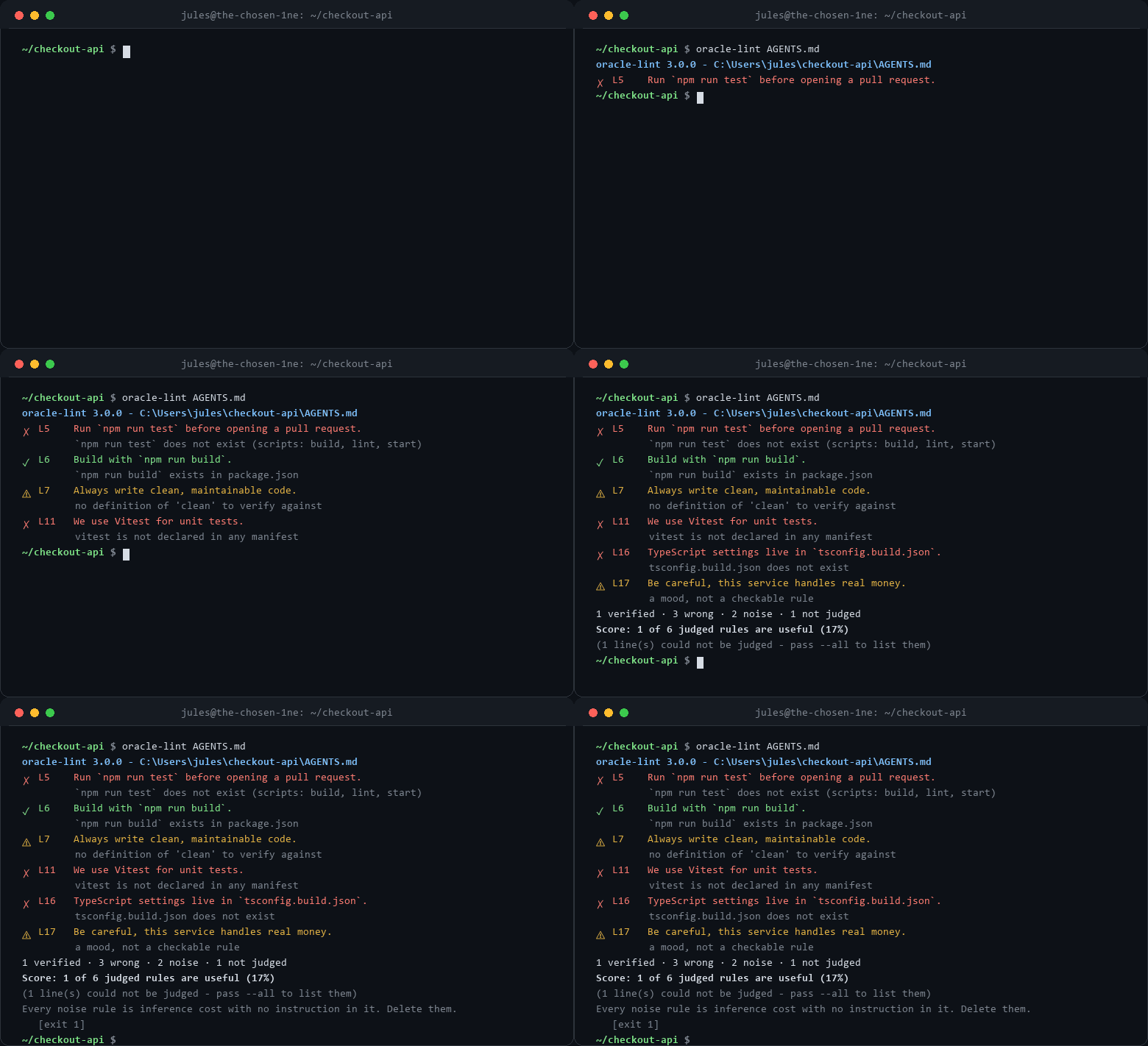
A real run, unedited: oracle-lint on a project whose AGENTS.md had drifted —
three rules contradicted by the repository, two unfalsifiable, one verified, exit 1.
Zero dependencies: pure Python 3.11+ standard library, cross-platform
(Windows, Linux, macOS).
The problem
A context file rots exactly the way any untested doc rots. A script gets renamed,
a folder is deleted, a "convention" is copied from another project — and the
agent follows all of it with total confidence, then spends your tokens
rediscovering what the repository already knew. It is the one file in the repo
that nothing verifies.
Audit the file you already have
pipx install project-oracle
oracle-lint AGENTS.md
Three verdicts, each one earned against the repository rather than guessed:
| Verdict |
Means |
Real output |
| ✗ contradicted |
the repo disproves the rule |
`npm run test` does not exist (scripts: build, lint, start) |
| ⚠ noise |
nothing in it is checkable |
no definition of 'clean' to verify against |
| ✓ verified |
the repo backs the rule |
`npm run build` exists in package.json |
It judges a rule by looking for the claim inside it: a cited script against
package.json, a declared tool (pytest, vitest, jest, eslint, ruff,
black, mypy, prettier, typescript) against the manifests, a cited config
file against the filesystem — any path or dotted name (config/ruff.toml,
tsconfig.build.json) plus recognisable names like tsconfig.json,
pyproject.toml or docker-compose.yml — and a TypeScript strict claim
against tsconfig.json. A citation introduced by "add" or "create" is advice
about a file that does not exist yet, not a false description of the repository,
so it is left alone. Anchored rules it cannot judge are reported as not judged
instead of being silently counted — --all lists them.
Exit is non-zero when too much of the file is noise, so it can gate CI:
oracle-lint AGENTS.md --max-noise 20     # allow 20% noise (default 50)
oracle-lint CLAUDE.md --strict           # any noise at all fails
oracle-lint AGENTS.md --json             # machine-readable
Works on files you did not generate. That is the point: an agent wrote your
CLAUDE.md, or you copied it from another project, or it drifted for a year
while nobody read it.
Stop the drift in CI
oracle-check re-reads the repository and exits non-zero when the generated
context no longer matches it — so the stale file fails the build instead of
lying to the next agent:
oracle-check --path . --agents AGENTS.md
As a GitHub Action, with no install step — it runs the scripts from its own
checkout:
- uses: actions/checkout@v5
- uses: iruzen-dono/project-oracle@v3
  with:
    agents: AGENTS.md
    lint: "true"      # also audit the file for noise
    max-noise: "20"   # fail above 20% noise
Generate the file
When there is no context file yet, the scanner writes one — and it keeps the part
no scan can see. It interviews you for the project's intent and known pitfalls,
then embeds both, so the agent reads the landmines before it touches code.
# 1. Scan a project (writes <project>/.oracle/scan-report.json,
#    and adds .oracle/ to the project's .gitignore when missing)
oracle-scan --path /path/to/project --output /path/to/project/.oracle/

# 2. Generate AGENTS.md, embedding the interview answers
oracle-generate \
  --scan .oracle/scan-report.json \
  --template agents-md \
  --output /path/to/project/AGENTS.md \
  --intent-file .oracle/intent.json

# 3. (Optional) push a note into your Obsidian vault
oracle-vault --scan .oracle/scan-report.json --vault ~/Documents/"Obsidian Vault"
Four templates (agents-md, claude-md, an Obsidian note, or all in one pass),
--output accepting a directory (.oracle/ or .oracle) or an explicit JSON
file path, and safe regeneration: content between <!-- oracle:start/end -->
markers is refreshed in place so your edits outside survive; anything else
requires --force and keeps a .bak backup.
What the scanner gets right
- Every framework, not just the first — a Next.js + Express + Socket.IO + React project lists all four
- Real, runnable commands — npm scripts captured with their actual shell command, not just the name
- Environment variable names — read from
.env.example; values are never copied and the real .env is never opened
- Secret-safe git context — remote URLs are credential-masked (
https://***@host/...) and de-duplicated
- 28 languages detected — Python, Java, Kotlin, TypeScript, Go, Rust, PHP, C#, Ruby, and more
- Build system + test detection — Maven, Gradle, npm/yarn/pnpm/bun, uv/pip, Cargo, Go modules, Composer; Jest, Vitest, pytest, JUnit, and test-file counts
- Monorepo aware — nested manifests discovered up to 2 levels deep
- Pruned during the walk, not after —
node_modules, .venv, .next, dist and the rest are skipped as they are encountered. On a fixture with 12 TypeScript files and a 4000-file node_modules, the scan reports TypeScript 100 % in 0.30 s; --include-vendored makes the same tree report JavaScript 99.7 % across 4015 files. The choice is recorded in the report, so oracle-check re-counts the same way
- Cross-platform —
pathlib everywhere, no platform-specific code
Install
Five commands land on your PATH: oracle-scan, oracle-generate,
oracle-vault, oracle-check, oracle-lint.
pipx install project-oracle
# or
uv tool install project-oracle
Renamed in 3.0.0. The package used to be published as
hermes-project-oracle, and the repository was iruzen-dono/hermes-project-oracle.
The old name still installs: its final release is an empty pointer that depends
on this package, so an existing install migrates itself on upgrade. New installs
use the name above.
As a skill — for Claude Code, Cursor, Codex, Hermes. The zip carries only
what the skill needs (SKILL.md, scripts/, references/, plus LICENSE and
README.md), no .git/, tests or build artifacts:
git clone https://github.com/iruzen-dono/project-oracle.git
cd project-oracle
python package_skill.py          # builds project-oracle.zip + validates it

# Claude Code / generic SKILL.md agents
unzip project-oracle.zip -d ~/.claude/skills/

# Hermes Agent
unzip project-oracle.zip -d ~/.hermes/skills/
On Windows (PowerShell): Expand-Archive project-oracle.zip -DestinationPath $HOME\.claude\skills\
Running from a skill install instead? Prefix with python $SKILL/scripts/
(SKILL=~/.claude/skills/project-oracle) — the flags are identical. Run
any script with --help for all flags.
Scripts
| Script |
Purpose |
scripts/oracle_lint.py |
Audit a context file: verified / contradicted / noise |
scripts/oracle_check.py |
Fail CI when the context has drifted from the repo |
scripts/oracle_scan.py |
Deep project scan → JSON report (28 languages, credential-safe) |
scripts/oracle_generate.py |
Report → context files (4 templates + optional intent file) |
scripts/oracle_vault.py |
Push a structured note into an Obsidian vault |
Docs
Development
pip install -e ".[dev]"
ruff check .                    # lint (deterministic via ruff.toml)
mypy scripts/ --ignore-missing-imports
pytest tests/ -v                # unit + end-to-end (scan → generate → vault)
pytest tests/ --cov=scripts     # coverage
The end-to-end test builds a fixture Node project, runs the full pipeline, and
asserts the output is safe (no leaked tokens, no env values, no absolute paths)
and complete (commands, frameworks, env names, pitfalls).
Contributing
PRs welcome. The rules are in AGENTS.md
and the workflow — including how to add a lint rule — is in
CONTRIBUTING.md.
Security reports go through SECURITY.md.
The short version: cross-platform, add tests, preserve the zero-dependency
promise, and never introduce network calls or credential collection.
License
MIT









