What is Pyzed
- Native performance. Python describes the interface; layout, text and drawing are done by Iced 0.14 in
Rust (wgpu on the GPU, tiny-skia on the CPU as a fallback).
import pyzed takes about 35 ms.
- Simple. The Elm architecture: state,
update and view. A button can call a method directly
(on_press=self.save), and update accepts coroutines, generators and streams.
- More than 90 components ready to use: buttons, forms, virtual tables with hundreds of thousands of rows,
file tree, tabs, command palette, code editor, terminal, custom window frame, charts… They all follow the
current theme.
- Pyzed Design, a visual designer installed as an app: draw forms and components, write their code with
completion and diagnostics, build node-based shaders and run it all with F5.
- Effects and animations: animate any property, transitions between windows, glow, bloom, blur, glass and
WGSL shaders with
pz.shader.
- Games: a game loop (
pz.frames), held keys, sprites and particles with pyzed.game.
- AI: an agent panel inside Pyzed Design (Claude, OpenAI, Gemini, Copilot, local models…),
pyzed.agents
for your own apps and an MCP server so any agent can build apps with Pyzed.
- Zed themes: One, Ayu and Gruvbox included, any Zed theme, generated themes and the system's light/dark mode.
- Cross-platform: Linux, macOS and Windows (x86-64 and ARM). IBM Plex fonts and about 2000 Lucide icons
included.
- Headless screenshots:
app.screenshot("ui.png") renders without a GPU or a display, ideal for tests and
docs.
Installation
You need Python 3.10 or newer. There are wheels for Linux (glibc and musl), macOS and Windows, so Rust is not
needed.
uv add pyzed-ui                  # in a uv project
pip install pyzed-ui             # inside an activated virtual environment
python3 -m pip install pyzed-ui  # with the system Python (on Windows: py -m pip install pyzed-ui)
Optional extras: pyzed-ui[mcp] (MCP server) and pyzed-ui[agents] (AI agents in your apps).
The package is pyzed-ui on PyPI and is imported as pyzed. It is not related to the pyzed module of the
Stereolabs ZED camera SDK.
Pyzed Design is installed separately as an app, with installers for Windows and macOS and a script for Linux,
and it updates itself: see Download Pyzed Design.
Quick start
import pyzed as pz
from pyzed import ui


class Counter(pz.App):
    title = "Counter"
    size = (360, 220)

    def __init__(self):
        self.count = 0

    def update(self, message):          # messages can be any Python value
        if message == "increment":
            self.count += 1
        elif message == "decrement":
            self.count -= 1

    def view(self):
        return pz.center(
            pz.column([
                ui.heading(str(self.count)),
                pz.row([
                    ui.button("1", "decrement", icon="minus"),
                    ui.button("1", "increment", icon="plus", variant="solid"),
                    # ...or a callable, which is called directly
                    ui.icon_button("rotate-ccw", lambda: setattr(self, "count", 0), tooltip="Reset"),
                ], spacing=8),
            ], spacing=16, align="center"),
            bg=self.theme.editor,
        )


pz.run(Counter)
Continue with the quick start and the basic,
intermediate and advanced tutorials.
A complete project
pyzed new my-app          # a uv project: UI in ui/, backend in src/, ruff, ty and git
cd my-app
uv run pyzed design       # opens Pyzed Design on the project
uv run pyzed dev main.py  # hot reload: the window updates on save and keeps its state
uv run pyzed build        # an executable for this platform
More in Create a project and
Distribute.
Pyzed Design
A visual designer made with Pyzed, with Zed's interface: drag components onto a grid with anchors, edit their
properties and styles, double-click to write the code of each event and press F5 to run it.
- Form, component, shader and code views, with tabs that can be torn off into their own window.
- A Zed-grade code editor: completion with ty, diagnostics with ruff, multiple cursors, find and replace,
folding, minimap, configurable shortcuts and IME.
- Project: a file tree with Zed's menu, file search, dependencies with uv and a terminal.
- Custom components with typed properties, inheritance, data binding and validation.
- A built-in AI agent that reads the project, creates forms and complete apps and drives the editor through
Pyzed's MCP.
- It updates itself, like Zed, with a what's-new tab.
Full manual in Designer and
Shading.
Components
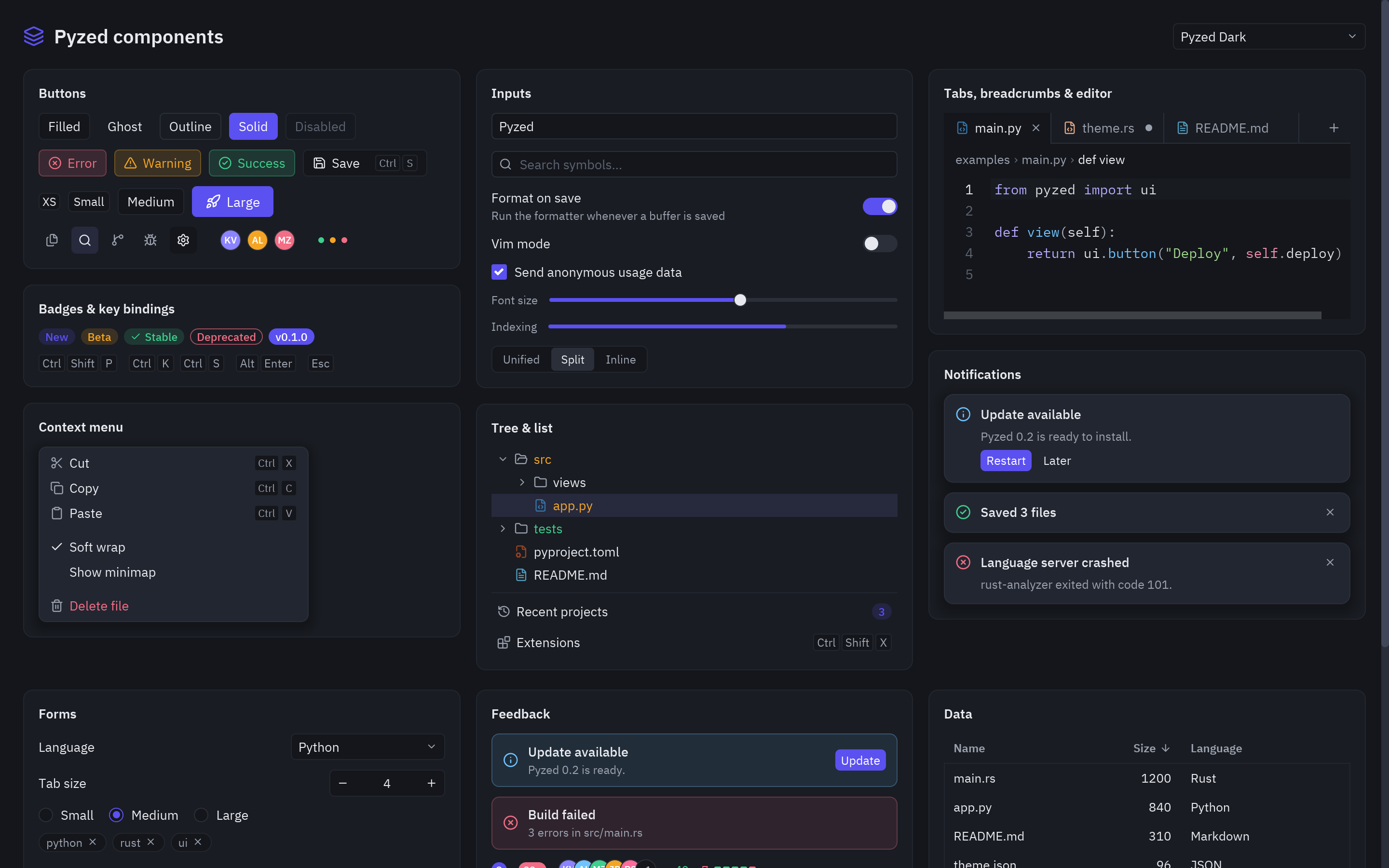
See them in motion (click one to open its page):
Every component has its own page with all its variants, examples and API in the
library. There are also ready-to-copy
blocks: sign-in screens, settings, dashboards…
Any widget has the usual events of a GUI builder (click, double_click, drag, key_down, resize…), and
custom components are classes with annotated props, state and events:
class Rating(pz.Component):
    value: int = 0
    events = {"change": "A star was picked"}

    def render(self):
        return pz.row([pz.text("★" if i <= self.value else "☆").on(click=lambda i=i: self.emit("change", i))
                       for i in range(1, 6)])
Animations and effects
Animate any property with presets, keyframes and timelines, move between views with transitions and add
glow, particles or your own WGSL shaders. See Animation and
Shading.
Games
Every game in examples/games has a step-by-step tutorial in
Games.
AI
-
Agent panel in Pyzed Design: sign in to Claude in the browser or with your subscription, or use OpenAI,
Gemini, GitHub Copilot, Vertex AI, OpenRouter, Ollama and more. Attach images, connect external MCP servers or
ACP agents (Gemini CLI, Codex…).
-
MCP server (pyzed mcp): Claude, Cursor, VS Code and other agents look up the exact API, generate and check
apps and see a screenshot of the result.
claude mcp add pyzed -- uvx --from "pyzed-ui[mcp]" pyzed mcp
-
pyzed.agents to add an agent with tools to your own apps.
See AI. For language models, the whole documentation is also available as
llms.txt.
Integrations
Tutorials and runnable demos with FastAPI, SQLAlchemy, SQLModel, Django, httpx and Pydantic:
where each thing runs (UI thread, asyncio loop, worker threads) and how to show validation errors in forms. The
code is in examples/integrations.
Why Pyzed?
Comparisons with tkinter, Qt, Kivy, Flet, Dear PyGui and Toga, with
measured, reproducible benchmarks of startup, memory, updates
and installed size (benchmarks/).
Examples
| Folder or file |
What it shows |
examples/counter.py, todo.py |
The basics: state, messages, forms and lists. |
examples/gallery.py |
Every component, interactive, with a theme picker. |
examples/zed_editor.py |
A complete code editor over a real folder. |
examples/showcase/ |
Game HUD, main menu, inventory, glass dashboard and shader gallery. |
examples/games/ |
Snake, Breakout and Neon Invaders. |
examples/integrations/ |
FastAPI, SQLAlchemy, SQLModel, Django, httpx, Pydantic and aiosqlite. |
examples/effects.py, animations.py |
Visual effects and animations. |
examples/window_frame.py |
A custom window frame with each platform's menus and buttons. |
examples/ai_chat.py |
A chat with an AI agent. |
examples/designer/ |
A Pyzed Design form (.pzform + .py). |
examples/tutorial/, hot_reload/ |
Step-by-step tutorial and hot reload. |
They all run with python examples/<file>.py (or uv run). More in
Examples.
How it works
Python                         Rust (pyzed._core, PyO3)                 Iced 0.14
App.view() ──► Widget tree ──► render.rs: Widget → iced::Element ──► layout + wgpu/tiny-skia
App.update() ◄── messages ◄────── app.rs: Message, Command → Task ◄──── events (mouse, keyboard)
Widgets are immutable Rust objects, so building the view from Python is cheap. The internal state of each editor
lives in Rust and the GIL is released while the event loop runs. More in
Architecture.
Developing Pyzed
git clone https://github.com/albakore/pyzed && cd pyzed
uv sync                     # builds the Rust core (1.88 or newer) and installs pyzed in editable mode
uv run pytest tests
uv run python examples/gallery.py
See CONTRIBUTING.md. Pyzed follows semantic versioning since 1.0; the
policy and known limitations are in Stability.
People
Pyzed grows with the people who use it. Thank you!
Maintainer
Contributors: thanks to everyone who reports bugs, proposes features and sends code.
See People for what each person did.
License
MIT. The bundled fonts are IBM Plex (SIL Open Font License) and Lucide (ISC); their licenses are in
assets/fonts. The One, Ayu and Gruvbox themes come from the Zed repository (MIT); see
python/pyzed/zed_themes/LICENSE.









