qrp-mcp
Offline post-quantum scanner for code: CycloneDX CBOM, RNG calls next to keys, what it did not read.
22 s, the real output of uvx qrp-mcp@0.52.0 scan on certbot at 56ee049, read back with jq and drawn frame by frame from that recording; the 5 s scan is shortened.
What it says about certbot at 56ee049, trimmed from
qrp-mcp scan (qrp-mcp 0.51.0): what it found, by role, and the files it did not read, with the
reason.
"verdict": "This scan read 850 of 1250 files (68.0%); the remaining 400 (3 of 20, by extension — files with no extension, .rst and .txt — being 76.14% of them) are listed with a reason each.",
"summary": {"pqc_readiness": "hybrid_partial", "by_role": {
  "key_establishment": {"families": ["DH", "ECDH", "ML-KEM", "X25519", "X448"], "pqc_readiness": "hybrid_partial"},
  "signature": {"families": ["DSA", "EC", "ECDSA", "Ed25519", "Ed448", "ML-DSA", "RSA"], "pqc_readiness": "hybrid_partial"}}},
"coverage": {"not_examined": [
  {"reason": "type_not_claimed", "count": 352, "by_extension": {"(no extension)": 147, ".rst": 97, ".txt": 24, "...": "..."}},
  {"reason": "symlink_not_followed", "count": 48, "...": "..."}]}
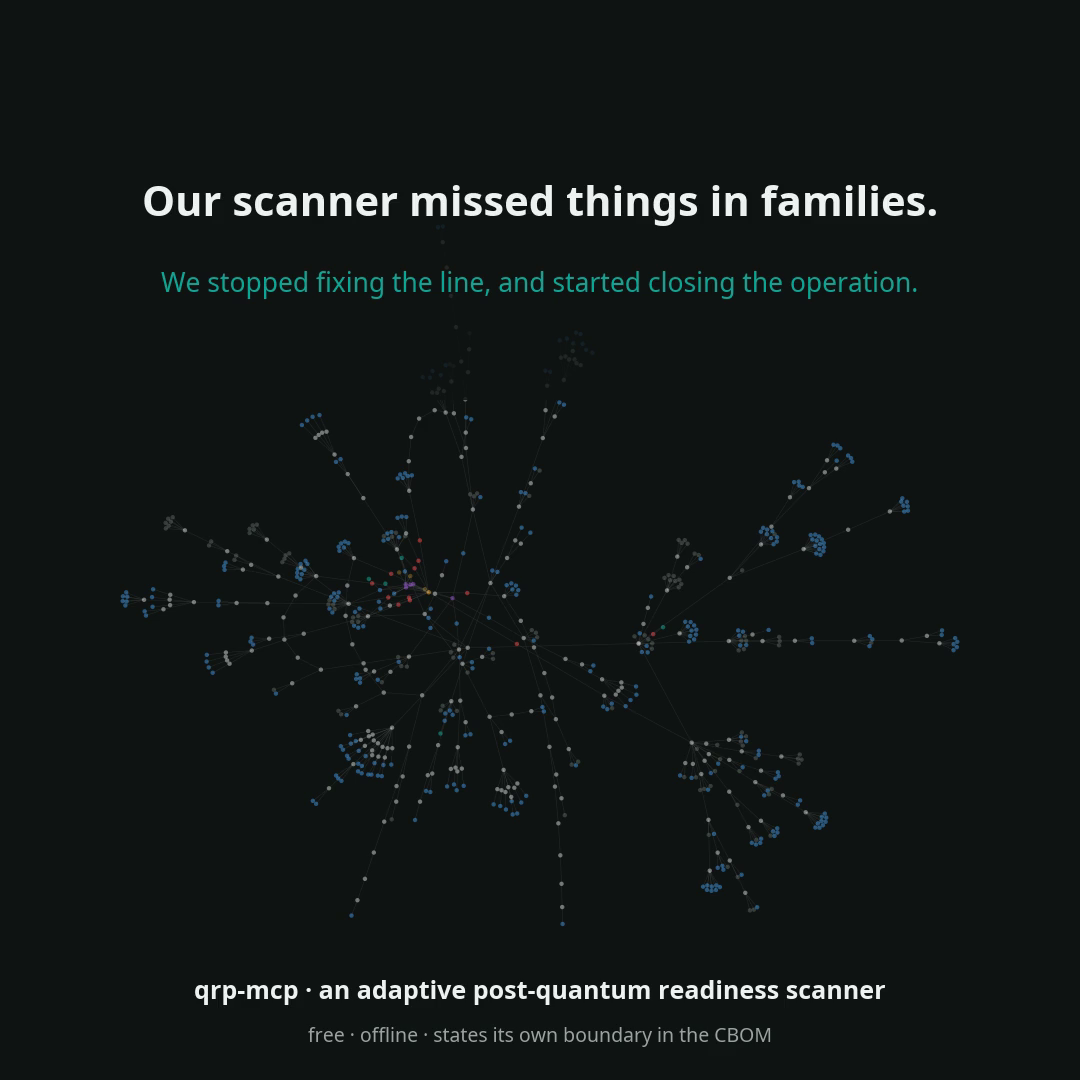 34 s: the fix list drawn as a network, and why closure is by operation. The method and the closure savings theorem: Tenev (2026), Zenodo, doi:10.5281/zenodo.24336932.
Every signature in your wallet, contract and validator rests on elliptic-curve cryptography, and
a large quantum computer breaks it. Plenty of tools will tell you what they found. This one also
tells you what it read, what it could not read, and which question it is not answering — in the
document itself, where an auditor can check it rather than take your word.
An MCP server that scans a local directory for cryptography that Shor's algorithm defeats —
secp256k1, Ed25519, BLS, Schnorr, RSA — plus weak primitives and CI signing commands, and
classifies each one: broken by a quantum computer, post-quantum, or neither.
Everything runs on your machine. No network calls, no account, no API key, nothing
uploaded. A tool that reads your keys' surroundings has no business phoning home, so this one
makes zero outbound connections — enforced by a test, not promised in a paragraph. The only process it
starts is a local git, to pin what it read, with the scanned repository's own hooks and filters disarmed.
flowchart TD
    R["Your repository, on your machine, at a commit"] --> Q["qrp-mcp — offline, zero network calls"]
    Q --> F["Found<br/>file:line and family"]
    Q --> N["Not read<br/>each file with its reason"]
    F --> J["scan --out result.json"]
    N --> J
    J --> O["CBOM (CycloneDX 1.6)<br/>SARIF<br/>closure: what a change closed"]
Need a cryptographic inventory (a CBOM) for a post-quantum migration or an audit, without
uploading your code? One command, no install step:
uvx qrp-mcp scan ~/code/my-project --out result.json
What comes back, run on this repository's own test fixtures -- the findings, and next to them
what the scan did not read:
"verdict": "This scan read 24 of 27 files (88.89%); the remaining 3 (1 of 1, by extension
            — .b64 — being 100.0% of them) are listed with a reason each."
"summary": { "total_findings": 10, "quantum_vulnerable_count": 6, "pqc_ready_count": 1,
             "weak_count": 1, "pqc_readiness": "hybrid_partial", ... }
Why this matters for chains and wallets
Bitcoin and Ethereum authenticate with ECDSA over secp256k1. Solana, Cardano and Polkadot
use Ed25519. Ethereum's consensus layer aggregates with BLS12-381. Taproot adds
Schnorr.
All four are public-key schemes whose security rests on discrete-log hardness — and all four
fall to the same quantum algorithm. The practical consequence is specific: once a public key
is exposed, the private key becomes derivable. Reused addresses, on-chain public keys,
and long-lived validator keys are where that exposure already exists today.
None of this is a prediction about dates. It is an inventory question: which of my code paths
sign with what? That question has an answer right now, and this tool gives it.
Quick start
Add it to your MCP client — no installation step, uvx fetches and runs it:
{
  "mcpServers": {
    "qrp": {
      "command": "uvx",
      "args": ["qrp-mcp"]
    }
  }
}
Then ask your agent:
Scan ~/code/my-protocol for quantum-vulnerable cryptography.
As a Claude Code plugin
The same server, packaged with a skill, so there is no config file to edit:
/plugin marketplace add StanimirTenev/qrp-mcp
/plugin install qrp@quantumreadiness
Then /qrp:pqc-scan in any project. Both routes need uv on
your PATH, since uvx is what fetches and runs the server.
Without an agent: write the result to a file
uvx qrp-mcp scan ~/code/my-protocol --out result.json
This produces the same result as the scan_repo tool, written to a file you can read
before it goes anywhere. Nothing is sent. By default (from 0.40.0, as cbom since 0.16.0 and
the tools) the quoted line is masked: everything in it but the algorithm name is starred out.
--level full writes the line as it is, and --level trimmed removes the line altogether; all
three keep each file and line number. The SHA-256 of the written bytes is printed,
so anyone you send the file to can quote back exactly what they received.
That digest is the file's integrity, and the file holds its read times, so two runs over one
commit print different ones. Beside it, findings sha256 is the fingerprint of the findings
alone (findings_fingerprint in the JSON, in SARIF's run properties and in the CBOM as
qrp:findings_fingerprint:sha256): the same on every run and at every --level that finds the
same, different when a finding is added or removed. Its normalisation rules are written into the
output beside it: each finding as family, raw value, classification and severity; each
occurrence as category, path, line, family, role and key size; excerpts, confidence, owners,
baseline state, mandate clauses, suppressed rows, coverage and the read window left out; both
lists sorted, serialised as compact JSON with sorted keys, SHA-256 in hex. It says the result
repeats; it says nothing about whether the result is complete.
uvx qrp-mcp cbom ~/code/my-protocol --out cbom.json
uvx qrp-mcp closure before.json after.json --out closure.json
cbom writes the same CycloneDX document as the export_cbom tool, masked by default because
it is the document built to be sent. closure writes the prove_closure verdict for two saved
scans, and names both inputs by their SHA-256, so the three files can be tied together by
whoever receives them. Both print the SHA-256 of what they wrote.
A control on your own tree
uvx qrp-mcp control ~/code/my-protocol --seed 1 --out control.json
From 0.43.0. The tree is copied to a temporary directory, known cryptographic uses (9 styles) and
lines that name an algorithm without using it (7 kinds) are planted into the copy, and the copy
is scanned with the same instrument. The result says which planted lines were found, which were
missed and which non-uses were reported as uses — robustness on known patterns, for this
version. It is not a statement about what your tree contains, and it never makes the coverage
claim stronger. scan --control-seed N carries the block in the result. The control.
A source scan against the build
uvx qrp-mcp scan ~/code/my-service --out scan.json      # before building
uvx qrp-mcp build-gap scan.json ~/code/my-service/bin/publish --out gap.json
From 0.44.0. Of K public-key-bearing packages or modules in the build, the source scan named J;
the K - J list; the families on one side only; and a Go binary's DefaultGODEBUG crypto
settings as recorded. It reads only tables the toolchain wrote (*.deps.json, .NET metadata
names, go version -m, go tool nm), never code, and never a key size from the build —
robustness on known patterns, not recall or coverage of the build. Source against build.
In GitHub code scanning
From 0.54.0 the repository is also a GitHub Action. It runs
uvx --from qrp-mcp==<this release> qrp-mcp scan PATH --format sarif --out FILE --level LEVEL on
the runner, and upload-sarif puts the results in the Security tab:
name: qrp-mcp
on: [push, pull_request]
permissions:
  contents: read
  security-events: write
jobs:
  scan:
    runs-on: ubuntu-latest
    steps:
      - uses: actions/checkout@v4
      - uses: StanimirTenev/qrp-mcp@v0.54.0
        id: qrp
        with:
          path: "."               # default; SARIF locations are relative to it
          level: masked           # default; full or trimmed
          output: qrp-mcp.sarif   # default
      - uses: github/codeql-action/upload-sarif@v4
        with:
          sarif_file: ${{ steps.qrp.outputs.sarif }}
          category: qrp-mcp
The inputs are only those scan already has; there is no "fail on" switch, and the step exits 0
on findings. Every file not read is in the SARIF as a tool execution notification with its
reason. Locations are relative to path, and code scanning reads them from the repository
root, so keep path at . when uploading.
How it adapts
An adaptive post-quantum readiness scanner. It closes operations against a catalogue of their
documented spellings, each with a test, says in its output which (operation, ecosystem) pairs are
closed, and carries its coverage and limits inside the CBOM. A maintainer tool in the repository
re-reads the documentation and proposes new spellings, which enter only with a source and a test.
"Adaptive" means one thing here: the operations in the scanner's catalogue are tested against the
documentation of the libraries and formats the catalogue cites, and a maintainer tool re-reads that
documentation for spellings the catalogue does not hold yet. The scan itself stays deterministic
and offline. Nothing is learned at run time, and no rule enters the scanner without a source and a
test.









