TL;DR
- Vulnerability scanning is automated, broad, and frequent, and reports weaknesses that might be exploitable; penetration testing is scoped, deeper, and less frequent, and attempts exploitation to prove which of those weaknesses actually are.
- Relying strictly on vulnerability scans leaves security teams with high false positive volumes and theoretical severity scores that do not demonstrate whether an attacker can reach a vulnerability.
- Dynamic Application Security Testing (DAST) acts as a hybrid technique that tests running web applications from the outside using automated payloads, but it cannot chain footholds, prove post-exploitation impact, or identify broken business logic.
- Autonomous agentic pentesting enables continuous validation by coupling exploit-grade verification directly to code releases and infrastructure changes rather than arbitrary annual calendars.
- AI does not replace human penetration testers; autonomous agents provide high-frequency coverage and regression testing, while humans remain critical for business logic analysis, novel attack chains, and production-safety decisions.
- Regulatory standards like the Payment Card Industry Data Security Standard (PCI DSS) v4.0.1 treat vulnerability scanning and penetration testing as distinct compliance controls, establishing that neither can substitute for the other.
- Effective remediation requires an unbroken verification loop that traces every validated exploit directly to the responsible code repository and retests the exact attack path before ticket closure.
What’s hiding in your own code?
See what needs fixing first.
Why Does the Difference Between a Scan and a Pentest Matter?
Vulnerability scanning and penetration testing are often mentioned in the same breath, but they address fundamentally different problems. A vulnerability scan reports potential weaknesses across an entire digital estate on an automated schedule, identifying flaws that might be exploitable under theoretical conditions. A penetration test takes a tightly scoped environment and actively attempts exploitation, proving which specific weaknesses an adversary can actually use to breach defenses.
Conflating these two disciplines introduces acute operational risk, particularly as threat actor patterns shift. According to the 2026 Verizon Data Breach Investigations Report (DBIR), 31% of breaches now start with software vulnerabilities as their initial access vector, outpacing stolen credentials for initial entry.
At the same time, defensive remediation velocity is falling behind. The same report finds that only 26% of critical vulnerabilities, defined specifically as those listed in the Cybersecurity and Infrastructure Security Agency (CISA) Known Exploited Vulnerabilities (KEV) catalog, were fully remediated in 2025, dropping sharply from 38% the prior year. Compounding this challenge, the median time required to resolve these vulnerabilities stretched from 32 days to 43 days.
Organizations cannot resolve this deficit by simply running more scanners and generating longer backlogs. Raw vulnerability scans produce sprawling lists of candidate weaknesses marked with abstract severity scores. They do not reveal whether a discovered flaw is reachable in practice, whether compensating controls neutralize the attack path, or how multiple minor findings can be chained together to compromise a database.
To bridge the gap between theoretical exposure and actual risk, engineering teams must move beyond the Common Vulnerability Scoring System (CVSS), Exploit Prediction Scoring System (EPSS), and basic reachability metrics to prioritize fixes based on proven exploitability. An unverified severity score cannot dictate an effective order of remediation work, but an exploit-validated finding can: it proves that an attacker has a demonstrable path to using the flaw, putting it at the front of the remediation queue.
What Does Vulnerability Scanning Do, and What Can’t It Prove?
As defined by the National Institute of Standards and Technology (NIST) in SP 800-115, vulnerability scanning is a technique used to identify hosts, host attributes, and associated vulnerabilities. In practice, scanning operates through automated tools that inspect broad inventories of network devices, servers, containers, and applications against vast databases of known security flaws and misconfiguration signatures. These tools query target systems, inspect software banners, evaluate patch versions, and check system configurations, running on periodic schedules or embedded directly into continuous integration and continuous deployment (CI/CD) pipelines.
Organizations classify vulnerability scanning along two primary operational axes:
- Authenticated vs. Unauthenticated: An unauthenticated scan probes network boundaries from the outside without credentials, observing only what exposed services and open ports present to the network. An authenticated scan uses administrative or service credentials to log into target hosts, allowing the scanner to inspect local package registries, software libraries, registry keys, and internal system configurations.
- Internal vs. External: External scans probe internet-facing IP addresses, web domains, and perimeter firewalls to map exposure visible to outside attackers. Internal scans execute from within the private network perimeter to identify outdated internal dependencies, unpatched servers, and misconfigurations that an intruder could leverage after gaining initial access.
These two dimensions translate into standardized baseline requirements within established cybersecurity frameworks. For example, the Center for Internet Security’s CIS Controls v8.1 Safeguards 7.5 and 7.6 codify these cadences in practice: Safeguard 7.5 prescribes performing automated vulnerability scans of internal enterprise assets on a quarterly or more frequent basis using both authenticated and unauthenticated scans, while Safeguard 7.6 establishes automated vulnerability scans of externally exposed assets on a monthly or more frequent basis.
The Inherent Boundary of Scanning
Despite its utility as a broad inventory and hygiene tool, vulnerability scanning has fundamental operational boundaries. A scanner merely infers the presence of a flaw through circumstantial evidence, such as an outdated version string or a default configuration flag. It does not execute safe exploitation to confirm whether that version is actually invoked, reachable, or shielded by external firewalls and web application firewalls.
Furthermore, scanners examine vulnerabilities in isolation. They cannot chain a low-severity information disclosure on one service with an unauthenticated configuration weakness on another to demonstrate an end-to-end compromise. OX Research’s 2026 disclosure of a four-vulnerability exploit chain in DataEase shows what that looks like in practice. An authentication bypass, listed in the Common Vulnerabilities and Exposures (CVE) catalog as CVE-2026-23958, combines with three further flaws (CVE-2026-40899, CVE-2026-40900, and CVE-2026-40901) to give an unauthenticated attacker remote code execution as root. That outcome comes from a combination of the entire chain; no single CVE in the chain could allow this exploit in isolation. Scanning on its own produces a high volume of theoretical findings and false positives, shifting a massive triage burden onto internal security teams who must manually investigate whether a flagged vulnerability represents an exploitable path.
What a Penetration Test Proves
According to NIST SP 800-115, a penetration test is security testing in which evaluators mimic real-world attacks to identify ways to circumvent the security features of an application, system, or network. NIST further emphasizes an essential operational nuance: most penetration tests intentionally search for combinations of vulnerabilities that, when chained together, allow an attacker to gain far greater access than any single vulnerability would grant in isolation.
A penetration test moves past hypothetical exposure to prove three concrete facts:
- Real-World Exploitability: It demonstrates that a specific flaw can be actively exploited in your environment, accounting for live network architecture, existing filters, and defensive controls.
- Actual Blast Radius: It reveals what an attacker reaches once access is achieved, such as backend databases, sensitive user data, or privilege escalation paths.
- Verifiable Proof of Concept: It produces explicit technical evidence for each finding, documenting request and response logs alongside step-by-step reproduction instructions.
The Three Assessment Perspectives
Penetration testing approaches are classified by the level of contextual knowledge and environment access granted to the evaluators:
| Testing Model | Evaluator Access Level | Operational Focus |
|---|---|---|
| Black-Box | Zero internal knowledge; public endpoints only | Simulates an unauthenticated external adversary mapping public exposure from scratch |
| Grey-Box | Partial knowledge; standard user credentials and API documentation | Simulates an insider or an external attacker who has breached initial perimeter defenses |
| White-Box | Full transparency; architecture designs, APIs, and source code access | Maximizes technical depth to uncover intricate logic flaws and deep architectural misconfigurations |
The Inherent Boundary of Penetration Testing
Despite the depth and high confidence of its findings, a penetration test is strictly constrained by its agreed boundary. It proves exploitability exclusively within the defined targets, against the authorized systems, and during the designated execution window. Any application, API endpoint, or infrastructure component left outside that explicit scope remains unexamined, and any novel vulnerability introduced to production after the test concludes is entirely unrecorded.
Penetration Testing vs Vulnerability Scanning, Side by Side
Vulnerability scanning and penetration testing serve fundamentally different functions in an information security program. The table below compares both approaches across their primary operational dimensions:
| Comparison Dimension | Vulnerability Scanning | Penetration Testing |
|---|---|---|
| Scope | Broad across all network assets, subnets, repositories, and cloud workloads | Narrowly scoped to specific applications, APIs, network segments, or system boundaries |
| Depth | Surface level inspection matching software banners, versions, and configuration flags against known vulnerability databases | Deep contextual assessment that attempts active exploitation, bypasses security controls, and chains multiple flaws together |
| Frequency | High frequency, running continuously in build pipelines or on automated daily, weekly, or monthly schedules | Lower frequency, typically performed annually, semi-annually, or following significant architectural updates |
| Proof of Exploit | None. Inferred theoretical vulnerability based on heuristic indicators, resulting in higher false positive rates | Confirmed. Generates verifiable proof of concept evidence demonstrating successful access, privilege escalation, or data exfiltration |
| Execution Ownership | Automated commercial or open source scanning engines, configured, maintained, and triaged by internal security staff | Qualified human ethical hacker, red team specialist, or autonomous agent executing within agreed rules of engagement |
| Compliance Mandate | Evaluated as recurring hygiene; Payment Card Industry Data Security Standard (PCI DSS) v4.0.1 Requirement 11.3 mandates internal and external scans at least once every three months, with external scans executed by an Approved Scanning Vendor (ASV) | Evaluated as active validation; PCI DSS v4.0.1 Requirement 11.4 mandates internal and external penetration testing at least once every 12 months and after any significant infrastructure or application upgrade or change |
This side-by-side comparison highlights why neither security methodology can replace the other. Vulnerability scanning provides broad, continuous visibility across every asset in your inventory to catch unpatched software, while penetration testing proves whether a specific vulnerability exposes real business risk. An organization that relies exclusively on scanning remains blind to exploitable attack chains, while an organization that relies solely on periodic penetration tests misses routine vulnerabilities that emerge between testing cycles.
Pen Testing vs DAST: Where Does DAST Fit?
Dynamic Application Security Testing (DAST) occupies the middle ground between a broad network vulnerability scan and a full penetration test: it operates as an automated testing mechanism, like a scan, while interrogating a running application from the outside, like a penetration test, but stops short of validating real post-exploitation impact.
As outlined in the Open Worldwide Application Security Project’s OWASP DevSecOps Guideline, DAST is black-box testing that identifies vulnerabilities in a running application by injecting malicious payloads. It primarily targets runtime weaknesses such as SQL injection (SQLi) and cross-site scripting (XSS), proving especially useful for diagnosing input and output validation errors, authentication failures, and server misconfigurations.
While DAST moves closer to offensive testing than basic version matching, it contrasts sharply with a true penetration test across four primary technical boundaries:
- No Foothold Chaining: A DAST engine dispatches predefined payloads and parses incoming HTTP status codes and responses. However, when a payload indicates a potential flaw, the scanner cannot use that preliminary foothold to pivot laterally, harvest credentials, or probe internal microservices.
- Surface Indicators Over Impact: DAST reports what appears vulnerable based on response reflections or timing anomalies. It does not construct an end-to-end exploit to prove what sensitive records, administrative controls, or database tables an attacker could extract.
- Staging and CI Alignment: DAST requires an active, accessible runtime environment, making it suitable for automated test suites and nightly integration runs against pre-production or staging environments. Conversely, a penetration test is an intensive engagement executed against production or production-mirror environments.
- Inability to Detect Business Logic Flaws: Because DAST relies on pattern matching against dynamic responses, it cannot evaluate business context. It cannot detect flaws like multi-tenant authorization bypasses, workflow circumvention, or race conditions in checkout flows.
Furthermore, because DAST evaluates applications strictly from the outside, its output consists of raw HTTP request and response logs with no direct file path or line of source code attached.
Is Pentesting Being Replaced by AI?
Agentic AI is not replacing penetration testing; rather, it is fundamentally altering how often and how thoroughly assessments run, while narrowing the human tester’s focus toward tasks automation cannot reliably handle.
What Agentic Pentesting Changes
The primary driver of this shift is the emergence of agentic pentesting as a testing category. An agentic pentester operates as an autonomous, AI-driven engine capable of planning offensive campaigns, selecting specific exploitation utilities, interpreting intermediate outputs, and adapting its attack strategies dynamically without requiring human intervention at every step.
Within modern engineering environments, continuous validation couples testing directly to change. Rather than awaiting an arbitrary annual calendar date, tests execute automatically following major code commits, architectural adjustments, or infrastructure deployments. Against the side-by-side comparison table, this shift moves pentest-grade proof of exploit and safe validation substantially closer to the high frequency traditionally reserved for vulnerability scanning, as explored in depth across our analysis of automated penetration testing methodologies.
Where Human Testers Still Lead
Despite these advances, autonomous agents operate within distinct boundaries. A benchmark study published on arXiv by researchers at Stanford in December 2025 directly compared this dynamic by pitting an experimental multi-agent research framework, named ARTEMIS, against ten human cybersecurity professionals across a live university network consisting of roughly 8,000 heterogeneous hosts. The Stanford ARTEMIS study found that although ARTEMIS achieved second place overall, ahead of nine of the ten human participants (technically recording 9 valid vulnerabilities with an 82% valid submission rate), it also exhibited higher false-positive rates and struggled disproportionately with graphical user interface (GUI) tasks, such as navigating modern administrative consoles.
Complex business logic remains an equally rigid boundary for automation. As documented in the OWASP Web Security Testing Guide, business logic flaws cannot be identified by an automated vulnerability scanner because automating business logic abuse cases is fundamentally not possible without human contextual awareness. Software workflows, permission delegations, multi-step purchase sequences, and nuanced transaction rules depend on contextual business intent that automated engines cannot infer on their own.
Furthermore, human specialists maintain critical advantages in defining assessment scopes and exercising production safety judgment, ensuring aggressive payloads do not corrupt live databases or disrupt core availability.
The prevailing operational model highlighted in our review of AI pentesting vs traditional pentesting is a collaborative division of labor: autonomous agents supply high-frequency breadth, continuous regression checks, and rapid proof-of-concept verification, while skilled human evaluators focus on intricate business logic, novel exploit chains, and authoritative sign-off.
How Do You Combine Scanning, DAST, and Pentesting in One Program?
A mature application security program does not pit testing methodologies against each other. Instead, it constructs a multi-layered validation architecture where each layer operates at a distinct cadence, targets a specific execution phase, and answers a unique risk question.
An effective testing architecture deploys across four coordinated tiers:
- Vulnerability Scanning Across the Estate: Automated scans run against code repositories during every build, supplemented by periodic authenticated scans across internal servers, cloud configurations, and containers. When selecting platforms, security teams evaluate factors like database coverage and deployment integration, as detailed in our guide to vulnerability scanning tools.
- DAST in Pre-Production Pipelines: Dynamic testing initiates within automated continuous integration workflows, running against running staging environments to evaluate dynamic API endpoints and web interfaces for input handling errors before code reaches production.
- Agentic Pentesting for Change-Driven Validation: As an emerging testing category, agentic pentesting executes when code updates, new APIs, or perimeter infrastructure changes occur. It automatically validates whether candidate weaknesses flagged by earlier scans can be chained into active proof-of-concept exploits, transitioning security teams from annual audits to continuous validation.
- Human-Led Penetration Testing for Critical Systems: Human penetration testers conduct deep, scoped assessments at least once a year and immediately following significant architectural overhauls. Their efforts focus where automation struggles: evaluating complex multi-tenant access logic, transaction workflows, core business models.
Connecting these layers ensures testing efforts reinforce each other rather than operating in isolation. Confirmed penetration testing results feed directly back into vulnerability scanners to refine rule sets and suppress false positives.
Furthermore, every validated finding must link to a specific code repository and an assigned developer owner. When engineering deploys a patch, the remediation must undergo an automated or manual retest against the exact original exploit path before the security ticket is marked closed.
Where Scan and Pentest Programs Go Wrong
Security programs that fail to distinguish between scanning, dynamic testing, and penetration testing repeatedly stumble into predictable operational traps:
- Purchasing Scans Disguised as Pentests: Engaging external service providers who deliver automated scanner output under the heading of a penetration test, leaving findings devoid of exploit proof or reproduction instructions.
- Equating Clean Scans with Inherent Security: Assuming that a report showing zero high-severity scanner hits means the perimeter is resilient, even though a scanner only detects what it has explicit signatures for and cannot evaluate complex software architecture.
- Relying on Stale Annual Reports: Presenting an annual penetration test report as proof of active security posture for an application that receives weekly or daily continuous deployment updates.
- Exclusively Unauthenticated Testing: Running vulnerability scanners and DAST tooling solely from the outside without credentials, leaving internal application logic, authenticated APIs, and cross-account authorization boundaries unexamined.
- Extrapolating Scope Across the Estate: Assuming that a penetration test executed against a single web portal proves the defensive security of surrounding databases, cloud storage buckets, or microservices left outside the testing boundary.
- Prioritizing Backlogs by Severity Scores Alone: Sorting remediation backlogs purely by theoretical CVSS metrics, forcing developers to waste sprint cycles on unreachable low-risk findings while actively exploitable vulnerabilities remain unaddressed.
- Resolving Deficiencies Without a Retest: Marking remediation tasks as completed based on merged code commits alone, without conducting an active retest to confirm that the technical patch successfully closes the exploit path.
Tying Pentest Proof Back to Code with OX Agentic Pentester
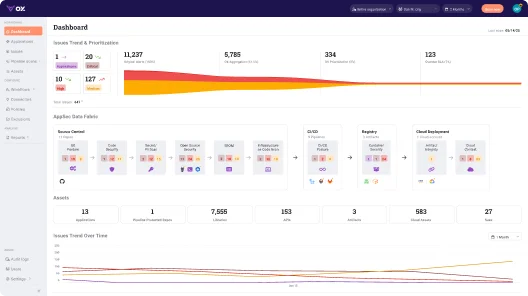
A validated runtime exploit only delivers full defensive value when engineering teams can trace it directly to the exact source code, configuration file, or API definition responsible for the exposure. The OX AI-Native Application Protection Platform (AINAPP) addresses this disconnect through four connected components sharing one context lake: OX VibeSec, OX Code, OX Cloud, and OX Agentic Pentester.
Within this unified platform, OX Agentic Pentester supplies the offensive validation layer. Currently in Early Access, with scans triggered manually, it bridges the gap between surface-level vulnerability scanning and resource-intensive manual engagements through four capabilities:
- AI-based Attack Simulation: Autonomous large language model agents mimic the behavior, techniques, and decision-making of skilled human attackers. The agents dynamically orchestrate target discovery, exploitation, and validation without requiring human operators to steer every transaction.
- Auto Repo-to-App Correlation: Rather than leaving security teams with an isolated runtime finding on an external IP address or domain, the engine connects each exploitable runtime flaw directly to the underlying code issue behind the vulnerability, at the repository level.
- API-BOM Data Collection: Automatically maps pentest findings and vulnerabilities to the responsible APIs and your Bill of Materials for APIs (API-BOM), uncovering the wider application attack surface for triage.
- Pentest Report: Delivers tailored reporting built for multiple operational audiences: clear executive summaries illustrating business impact and compliance posture for leadership, paired with granular technical findings reports providing step-by-step reproduction logs, code references, and fixes for remediation teams.
Breadth From the Scan, Proof From the Pentest
Building a resilient security posture requires recognizing what each testing methodology contributes. Vulnerability scanning delivers broad, continuous visibility across your entire asset inventory to surface where potential weaknesses might exist. DAST interrogates running web applications and APIs from the outside to catch dynamic runtime errors during development and integration. Penetration testing provides the decisive answer that neither tool can generate on its own: safe, authoritative proof of which weaknesses an attacker can actively exploit to achieve unauthorized access.
A modern security program does not treat these capabilities as mutually exclusive alternatives. Instead, it unifies them into a coordinated, defense-in-depth workflow. Emerging agentic pentesting approaches bring exploit-grade validation closer to the velocity of daily software releases, while skilled human testers apply critical judgment to complex business logic, bespoke architecture, and production safety.
To see how automated exploit validation connects runtime risk directly to your codebase, explore the Sample OX Agentic Pentester Report or book a demo with OX Security.
FAQs
No, AI is not replacing penetration testing. Autonomous agents are changing testing velocity and coverage by handling repetitive discovery, rapid payload delivery, and ongoing regression verification, which brings validation closer to the pace of code releases. However, human specialists remain irreplaceable for evaluating intricate business logic, executing multi-step lateral attack chains, defining engagement scopes, and making critical production-safety judgment calls.
The primary classification of vulnerability scanning is authenticated versus unauthenticated scans. Authenticated (credentialed) scans use authorized system or user credentials to inspect internal host configurations, local package inventories, and registry settings. Unauthenticated scans probe assets strictly from the outside without credentials, identifying open ports and exposed services visible to anyone without credentials.
Not in the strict sense, though the two are closely related. A vulnerability assessment identifies, evaluates, and ranks the weaknesses in a system, whereas vulnerability scanning is the main tool used to find those weaknesses. A penetration test goes a step further: it attempts to exploit those weaknesses, proving which ones an attacker can actually use and what that access reaches.
The three primary penetration testing approaches are black-box, grey-box, and white-box testing, categorized by the level of contextual knowledge provided to the evaluator. Black-box tests simulate an external attacker with zero prior system knowledge, grey-box tests provide partial access such as standard user credentials and API documentation, and white-box tests grant complete transparency, including architectural designs and source code.
Dynamic Application Security Testing (DAST) is an automated black-box testing method that injects common attack payloads into a running application and analyzes HTTP responses for anomaly signatures. Penetration testing is a comprehensive evaluation conducted by human experts or autonomous agents that actively attempts safe exploitation. While DAST stops at identifying potential input and output flaws, a penetration test chains multiple vulnerabilities together to prove real business impact and bypass defensive controls.