TL;DR
- AI vulnerability scanners utilize context-aware semantic analysis and cognitive reasoning to discover business logic, developer intent, and architectural risks that traditional tools miss.
- Legacy SAST and DAST scanners trigger many false positives and stall pipelines because they lack cloud runtime context and cannot analyze non-deterministic code.
- Real-time, in-workflow security catches critical machine-scale threats (such as hardcoded secrets and hallucinated packages) at the exact moment of generation inside the IDE and PR stages.
- Continuous reachability analysis connects repository code lineage straight to live production, filtering out unroutable noise to isolate the small fraction of vulnerabilities that pose actual risk.
- Modern AI security tools close the code-to-cloud gap by generating tailored patch files or “diffs” directly in developer workflows, eliminating security debt at the source without hurting velocity.
What Is an AI Vulnerability Scanner?
An AI vulnerability scanner is an intelligence-driven security solution that autonomously discovers, analyzes, and prioritizes software flaws across the development lifecycle. Unlike legacy scanners that rely on rigid, rule-based signature matching (which simply checks code strings against a static checklist), modern AI scanners use dynamic, context-aware semantic analysis.
By shifting from structural pattern matching to cognitive reasoning, these tools evaluate code similarly to an ethical hacker, interpreting the fluid relationship between functions, data flows, and infrastructure to expose deep architectural flaws traditional tools miss.
This guide is designed to help AppSec managers, DevSecOps leaders, and product security directors to understand how AI vulnerability scanners use semantic analysis and cloud context to detect and remediate machine-scale engineering risks in real time.
How AI Scanners Read the Codebase
The true differentiation of an AI vulnerability scanner lies in its ability to look beyond syntax and parse the underlying design of an application. Powered by LLMs and machine learning, these engines evaluate software through three distinct layers:
- Understanding Business Logic: Traditional tools are blind to business logic flaws like authorization bypasses. AI scanners read code contextually to understand what the application is designed to do, flagging instances where code executes successfully but deviates from secure business logic.
- Decoding Developer Intent: By analyzing surrounding code structures, comments, and semantic patterns, the scanner infers the developer’s architectural goal. This allows it to accurately distinguish between a secure custom validation routine and a genuine exposure.
- Mapping Full Application Architecture: AI scanners do not look at files in isolation. They map out the entire structural lineage of an application, evaluating how a local code chunk interacts with third-party libraries, databases, internal APIs, and Infrastructure-as-Code (IaC) templates.
This holistic model enables predictive risk assessment. Instead of waiting for a developer to write a deployable exploit, the AI scanner proactively simulates adversarial attack paths through the codebase, predicting how minor, disparate bugs can be chained together to compromise the broader system.
For years, application security has suffered from a critical operational flaw: scanning engines evaluated code abstractly, ranking vulnerabilities based on theoretical severity scores (like generic CVSS metrics). This approach fractures engineering pipelines, producing massive security backlogs crammed with false positives.
AI vulnerability scanners trigger a vital shift from reactive discovery to real-time, risk-based prioritization. Instead of flooding dashboards with raw alert volume, an AI system automatically assesses actual exploitability. It queries a unified data model to determine if a specific vulnerability is truly exposed to the public internet, whether it interacts with sensitive data, and if it sits on an active runtime execution path. By analyzing the true threat surface in real time, the scanner suppresses unroutable noise and only surfaces the critical exposures that pose an immediate business risk.
The Expanding Attack Surface in AI-Driven Development
The rapid adoption of AI coding assistants has introduced a profound paradox: software engineering velocity has scaled exponentially, but so has the application attack surface. While tools like GitHub Copilot and Cursor allow development teams to ship features faster than ever before, they introduce hidden, complex vulnerabilities at a machine-scale that completely overwhelm existing enterprise defenses.
Exponential Velocity Meets Machine-Scale Risk
The core business risk of this hyper-velocity is not just the volume of code being produced, but the untrusted – and potentially untrustworthy – nature of that code. Generative AI models are prediction engines trained on historical public repositories that naturally contain architectural flaws, outdated open-source dependencies, and insecure coding patterns. When developers blindly accept AI-generated recommendations to meet aggressive deadlines, they unknowingly flood the repository with subtle logic bugs, hardcoded secrets, and hallucinated packages.
This creates a dual-sided operational crisis:
- AppSec Team Overwhelm: Security teams, historically outnumbered by engineering teams, are now tasked with auditing a codebase that is expanding faster than humanly possible.
- Developer Burnout: Industry data indicates that engineers using AI-assisted tools are reporting significantly higher rates of burnout. Instead of spending their days creatively architecting software, they find themselves acting as tedious, full-time code reviewers – spending hours untangling, debugging, and retroactively patching thousands of lines of machine-generated text they didn’t write. This leads to situations where 77% of AI users (ironically) report that their workload has actually increased, with some studies finding that developers’ task completion rose by up to 19% while actual software decreased by 7.2%.
Why Legacy Scanners Cripple Modern CI/CD Pipelines
When forced to analyze fluid, non-deterministic AI code logic, legacy scanners completely break down due to distinct architectural limitations:
- Complete Lack of Runtime Context: Traditional SAST tools scan files in isolation, evaluating vulnerabilities abstractly. They cannot see how a code snippet behaves once deployed into a specific cloud configuration, leaving security teams blind to whether a flaw is actually reachable or exploitable by an adversary.
- Inability to Parse AI Logic Flaws: Legacy tools are designed to look for specific textual signatures (like an unvalidated input field). They completely lack the cognitive reasoning required to identify semantic business logic flaws, such as an AI assistant successfully writing a function but inadvertently skipping an authentication check or misconfiguring an API data-sharing routine.
- Debilitating Alert Fatigue: Because these tools lack semantic understanding, they treat every potential anomaly as a critical threat, resulting in false positive rates from 76% and often exceeding 90%+ in enterprise SAT deployments (depending on industry and type of code vulnerability). When forced into modern Continuous Integration and Continuous Deployment (CI/CD) pipelines, this wave of noise triggers severe alert fatigue. Pipelines are routinely stalled, development velocity grinds to a halt, and frustrated engineering teams ultimately bypass security guardrails altogether just to push code to production.
How AI Scanners Detect AI-Generated Risk
Traditional security scanners operate like a standard text search, failing to catch abstract or multi-layered architectural threats. To accurately secure machine-speed development pipelines, modern AI scanners intercept and analyze code through a multi-stage, context-driven validation process.
Real-Time In-Workflow Interception
Instead of running long after the software is written, an AI vulnerability scanner operates directly within the developer’s native workspace (the IDE) and during branch creation (the PR stage). This real-time positioning allows the tool to parse code at the exact moment of generation, neutralizing specific machine-scale threats instantly:
- Catching Hallucinated Dependencies: The scanner cross-references generated package imports against public registries and the enterprise’s authorized Software Bill of Materials (SBOM), instantly blocking phantom or unregistered library installation attempts before the package manager executes them.
- Exposing Embedded Secrets: By analyzing the surrounding text strings and variable assignments, the engine differentiates between benign placeholder code and live, hardcoded cryptographic keys or third-party API tokens.
- Flagging OWASP Logic Flaws: Rather than relying on rigid syntax matching, the cognitive layer evaluates the overall flow of data, catching complex logic vulnerabilities (such as broken object-level authorization (BOLA) or unvalidated input loops) that traditional tools completely miss.
Mapping Vulnerabilities to Runtime Reachability
An isolated code block only presents a true enterprise hazard if a malicious actor can actively exploit it. AI vulnerability scanners eliminate backlog chaos by building an end-to-end understanding that connects repository lineage directly to live cloud infrastructure.
The scanner ingests live data across code, containers, and live API endpoints to perform an active reachability analysis. It verifies whether an AI-generated bug sits on an active, internet-routing network path or operates with excessive cloud infrastructure privileges. If a flaw is buried within a non-internet-routing microservice behind Zero Trust boundaries, the scanner deprioritizes it. This filters out unroutable noise, allowing security and development teams to focus their energy entirely on the small percentage of vulnerabilities that present genuine production risks.
The Automated, Context-Aware Remediation Cycle
When a critical, reachable risk is validated, the AI scanner does not simply drop a generic ticket or static advice into a developer’s backlog. It initiates an automated remediation cycle that delivers custom, codebase-tailored patch recommendations.
By reading the specific software architecture, localized parameter naming conventions, and the individual developer’s unique writing style, the scanner’s integrated agent automatically generates precise patch files and code diffs. This fix is delivered straight into the developer’s workflow as an interactive inline comment in the IDE or a ready-to-merge Pull Request. Engineering teams can review the context-specific patch and resolve the exposure with a single click, eliminating the time-consuming triage process and burning down security debt without stalling production speed.
How to Choose an AI Vulnerability Scanner
Selecting an AI vulnerability scanner requires moving past legacy acquisition habits. Because AI-driven development scales code output at machine speed, security leaders can no longer evaluate tools based on how many vulnerabilities they flag. Success is determined by how accurately a platform reduces noise, maps context, and enables autonomous prevention.
Core Evaluation Criteria for Security Leaders
To protect an engineering ecosystem from machine-scale risk, security leaders should evaluate candidates against strict operational requirements:
- Unified Code-to-Cloud Visibility: Avoid fragmented point-solutions that analyze code in absolute isolation from the deployment pipeline. A modern scanner must provide a continuous data lineage that bridges your application source code repositories, software supply chains, and active cloud runtime environments into a single, cohesive security graph.
- Reject “Black Box” AI Tools: Do not adopt scanners that use generic LLMs to output speculative text descriptions of vulnerabilities without providing transparent, reproducible proof or verifiable remediation fixes. If a tool flags an architectural logic flaw, it must deliver a contextually accurate, syntax-aware code diff that developers can safely merge into their IDE or Pull Request.
- Avoid Infrastructure-Only Scanners: Legacy Cloud Native Application Protection Platforms (CNAPPs) are effective at flagging misconfigured containers or live production exploits, but they have a fatal flaw: they cannot trace runtime risks back to the source code repository or original author. Without this root-cause traceability, fixing a production bug remains a multi-week operational bottleneck.
- Autonomous In-Workflow Interception: The platform must natively support active prevention layers – such as policy-driven prompt governance approaches like OX’s AI Usage Controls and other automated guardrails – directly inside developer IDEs and repo pipelines. AI Usage Controls automatically blocks unapproved models, interfaces, and dependencies to actively constrain AI coding tools from generating insecure primitives, hardcoded secrets, or hallucinated packages in the first place, rather than scanning for them hours after creation.
Feature Comparison: Legacy Add-Ons vs. Unified AI-Native Platforms
| Security Capability | Legacy Scanners with AI Add-ons | Unified AI-Native Security Platforms |
| Analysis Methodology | Rigid, rule-based signature matching with an LLM text-summarization layer applied post-scan. | Deep, context-aware semantic analysis parsing business logic, data flow, and developer intent. |
| Contextual Awareness | Low; scans code files as isolated text strings without mapping live infrastructure configurations. | High; builds a unified graph connecting source repositories directly to cloud runtime exposure. |
| Signal-to-Noise Ratio | Low; generates debilitating alert fatigue with false positive rates often exceeding 90%+ in enterprise and other large code projects, often by exploring infeasible paths. | High; filters out unroutable, non-exploitable noise by executing automated reachability validations. |
| Remediation Loop | Delivers generic, out-of-context text advice or tickets that require manual code refactoring. | Generates codebase-tailored, one-click patch recommendations directly inside the active IDE or PR. |
| Supply Chain Defense | Reactive; catches known open-source vulnerabilities only after the package manager executes them. | Proactive; flags non-existent, hallucinated package dependencies (Package Baiting) before installation. |
Preventing Risk at the Source with OX Security
As the application attack surface expands under machine-speed development, securing your pipeline requires moving past legacy, fragmented scanners. OX Security directly answers the strict evaluation criteria needed for modern software development, bridging the gap between velocity and risk. OX VibeSec is an integral component of the OX Platform, where it works in concert with OX Code to secure your AI-generated code process from prompt to repository to build. By synthesizing your code repositories, open-source supply chains, and active production environments into a single, cohesive visibility graph, OX shifts application security from a reactive guessing game to an autonomous prevention architecture.
Stop AI Code Vulnerabilities inside the IDE with OX VibeSec
To neutralize the distinct threat vectors of generative programming, OX Security delivers OX VibeSec — a core component of the unified OX Platform and the premier solution for securing AI development workflows. OX VibeSec provides total AI coding protection — embedding visibility and control directly into developer workflows and ensuring the end-to-end security of coding tools. Rather than running slow, detached scans after code has already entered your repositories, OX VibeSec operates natively inside your engineering team’s preferred IDEs — working seamlessly alongside AI coding agents like Cursor, Claude Code, Copilot, and Windsurf.
OX VibeSec acts as an intelligent firewall for AI assistants by intercepting risks at the exact moment of creation. At the heart of this prompt-time prevention mechanism is the Code Security Agent. Instead of waiting to generate patch files or inline PR comments for already-written code, this agent analyzes the developer’s initial prompt, identifies likely security risks, and proactively sends security guidance to the AI coding agent so it writes more secure code in the first place.
The Secure Dependency Gate further reinforces this proactive defense, actively preventing the introduction of malicious, hallucinated, risky, license-violating, or otherwise-risky application components from ever entering the workspace. VibeSec uses Custom Coding Guidelines to deterministically enforce organizational code security requirements across all AI tools and processes, operating as the ultimate policy enforcement layer. Preventing prompt-time risk empowers engineers to more confidently accept AI suggestions and maintain high velocity while still decreasing the introduction of systemic enterprise vulnerabilities.
Eliminate Security Debt from AI Gen to Cloud Runtime
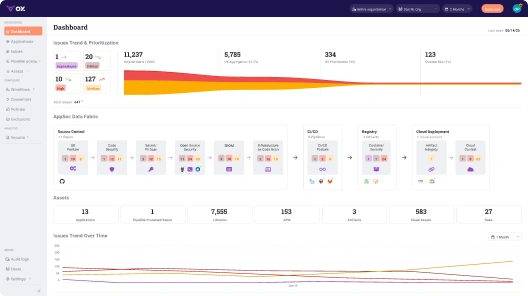
The true strength of the OX Security platform lies in its ability to permanently close the code-to-cloud visibility gap. Through its central data model, OX continuously tracks your application’s risk posture across its entire lifecycle, connecting the DNA of AI-generated artifacts straight to live cloud runtime exposures.
Instead of forcing teams to waste valuable engineering hours triaging an endless backlog of static alerts, OX performs continuous runtime reachability analysis. It isolates the tiny fraction of vulnerabilities that sit on an active, internet-facing network path or possess overly permissive cloud permissions. When an exploitable risk is validated, OX doesn’t just issue a generic infrastructure alert; it traces the malicious path all the way back to the exact code repository, file, and line of code responsible – allowing development teams to wipe out security debt at the source before it ever impacts production.
Future-Proof Your Security Pipeline
OX is the only platform that enables organizations to prevent new risks, secure development systems and fix previously identified issues across their entire AI coding stack, reducing newly created production issues by as much as 90 percent. The transition toward AI-native development and vibe coding is an irreversible shift. You cannot secure a pipeline moving at machine velocity using traditional, rule-based signature matching that forces engineers to stop and manually review thousands of lines of code. Safely embracing this next era of software creation demands an equally intelligent, context-aware defense. To protect your business without bottlenecking innovation, your security tools must understand semantic intent, map code lineage to production, and actively prevent risk at the source.
Don’t let machine-speed generation outpace your application defenses. Explore how OX VibeSec can future-proof your application security pipeline and enable your engineering teams to build at terminal velocity, securely.