
Code alone is not enough. Infrastructure alone is not enough. What you need is runtime, informed by unified context.
TL;DR
What this blog post covers:
- Why AI has broken the static AppSec model, and what replaces it
- Why securing code and cloud infrastructure are two sides of the same problem
- Why runtime is the ultimate signal in pinpointing what’s happening right now
- How OX Cloud connects code, cloud, and runtime, from prompt to production
The Museum Comes Alive
Picture a museum at 3 AM. The building is enormous. The collections are vast. Every exhibit is exactly where it was when the doors closed: catalogued, labelled, cross-referenced, and completely inert.
The dinosaur skeleton has not moved. The cultural artifacts are undisturbed. Nothing is alive. Security guards make rounds, checking locks, doors and listening for alarms.
For most of its history, application security looked something like this.
A misconfigured S3 bucket surfaces in a dashboard. A critical CVE sits in a backlog, logged and categorized and thoroughly unaddressed. A static scan runs on Monday morning and produces a report that nobody fully reads by Friday.
Tools produce findings. Findings produce tickets. Teams respond. Tickets age.
Nothing connects to anything else, because nothing was built for that reason. The posture management platform doesn’t talk to the code scanner. The code scanner doesn’t talk to runtime security. Runtime doesn’t talk to anything because it just runs, silently accumulating risk into which the rest of the stack has no visibility.
It’s a history museum of process. Then AI wakes the statues up.
Not gradually, not incrementally, but instead fundamentally, in a way that doesn’t permit a return to the previous state. The system that security was built to govern is now moving at a speed and scale that static governance cannot track. That changes everything about how we have to think about the problem.
AI Changed the Assumption on AppSec
There are long held working assumptions that have shaped almost every tool, process, and organizational model in application security: code is the problem. Developers introduce risk and security exists to catch it.
That assumption was never entirely fair to developers, but it was accurate enough that the world organized itself around it. Walls were built between development and security, with review gates and scanners that sat at the end of the pipeline. Findings were sorted by severity before passing them back upstream. Security was, fundamentally, a checkpoint.
AI broke that model.
The promise of AI-native security is code that’s more secure by design, not by audit. The idea: AI suggests fixes and flags issues at the point of creation. It won’t get tired or skip steps because a deadline is approaching. The old assumption, that developers are the primary source of security risk, is being retired in real time.
But AI introduced an even bigger problem.
Code is now essentially prompts. A developer writes an intent; a model generates the implementation; a pipeline runs the build; a container lands in production. The cycle that used to take days now takes minutes. The volume of code being generated, modified, and deployed has increased by an order of magnitude.
The security model that was designed for human-paced development (scan, review, fix, repeat) cannot keep pace with a system that never stops moving.
AI is doing to AppSec what the cloud did to physical servers. It isn’t just accelerating the process, it’s fundamentally changing the process.
When cloud computing arrived, the answer wasn’t “faster rack management.” The infrastructure model changed. New tools, new architectures, and new mental models followed.
The same transition is happening now in application security and the teams that are still trying to run static processes against AI-generated code are discovering, the hard way, that they’re rack-managing in a cloud world.
Two Directions, One Problem
The disruption that AI has brought to AppSec doesn’t pull in one direction. It pulls in two simultaneously, and the tension between them is where most security programs are currently stuck.
The first direction is the coding layer. AI-generated code needs to be secured at the moment of creation. Not after the fact, not at a review gate, not in a post-deploy scan. The risk profile of a codebase that was written by a model running at machine speed is fundamentally different from one written line by line by a human developer.
Vibe coding is real, it’s accelerating, and it needs a security model that operates at its pace. That means: embedded in the IDE, active in the editor, aware of context before a single line ships.
The second direction is the infrastructure layer. The live environment where that AI-generated code runs is itself dynamic in ways that static infrastructure management was never designed to handle.
Cloud environments drift. Configurations diverge from the templates that originally defined them. New services spin up. APIs surface. Containers deploy from images that haven’t been fully audited.
Runtime is where every upstream assumption (every prompt, every dependency declaration, every IaC template) is finally tested against reality.
Neither direction alone closes the gap.
A perfectly secured codebase running on misconfigured infrastructure is still a compromised system. A hardened cloud environment running vulnerable AI-generated code is still an exposed one. You can do everything right on one side and still lose on the other.
The two problems aren’t parallel, but interdependent. Treating them as separate disciplines, owned by separate teams using separate tools, is how you end up with a museum: comprehensive, catalogued, and completely inert.
They aren’t two separate problems. They’re two parts of the same organism.
The Living Organism Problem
Here’s what changes when you stop treating code security and cloud security as separate problems and start treating them as a single continuous surface: the system comes alive.
When runtime is informed by what’s happening in code (i.e., when a live exposure can be traced back through the container, through the image, through the pipeline, to the dependency declaration or IaC template or specific commit that created the condition) security stops being a retrospective discipline and starts being a dynamic one.
The findings move. The context travels with them. Remediation has a precise target. Prevention has a feedback loop.
Runtime is the ultimate signal. It’s where every upstream decision either holds or fails under real conditions. It doesn’t lie, it doesn’t estimate, and it doesn’t produce theoretical risk scores that require three meetings to interpret. Runtime tells you what is actually happening, right now, in the environment where your users live.
But if you don’t address the coding layer with the security context it needs, you won’t get to runtime. You’ll get to downtime.
The vulnerabilities arrive before the monitoring does. The blast radius precedes the alert. If your cloud stack isn’t right (read: infrastructure is drifting, APIs are surfacing outside any inventory, containers are running from images that no one has fully audited) the runtime has no stable foundation to stand on.
You can monitor all you want. You’ll be monitoring a system that’s already compromised.
AppSec is the mind. The cloud is the body.
When something goes wrong at runtime, that’s when you need the doctor. The symptoms will appear in the infrastructure, but the causes live in the code. You can treat one without the other, but that’s triage, not medicine.
This is the living organism problem: security only functions as a system when its parts are connected. A disconnected security stack is still a museum with nothing talking to anything else.
Prompt to Runtime: The Complete Picture
CNAPP as a category exists because the industry recognized that cloud security needed to be more than posture management. Runtime visibility, attack path analysis, and correlation across cloud environments all matter.
While the instinct behind CNAPP is correct, CNAPP itself has gaps. Current solutions address the infrastructure and runtime layers without the code context that gives runtime signals their actual meaning.
When a runtime alert fires in a CNAPP platform, it tells you that something is wrong in a container. It rarely tells you which line of code caused it, which developer introduced it, which pull request delivered it, or how to fix it in a way that prevents redeployment. The alert is the beginning of the work…and CNAPP stops there.
OX Cloud is the piece that closes that loop. It brings runtime, informed by both code and infrastructure: CSPM, Cloud Bill of Materials, IaC scanning, runtime security, API exposure analysis, and Code Projection Technology, all connected into a single continuous surface.
It’s not a dashboard that aggregates findings from separate tools. OX Cloud understands the relationship between what’s running and what caused it to run that way, offering:
- Cloud Security Posture Management (CSPM) to centralize and correlate data across more than 100 third-party tools and scanners — eliminating the siloed visibility that turns posture management into a checkbox exercise.
- Cloud Bill of Materials (CBOM) to maintain a live inventory of every cloud resource and service, actively mapping vulnerabilities and misconfigurations so their impact on overall security posture is always visible.
- IaC Scanning to identify misconfigurations in Terraform and other IaC templates before they ever reach production, catching the upstream decision before it becomes a downstream exposure.
- Code Projection Technology to map runtime cloud vulnerabilities directly back to their originating source code, enabling immediate understanding of where a risk began, not just where it appeared.
- API Exposure Analysis to surface every API-related vulnerability, shadow API, and misconfiguration (including the full API Bill of Materials) so every interaction point is accounted for and secured.
- Runtime Security to move beyond posture and vulnerability analysis to detect and respond to active threats in real time, connecting SecOps and AppSec workflows around the signals that actually matter.
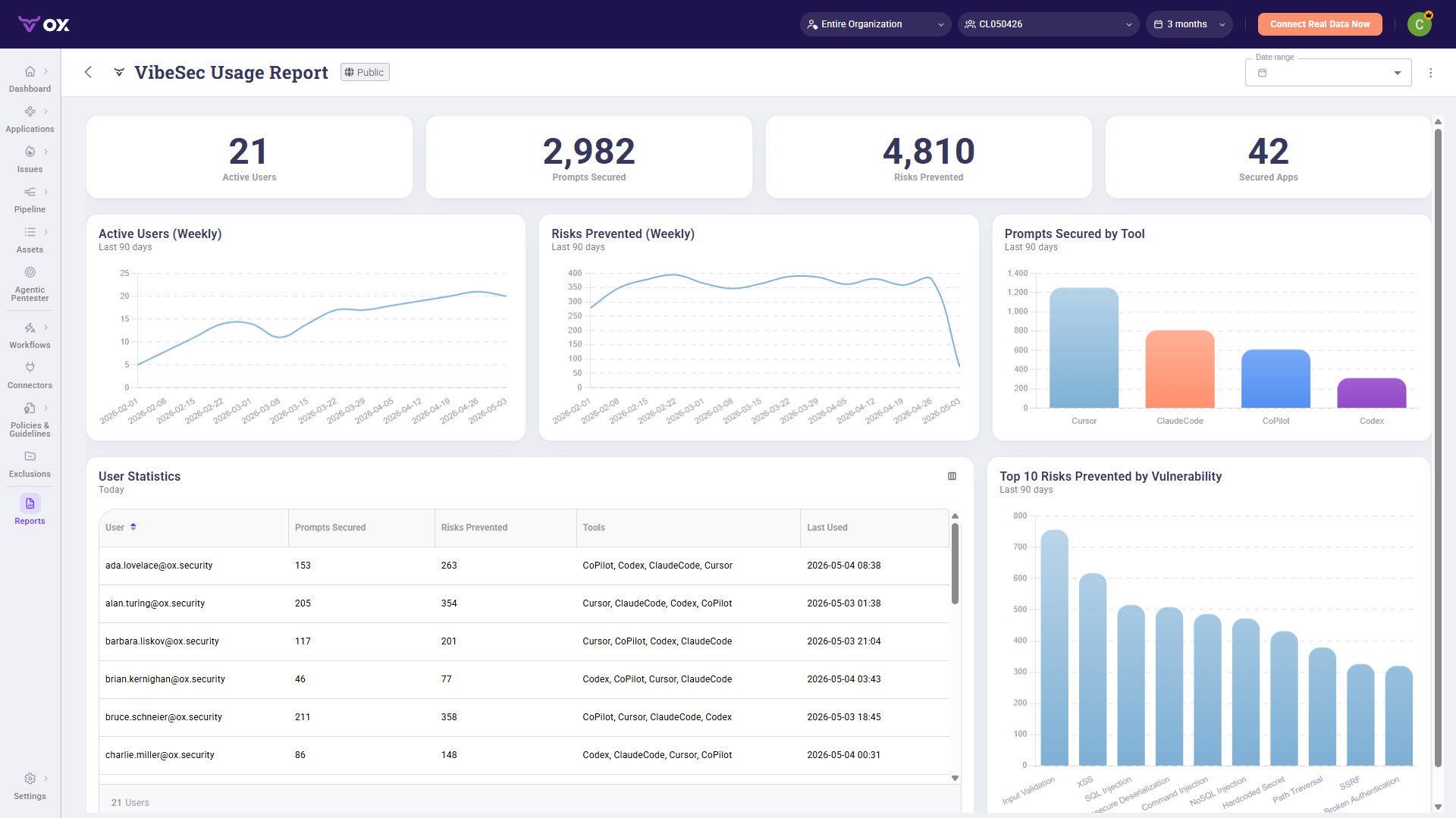
Together with OX VibeSec (which secures AI-generated code at the moment of creation) and OX Code (which provides SAST, SCA, secrets detection, and more across the full development lifecycle) OX Cloud completes path that runs from the first prompt to the last deployed workload.
This is what “stronger together” actually means: not integration, but a living system where every layer informs every other.
VibeSec secures the prompt. OX Code secures the build. OX Cloud secures the runtime and traces every finding back through the pipeline to the code that caused it.
The loop closes. The system is alive.
Why Runtime Is the Signal That Changes Everything
Nobody loses sleep over a cloud misconfiguration report. Everyone loses sleep over a call at 2 AM telling them something is actively being exploited in production.
The gap between what security tools report and what security teams actually care about is the runtime gap.
Posture findings are theoretical. Runtime findings are real. Posture tells you what could happen. Runtime tells you what is happening.
AI-generated code is shipping faster than any team can manually review, so the only signal that cuts through the noise is the one that comes from the live environment.
Runtime is where abstract risk turns into concrete consequence. It’s where you learn whether the decision made three sprints ago (i.e. the dependency version that looked fine at the time, the IaC template that passed the policy check, the API that nobody thought to add to the inventory) was actually fine, or was quietly waiting for the right conditions.
The teams that will win in this environment aren’t the ones with the most tools. They’re the ones whose runtime is continuously informed by what’s happening in code, and whose code decisions are continuously validated by what’s happening at runtime.
Security is no longer a single discipline owned by a single team and enforced at a single gate. It’s a conversation that runs across the entire stack (from the developer’s editor to the production cluster) and it has to be continuous, or it’s irrelevant.
The Museum Wakes Up
You’ve seen the movie, right? The statues are moving now.
Application security is no longer a collection of point-in-time snapshots stored in separate systems. It’s a continuous, connected discipline that runs from the moment a developer writes a prompt to the moment that code executes in a live environment. That closes the loop between those two moments in both directions, constantly.
The old model (static scans, siloed tools, sequential handoffs between teams) was designed for a pace of development that for the most part no longer exists.
AI-generated code doesn’t wait for the weekly scan window. Cloud environments don’t hold still for the quarterly posture review. Runtime exposures don’t schedule themselves around your incident response calendar.
What the moment requires is a platform that moves at the speed of the system it’s securing. One that understands code and cloud not as adjacent disciplines but as two layers of the same surface. It also treats runtime as the ultimate source of truth, and can trace every signal it produces back to the development decision that caused it.
From prompt to runtime. The full picture. Finally connected.
OX Cloud is the infrastructure and runtime pillar of the OX Security Platform, completing the code-to-cloud architecture that runs from OX VibeSec and OX Code through live cloud environments, continuously, without gaps.
The museum has woken up. AppSec is alive. And the only question left is whether your security program is moving with it.
Don’t wait for Robin Williams or Ben Stiller to show up. Book an OX Security demo to see the complete picture, or start for free to explore OX Cloud in your own environment.