TL;DR
- Legacy security tools fail because they check code at human speeds and lack the broader cloud context needed to understand machine-scale AI code risks.
- Built-in AI assistant filters are not enough since they focus entirely on speed and syntax optimization inside isolated text editors rather than deep risk verification.
- AI models confidently replicate vulnerable patterns because they are trained on decades of legacy open-source repositories that contain outdated security habits.
- AI “hallucinations” threaten your software supply chain when models invent fake package names that hackers can pre-register on public registries to inject malware into automated builds.
- Unauthorized AI skills and MCP servers bypass access controls by running locally within developer environments, creating unmonitored pathways that leak internal code semantics.
- Defending AI-native code requires a centralized platform that uses an AI Bill of Materials (AI BOM), secure dependency gates, and real-time semantic analysis to catch flaws at the source.
The Challenge: The Expanding Attack Surface of AI-Assisted Development
The rush to integrate AI-driven development tools has introduced a massive shift in corporate technology. Engineering organizations are scaling up code delivery velocities by using automated assistants to turn human ideas into production-ready scripts. This explosive growth, however, has triggered a critical business dilemma. Attempting to secure machine-scale software generation using traditional Application Security (AppSec) workflows has quickly become completely outmoded. Legacy security review pipelines were built to keep pace with human coding speeds, not the instant creation of entire application modules.
Compounding this pipeline acceleration is the reality that modern software delivery is now deeply interwoven with third-party ecosystems. According to the 2026 OSSRA (Open Source Security and Risk Analysis) industry report, 98% of codebases now contain open source code. When AI assistants pull from these fragile digital supply chains at machine speed, they inherently scale up exposure to unverified components, rendering manual human oversight practically impossible.
This article will guide systems builders, DevOps Engineers, and CISOs to better understand the scope of the security risks associated with AI code generation systems and ways to defend against them.
The Flaw of Built-In Assistant Security
Many organizations erroneously assume that because standalone AI coding tools and IDE-native assistants include built-in safety filters, the code output is safe by default. This is a highly dangerous misconception. Integrated coding assistants are engineered fundamentally for code generation speed and context optimization, not deep risk verification. Because they operate directly inside the developer’s isolated text editor, they inherently lack the independent perspective of purpose-built security systems.
A coding tool’s built-in security can never have the full context to understand how a generated function interacts with your specific cloud infrastructure, identity networks, or database permissions. It evaluates text syntax line by line, completely blind to the unified AppSec and cloud security architecture of the broader enterprise.
The Manual Visibility Gap
Relying on these fragmented, localized assistant filters creates a severe visibility gap across the software delivery lifecycle. Without a centralized, objective security layer, AppSec leaders are forced to manually sift through massive quantities of automated code to map out hidden vulnerabilities and architectural blind spots.
When security teams lack an integrated, platform-wide view, AI code security risks propagate silently across code repositories, trigger flawed build deployments, and settle deep within production clouds. This creates a high-velocity risk pipeline, leaving businesses exposed to automated software vulnerabilities that human teams simply cannot scale to discover manually.
Core Concepts: Understanding AI Code Security Risks
AI code security risks represent the vulnerabilities, logic flaws, and supply-chain exposures introduced when software is generated by non-deterministic machine models rather than human engineers. Because these models lack situational awareness, they often confidently output – amongst others – insecure code primitives, hardcoded credentials, and hallucinated packages – necessitating automated, context-aware validation across the entire development pipeline.
The Confidence Trap: Outdated Patterns and Zero Context
Arguably, one of the core hazards of relying on LLM-driven coding tools is that they optimize for syntax correctness and conversational confidence, not absolute structural security. AI models – especially models prized for coding capability – are trained on massive public repositories containing decades of open-source software. Consequently, they routinely and confidently replicate outdated design patterns, deprecated encryption algorithms, and vulnerable legacy methods that have long since been abandoned by security professionals.
Furthermore, an AI assistant possesses zero innate architectural context. It does not know if the snippet it just generated will sit behind a highly restricted internal gateway or be exposed directly to the public internet. Given that language models lack a sense of self, are programmed to prioritize user approval, cannot distinguish between training text, user input, and secure code, and are trained on astronomical amounts of barely curated, publicly accessible human language, their non-deterministic nature seems to be an unavoidable outcome. This means that if it worked for someone somewhere in your model’s training text, and if many people upvoted it, your LLM might just be a little more likely to surface that code than a newer, more correct solution – even if the original post was from years ago.
Real-time, predictive risk assessment is essential before that code ever reaches your production runtime; the model cannot predict how code behaves within a distributed environment. Waiting until a system is deployed to run a scan means letting automated flaws slip straight into your active cloud perimeter.
The Vibe Coding Era Demands Vibe Security
Managing these AI code security risks is directly tied to the shift toward Vibe Coding—the AI-native development paradigm where developers construct enterprise applications using natural language intent while agentic AI workflows do the actual building. When software creation shifts from manual typing to high-level orchestration, security cannot remain a manual review process.
Vibe coding fundamentally demands Vibe Security (VibeSec). In an ecosystem where code is spun up instantly by machines, security architectures must be natively baked into the development workflow. Vibe Security applies real-time, semantic analysis directly inside the IDE and pull-request environments, evaluating the developer’s underlying intent alongside the model’s output. By embedding continuous security guardrails directly into the vibe coding cycle, organizations can embrace the full velocity of AI-assisted software generation without accidentally launching high-speed, automated vulnerabilities.
The Top Security Risks of AI-Generated Code
Machine-speed code generation skips the natural checkpoints of human engineering. Without centralized guardrails, integrating automated assistants into development pipelines introduces distinct AI code security risks that directly impact software supply chains and architectural surfaces.
Hallucinated Dependencies and Malicious Components
AI models suffer from “confident wrongness.” When tasked with solving a niche programming problem, an LLM frequently invents or “hallucinates” non-existent open-source packages, libraries, or registries, presenting them as valid solutions.
This creates a high-risk vector for supply chain attacks. Threat actors track common AI hallucination patterns, register those spoofed package names on public package managers (like npm or PyPI), and inject malicious code payloads into them.
The threat to public registries is far from theoretical; it maps directly to proven, highly disruptive compromise vectors. A narrowly-avoided multiyear social engineering attack campaign almost resulted in global internet supply chain subversion catastrophe in 2024 when a hacker managed to subvert the xz (aka liblzma) project; ultimately he was only weeks away from infecting every Debian and Fedora server on the internet with an SSH backdoor when a Microsoft software engineer named Andres Freund noticed a strange 400-500ms lag in SSH connections while testing a Debian unstable build and alerted the Debian security team.
By predicting fake dependencies that look legitimate, AI engines essentially automate the setup for these exact kinds of attacks. If an automated pipeline pulls down these unverified, attacker-controlled packages, malicious components land directly inside production. Additionally, AI engines regularly output snippets covered by restrictive, copyleft open-source licenses, exposing the organization to major legal and compliance liabilities.
Unapproved Models and Risky Skills
As developers optimize their environments, they often wire up external plugins, Model Context Protocol (MCP) servers, or custom tool hooks to extend their AI assistant’s capabilities. If engineers use unauthorized MCP servers or unapproved public models, they create unmonitored pathways into corporate infrastructure.
These rogue “skills” and extensions bypass role-based access controls (RBAC) and data loss prevention (DLP) frameworks. An unvetted tool hook can allow an external AI engine to read internal code semantics, pull down protected schemas, or execute unapproved commands in the background – completely undermining organizational security requirements.
Automated OWASP Top 10 Replications
AI assistants excel at writing functional boilerplate code, but they fundamentally replicate the baseline patterns found across public training sets. As a result, they frequently introduce classic software vulnerabilities like SQL injection, cross-site scripting (XSS), and insecure direct object references (IDOR).
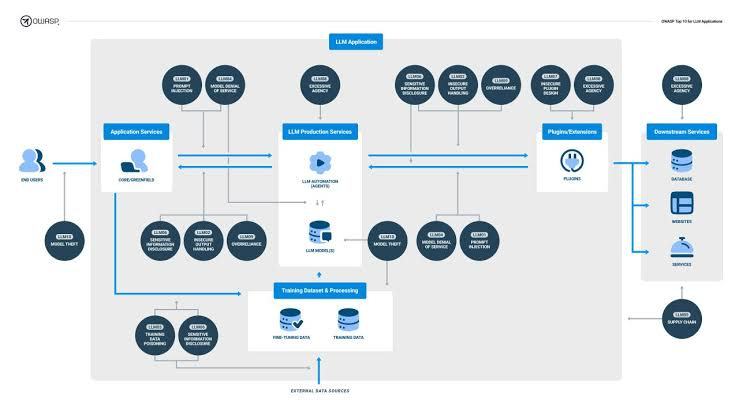
Source: OWASP Gen AI Security Project – OWASP Foundation
Catching these machine-generated flaws requires deep, unified AppSec context. A standalone linter or isolated IDE filter can easily miss an IDOR flaw because it lacks visibility into the broader environment’s identity and access layer. To fix these flaws without destroying developer velocity, security teams must deploy context-aware tooling that analyzes how the generated script functions relative to the entire code-to-cloud ecosystem.
Practical Steps: What AppSec Leaders Must Do Differently
Securing pipelines against AI code security risks requires a fundamental shift in defensive architecture. AppSec leaders cannot rely on localized developer filters to protect the broader enterprise. Instead, they must deploy centralized, automated guardrails that actively govern machine-scale development workflows.
1. Establish a Continuous AI Agent Bill of Materials (AI BOM)
Traditional Software Bill of Materials (SBOM) frameworks only catalog static, open-source dependencies. In an environment driven by autonomous engineering, AppSec teams must establish a continuous AI Agent Bill of Materials (AI BOM).
An AI BOM automatically discovers, catalogues, and analyzes every active component across your enterprise AI coding stack. This includes mapping out which foundational models are in use, which developers are connecting to external MCP servers, and what specific skills, tools, or background hooks have been granted access to your source repositories.
Maintaining a live AI BOM ensures total visibility into the operational lineage of your automated software supply chain.
2. Implement AI Usage Controls and Custom Coding Guidelines
Organizations must move away from voluntary safety policies and enforce deterministic AI Usage Controls. By integrating access management straight into the engineering lifecycle, security teams can automatically block unapproved models and unauthorized AI interfaces before they touch corporate codebases.
Furthermore, custom coding guidelines should be enforced programmatically, user by user. These controls establish role-based boundaries, ensuring that an automated coding assistant can only request skills or execute functions that align with that specific developer’s access tier. If an AI agent attempts to hook into a restricted database schema or pull down an unvetted library, the policy engine auto-blocks the interaction instantly.
3. Deploy a Secure Dependency Gate and Skill Scanning
To eliminate the threat of hallucinated packages and rogue plugins, security architectures must implement a continuous Secure Dependency Gate coupled with real-time Skill Scanning.
Whenever an AI coding tool generates a code block containing an external package reference, the dependency gate automatically scans the package name against active public registries. If the package is flagged as non-existent (a hallucination), malicious, or unverified, it is quarantined immediately. Simultaneously, skill scanning continuously audits the permissions of AI plugins, blocking extensions that request risky, excessive capabilities – such as outbound network access or code-execution privileges inside unprotected dev environments.
Fragmentation vs. Centralized Platform Architecture
| Security Capability | Fragmented / IDE-Native Tools | Centralized Platform with AI BOM & Skill Scanning |
| Visibility Scope | Isolated to the individual developer’s text editor window. | Universal view across all repositories, pipelines, and cloud runtimes. |
| Supply Chain Defense | Blind to hallucinated dependencies and copyleft open-source licenses. | Secure Dependency Gate flags and quarantines malicious or invented packages. |
| Extensibility Governance | Cannot monitor or regulate external MCP servers, tool hooks, or plugin skills. | Continuous AI BOM tracks and catalogues every AI extension and model version in real time. |
| Policy Enforcement | Relies on voluntary settings and easily bypasses local configurations. | Deterministic, role-based controls auto-block unapproved models user by user. |
| Business Context | Zero awareness of runtime architecture or live infrastructure exposures. | Deep semantic analysis maps generated code directly to its active production blast radius. |
Code-to-Runtime Protection: The OX Security Advantage
Securing modern development pipelines requires a platform that understands both the speed of machine-generated software and the realities of live infrastructure. OX Security meets this need by delivering an integrated, code-to-runtime solution through the unified OX Platform.
By continuously tracing software lineage from the initial repository branch to active cloud instances, OX eliminates the blind spots created by fragmented, standalone tools. Instead of chasing vulnerabilities after they reach production, OX anchors security directly within the engineering pipeline, enabling organizations to scale up automation safely while keeping their software ecosystems locked down.
Total AI Coding Protection with OX VibeSec
To stop AI code security risks from infiltrating your application pipelines, the OX Platform features OX VibeSec – an integral platform-wide capability built to govern automated development workflows. Operating natively within your team’s existing infrastructure, OX VibeSec deploys a highly specialized Code Security Agent that monitors interactions directly inside developer workspaces and pull-request environments.
Rather than forcing AppSec leaders to manually audit massive blocks of machine-generated text, the Code Security Agent analyzes the underlying semantic intent of the AI assistant’s code blocks in real time. If an automated assistant accidentally generates an insecure design primitive, embeds a hardcoded token or other PII, or references a hallucinated dependency, OX VibeSec intercepts during the prompt phase of the vibe coding cycle to send real-time security guidance to the AI coding agent to prevent the insecure code from ever being generated in the first place.
Eradicating Security Debt Before Production
The true value of moving your defenses upstream with OX Code and OX VibeSec is the complete elimination of compounding security debt. Waiting to scan software until it hits a production registry forces AppSec teams into a defensive cycle of endless alert triaging.
By embedding deterministic validation gates and automatic remediation suggestions directly into the AI coding workspace, organizations can neutralize flaws at the exact moment of creation. Integrating these advanced guardrails into your active engineering environments can reduce newly created production issues by up to 90%. This allows security teams to confidently accelerate their software delivery velocity, knowing that their cloud runtime is continuously protected from automated vulnerabilities.
Securing the Future of AI-Driven Engineering
In summary, the rapid adoption of AI coding tools has turned natural language into a highly unpredictable software attack surface. Therefore, AppSec leaders must evolve their security strategies past legacy, deterministic scanning methodologies that simply cannot keep pace with machine-scale code generation. Protecting the modern enterprise demands an intelligent, platform-centric architecture that actively monitors developer intent, enforces strict AI agent boundaries, and continuously tracks risk – from code to cloud.
Do not allow automated development pipelines to outpace your application security defenses. Explore how the OX Platform and the OX VibeSec capability provide the most compelling, end-to-end application security solution on the market.
FAQs
An AI dependency hallucination happens when an AI coding assistant invents a completely fake software library or package name and includes it in a code suggestion. Because the AI optimizes for confident-sounding syntax rather than checking if a resource actually exists, it will hallucinate a name to solve a programming problem. This creates a severe security risk: hackers track these common fake names, register them on public registries like npm or PyPI, and wait for automated pipelines to download their malicious code.
It threatens your supply chain by turning an AI mistake into a pathway for malware. Hackers track common fake package names generated by AI, register those “phantom” names on public registries like npm or PyPI, and upload malicious code to them. The moment your automated pipeline runs a build or update, it unknowingly downloads the attacker’s package and runs malicious code directly inside your system.
Model Context Protocol (MCP) servers and tool hooks give AI assistants the power to read local file schemas, connect to external databases, and execute background tasks. If developers connect their coding tools to unapproved public models or unauthorized local MCP servers, they create unmonitored communication pathways. These rogue “skills” run straight inside the local workspace, completely bypassing central role-based access controls (RBAC) and allowing external AI engines to access internal code semantics.
In AI-native engineering, natural language prompts function exactly like source code because they dictate how the application behaves and what code is generated. Now, more than ever, “garbage in = garbage out.” Securing the prompt layer acts as the ultimate upstream defense. By validating, cleaning, and filtering prompt intents before they reach an LLM, security teams can programmatically stop the model from generating insecure design primitives, exposing sensitive API keys, or introducing flaws that would otherwise propagate into the production cloud.