OX Security analyzed 542,207 components across npm, PyPI, MCP servers and Agent Skills. The findings demonstrate how the attack surface is expanding from code that runs to instructions that agents follow.
We all learned the USB rule years ago. Don’t plug in a drive you just found somewhere. You don’t know who left it or what it will do.
AI agents break that rule every day. They connect to MCP servers, load Agent Skills, and pull packages from public registries. Then they act on what those components tell them, often with access to files, credentials, development tools, and enterprise systems.
In an effort to understand what’s underneath the surface of the software supply chain, the OX Security research team analyzed 542,207 open-source software components between July and October 2026. Using OX.Radar, OX security’s early-warning system for emerging threats, we tracked four ecosystems: npm, PyPI, MCP servers, and Agent Skills. OX researchers then investigated the suspicious components the system identified.
The results point to a new attack path and a growing verification gap: First, instructions are becoming an attack path. Code execution remains a major threat, but attackers can now manipulate an agent into taking actions with permissions it already has. Second, security teams can’t verify what their agents connect to. In many cases, agents are taking orders from strangers: tools with no identifiable owner, running code no one can verify before it’s already in your environment.
“Companies are giving AI agents access to critical systems while relying on trust signals built for a different era,” said Neatsun Ziv, CEO and co-founder of OX Security. “Our research shows that the problem isn’t just what a tool can do. It’s who controls it, what code it actually runs, and what instructions it can give an AI agent. We need a new model for software trust.”
Read the full report | Plug and Pray: How AI Is Changing Software Supply Chain Attacks
Want to go deeper? Join Moshe Siman Tov Bustan and Jillian Jones live on December 8 for The Sweep, Episode 1: Your AI Agents Are Taking Orders From Strangers.
AI Agents Introduce a New Supply Chain Attack Model
Traditional software supply chain attacks often rely on malicious code executing during installation or import. A package steals credentials, downloads a payload, or opens a backdoor. Security tools look for malicious code, suspicious behavior, and vulnerable dependencies.
AI agents introduce another way in.
MCP servers can expose tools and instructions to agents. Agent Skills can provide instructions that shape how agents behave. If those instructions are malicious, an agent may follow them using its existing access.
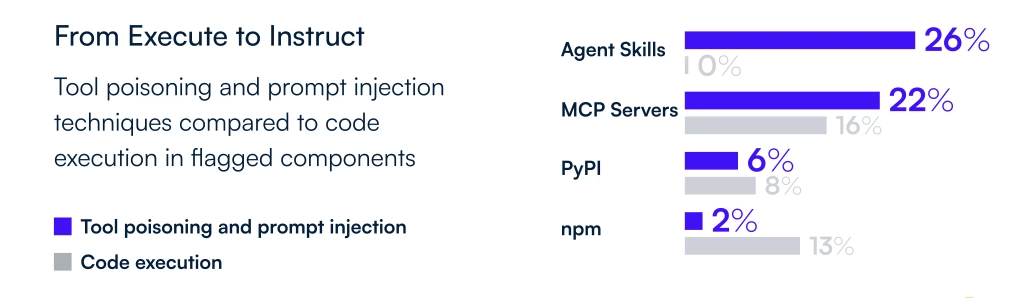
Prompt injection and tool poisoning appeared in 22% of flagged MCP servers. Install- or import-time execution appeared in 16%. In flagged npm packages, the pattern was reversed: execution techniques were six times more common than prompt injection and tool poisoning.
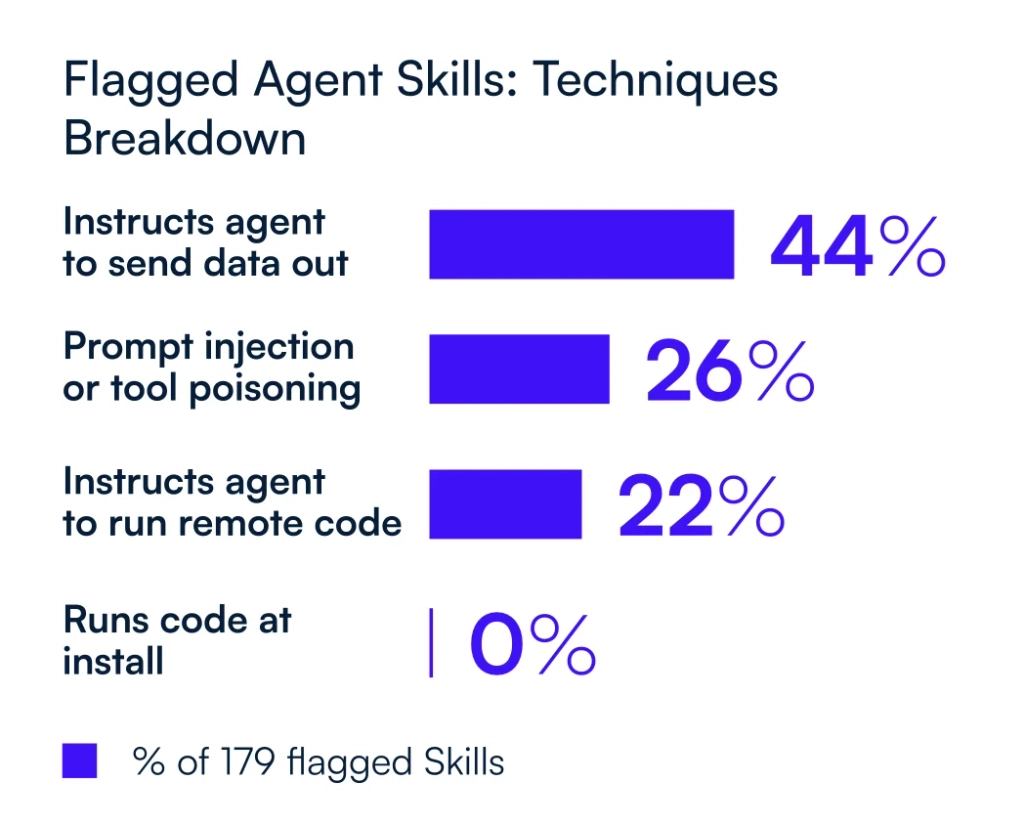
Agent Skills make the distinction even clearer. None of the 179 flagged Skills executed code at install time. Yet 44% contained instructions directing agents to send data out.
The sample is small and the ecosystem is young, but the finding illustrates a different attack path. An attacker doesn’t necessarily need to execute malicious code. They can manipulate the agent into performing the action.
“The agent already has the permissions it needs. Attackers just have to convince it to use them,” said Moshe Siman Tov Bustan, Research Lead at OX Security.
The trust signals we rely on are breaking
Security teams make decisions about software based on a few basic questions: Who published it? What code does it run? Has that code changed?
Our research found gaps in each.
Who published it? OX.Radar identified a source owner for only 69.8% of MCP servers, compared with 92.8% of npm packages. Researchers couldn’t trace an owner for nearly one in three MCP servers. Without a clear source owner, organizations have fewer ways to establish who is behind a tool, assess its origin, or hold its publisher accountable.
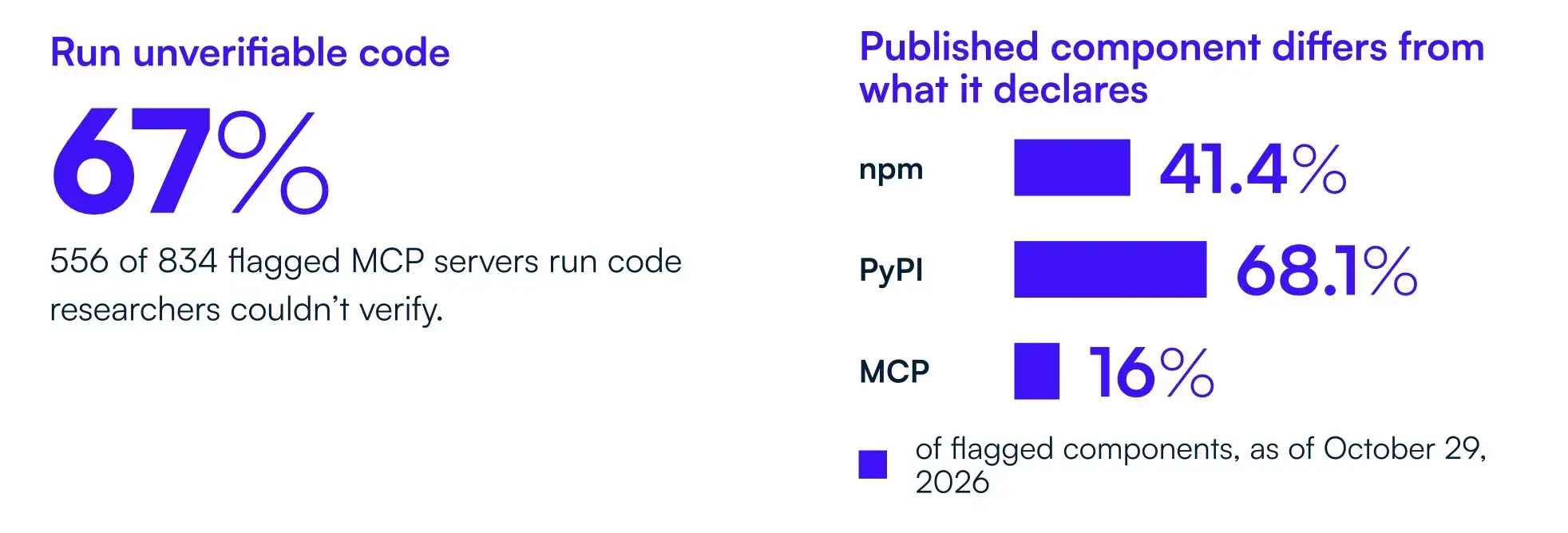
What code does it run? Of 834 flagged MCP servers, 67% ran on publisher-controlled infrastructure where researchers couldn’t independently verify the deployed code. Another 16% served files that differed from what publishers declared.
Together, more than 80% of flagged servers presented a code verification problem. The source code a publisher makes available doesn’t necessarily establish what an agent connects to and runs.
Has that code changed? Of researcher-confirmed malicious components, 82% were malicious in their first observed version. There was no clean version to compare against. Monitoring updates alone won’t catch components that enter an environment already compromised.
The ecosystem is also concentrated. Two publisher accounts were responsible for 44% of flagged MCP servers. One account published 2,364 servers in just 17 days. Volume alone doesn’t establish malicious intent, but concentration does create risk. If an account responsible for thousands of tools is compromised, every one of those tools is exposed.
These findings point to a core problem: the trust signals organizations have relied on for traditional software dependencies don’t necessarily provide the same assurance when agents connect to external tools and instructions.
Three questions before your agents plug in
Organizations deploying AI agents need to ask more than whether a dependency contains vulnerable or malicious code. They need to understand the tools their agents trust and the authority those tools can exercise.
At least three questions should be part of that assessment:
- Who controls the tools our agents connect to? Can you identify the publisher and establish where a tool comes from?
- Can we verify the code those tools actually run? Does the deployed implementation match what the publisher claims?
- Will we know when that code changes? Can you see changes to a tool that runs on someone else’s infrastructure?
Treat tool descriptions and Skill instructions as part of the attack surface, not as trusted documentation. Verify the source, inspect the instructions and understand what permissions a component can exercise before connecting it to an agent. Don’t wait for an update to reassess trust. A component can be compromised before it ever enters your environment.
How OX can help
To help teams answer some of these questions, OX Research publishes its findings in OX.Radar, a free public record of the components it tracks.
scanned component has its own page showing the publisher, where it’s listed, and the results of every version OX Research scanned, including findings and a risk score. Some code runs on publisher-controlled infrastructure and can’t be verified by anyone, including us. For those tools, that gap is worth weighing before you connect.