TL;DR
- AI-assisted code scales output velocity but introduces more than twice the number of critical vulnerabilities and logic errors compared to human-written code.
- Generative coding assistants replicate training data flaws, exposing hardcoded secrets and hallucinating packages that trigger supply chain attacks.
- Traditional SAST/DAST tools rely on isolated pattern matching that lacks semantic intent, burying developers under high rates of false positives.
- Blanket corporate bans on AI tools fail, driving the majority of developers to use unsanctioned assistants underground with zero security visibility or managerial oversight.
- Mitigating AI-native risk requires real-time, in-workflow prevention that maps code repository lineage directly to live cloud runtime reachability.
What is AI Code Security?
AI code security is the specialized practice of identifying, analyzing, and mitigating vulnerabilities within software generated by Artificial Intelligence (AI) and Large Language Model (LLM) coding assistants. As tools like GitHub Copilot or Amazon Q accelerate engineering, code security must evolve past human code review. It requires an automated, context-aware framework capable of parsing non-deterministic logic, (in)validating hallucinated open-source dependencies, and ensuring production code matches enterprise safety standards.
This guide is designed to assist AppSec managers, DevSecOps leaders, and product security directors in understanding the critical risks of AI coding tools and how to implement real-time, context-aware prevention from code to cloud.
The Velocity vs. Vulnerability Crisis in AI Development
AI coding assistants grant developers machine-speed velocity, but this hyper-acceleration has triggered a massive security crisis: organizations are scaling code output far faster than their ability to secure it.
High-Speed Code, High-Speed Vulnerabilities
The business risk of unchecked AI generation is severe. According to the 2026 OX Application Security Benchmark Report, critical application security findings rose nearly 4x year-over-year, driven heavily by AI-assisted code output. Because AI models are prediction engines trained on historical public data, they frequently replicate existing flaws, unknowingly injecting:
- Legacy Exploit Primitives: Re-introducing classic vulnerabilities like SQL Injection and Cross-Site Scripting (XSS).
- AI Hallucinations (Package Baiting): Generating non-existent package dependencies, which attackers actively monitor, register on public registries (like npm or PyPI), and weaponize for software supply chain attacks.
- Hardcoded Secrets: Automatically completing code blocks using placeholder API keys, private tokens, or administrative credentials that slip past busy human reviewers.
Why Traditional AppSec Tools Fail
Traditional Static (SAST) and Dynamic (DAST) security tools cannot keep pace with AI-driven development.
Relying on rigid, deterministic pattern matching, legacy SAST engines scan code strings in complete isolation without understanding semantic intent. When flooded with mass-produced AI code, these tools suffer from massive alert fatigue – frequently generating at least 76% % false positives and exceeding 90% on many large software projects. Overwhelmed developers facing tight deadlines simply tune out or bypass these alerts, leaving organizations blind to genuine, critical risks.
The Code-to-Cloud Visibility Gap
Traditional security operates in fragmented silos: AppSec scanners review source code repositories, while cloud infrastructure tools monitor live production environments. This visibility gap leaves real runtime exposures completely unaddressed.
A vulnerability that appears low-severity in an isolated source file can become a catastrophic entry point when deployed into a public, internet-routed cloud environment. Conversely, developers waste valuable engineering hours fixing critical-looking SAST alerts on unreachable code blocks that pose zero real-world risk. Without a unified, context-aware graph linking code lineage directly to live cloud infrastructure, separating real risk from irrelevant noise is nearly impossible.
Core Concepts of AI Code Security
AI code security is the proactive discipline of discovering, analyzing, and mitigating vulnerabilities within machine-generated software before it reaches production. Rather than relying on traditional, post-hoc reactive scanning that flags issues long after development, modern AI code security focuses on real-time, context-aware risk prevention embedded directly within the generation lifecycle. By shifting security left to the exact moment of creation, it validates logic, tracks software supply chains, and stops systemic risks before code is ever committed.
The Model “Echo Chamber” Effect
The primary risk driver in machine-generated software is the Echo Chamber effect. Generative AI models are statistical prediction engines trained on decades of public code repositories. Consequently, they mirror and amplify the historical flaws embedded within their training datasets, propagating risks in three specific ways:
- Vulnerability Replication: Models frequently complete code strings using legacy exploit primitives, seamlessly injecting classic flaws like SQL injection or improper access controls into a clean codebase.
- Dependency Hallucination (Package Baiting): LLMs prioritize plausible-sounding text over factual verification, often inventing non-existent open-source libraries. Threat actors actively monitor these trends, register the hallucinated package names on public registries (like npm or PyPI), and publish malicious payloads – turning an AI glitch into a software supply chain attack.
- Secrets Exposure: Training data remains littered with exposed cryptographic keys and API tokens. When prompted to write authentication or cloud setup scripts, coding assistants often pull these hardcoded secrets from memory, exposing production environments upon generation.
Vibe Coding and the Need for Code-to-Runtime Context
The software landscape is shifting toward “vibe coding”, an AI-native paradigm where developers build complex applications entirely through natural-language prompts, letting agentic AI tools handle the execution. Vibe coding collapses traditional development lifecycles, but it introduces massive risk.
Data reveals that AI-generated code contains up to 2.74x more cross-site scripting security vulnerabilities and 1.7x more logic errors than purely human-written code. Because vibe coders rarely review every line of machine-generated text, they routinely bypass manual security gates.
This velocity makes a unified, code-to-runtime security context non-negotiable. Securing an AI-native ecosystem requires AINAPP by OX, a platform built to connect code lineage directly to production. Security engines must analyze not just the static, generated file, but how that AI logic interacts with live cloud infrastructure and network permissions, allowing teams to isolate high-severity runtime exploits from harmless, unroutable glitches.
Practical Steps for Securing AI-Generated Code
Securing an environment accelerated by AI coding assistants requires shifting from retroactive, post-build scanning to real-time, programmatic prevention. Organizations must establish strict governance before code generation begins and embed validation directly into existing developer workflows.
Establishing Prompt Governance and IAM Boundaries
Mitigating AI code risk begins with controlling the inputs and structural boundaries of the models themselves. Organizations should implement Prompt Governance frameworks using custom corporate system prompts and Retrieval-Augmented Generation (RAG) pipelines. By injecting security rules directly into the developer’s assistant environment, the system can block risky outputs before they are typed:
- Insecure Logic Blocking: Enforce strict system-level instructions that forbid the model from generating deprecated cryptographic algorithms (such as MD5 or SHA-1) or hardcoded secrets.
- IAM Boundary Templates: Ground the AI model using verified, pre-approved Identity and Access Management (IAM) and network configuration templates. If a developer prompts the assistant to open a firewall or configure a cloud access role, the AI is constrained to use pre-vetted, least-privilege infrastructure-as-code modules rather than hallucinating custom permissions.
Shifting Security In-Workflow (IDE and PR Stages)
To catch vulnerabilities the moment they are generated, security validation must be embedded directly into the developer’s native workspace: the Integrated Development Environment (IDE) and the Pull Request (PR) lifecycle.
When an AI assistant inserts a block of code, real-time IDE plugins analyze the generated delta for vulnerabilities, hardcoded credentials, or hallucinated packages before the developer saves the file. If an issue evades the IDE layer, it hits a mandatory PR guardrail within the repository pipeline.
Instead of running a decoupled, slow security scan hours later, automated security engines analyze the PR context, correlate it with runtime risk, and provide in-workflow remediation – instantly commenting on the exact line of code with the correct, secure refactoring block so the developer can fix it with a single click before merging.
Curating Your Sources: MCP and Agent Skills
Because autonomous agents handle complex execution, securing these workflows requires continuous analysis of every connected component. Modern platforms must feature automatic “Skill Scanning” to flag and quarantine risky AI agent skills, preventing the use of malicious or unintentionally problematic instructions. Furthermore, security teams must continuously monitor MCP servers, models, and hooks to ensure total visibility into the behaviors of the entire AI dev ecosystem.
Comparative Analysis: Reactive vs. Preventative Security
| Security Capability | Legacy Reactive Scanning (SAST/DAST) | In-Workflow Preventative AI Security |
| Execution Timing | Post-commit, nightly build, or pre-production staging phases. | Real-time during code generation (IDE) and branch creation (PR). |
| Context Awareness | Scans code blocks in isolation; completely blind to live cloud infrastructure. | High; maps the entire lineage from the code repository directly to runtime. |
| Developer Friction | Causes massive alert fatigue with 76%+ false positive rates (rising to over 90% in enterprise and other large software products). | Minimal; filters out unroutable bugs and delivers ready-to-merge fixes. |
| Supply Chain Defense | Flags vulnerable packages only after they are pulled into the node tree. | Flags hallucinated packages (Package Baiting) before installation. |
| Remediation Speed | Weeks; requires opening manual tickets, triaging, and manual code refactoring. | Seconds; contextual fixes are applied directly inside the open pull request. |
Common Pitfalls in Managing AI Code Threats
As organizations scramble to defend against the unique risks of machine-generated software, they frequently stumble into reactive anti-patterns. Misjudging the nature of AI acceleration often leads to operational friction, fragmented visibility, and underground security risks.
Stack Fragmentation and Siloed Security Noise
The most common operational mistake when addressing AI-driven development velocity is simply layering new, niche point-solutions onto an already bloated application security stack. When organizations deploy independent tools for Static Analysis, Software Supply Chain Security, and API posture management without an underlying context engine, they create a disconnected echo chamber of noise.
Because AI coding assistants generate code chunks in seconds, siloed security tools respond by flooding the pipeline with disjointed alerts. Lacking a unified plan to aggregate and correlate these findings, security teams cannot tell if an AI-generated SQL query is an isolated, harmless snippet or a critical gateway leading to an exposed production database. The result is debilitating alert fatigue and, ultimately, actively pits AppSec teams against engineering.
This fragmentation is especially apparent when organizations rely on standalone AI coding tools (such as ArmorCode, Backslash, or Strix). These tools address AI code security in a fragmented manner, lacking the centralized management and code-to-cloud context of a comprehensive platform. Similarly, relying solely on IDE-native AI coding tools is risky; they fundamentally lack the independent perspective of purpose-built security systems and do not have the unified AppSec and cloud security context required to prioritize real-world risk.
The Mirage of Blanket Bans: Driving Shadow AI Underground
Faced with the reality that AI-assisted code contains 2.74x higher security vulnerabilities than human-written code, some risk-averse security leaders attempt to mitigate the threat by issuing blanket bans on generative AI coding tools. This is a critical governance failure that yields the exact opposite of its intended result.
OX’s security benchmark study data also highlights a stark reality: up to 57% of developers admit to using unsanctioned AI coding assistants to meet tight deadlines despite corporate prohibitions. Banning these tools does not stop their usage; it merely drives them underground into unmonitored “Shadow AI” environments. Engineers paste proprietary code blocks into personal, web-based LLMs or load unsanctioned browser extensions to autocomplete functions. This strips security teams of all visibility, completely exposing intellectual property to unknown third parties, not to mention violating strict regulatory compliance frameworks (like GDPR or HIPAA) and ensuring that flawed AI code bypasses any chance of automated enterprise guardrails.
The Danger of Ignoring Runtime Reachability
Treating every security flaw discovered in an AI-generated file with identical severity is an inefficient use of engineering resources. When security frameworks evaluate code based solely on its static properties, they are operating blindly, unaware of how that code behaves inside a live cloud ecosystem.
A vulnerability generated by an AI assistant, such as an unvalidated input parameter, only poses a true existential risk if it is reachable by an attacker at runtime. If that specific line of code is buried inside an internal, non-internet-facing microservice with strict zero-trust IAM boundaries, its real-world business risk is minimal. Conversely, a seemingly minor logic flaw can become a catastrophic exposure if deployed onto an internet-routed, public-facing cloud container. Failing to map static vulnerabilities to actual cloud runtime exposures forces developers to waste hundreds of hours fixing unroutable, non-exploitable bugs while leaving genuine production entry points wide open.
Preventing Vulnerabilities at Creation with OX Security
As development velocity accelerates past human capacity, application security must shift from a fractured scavenger hunt to a unified, context-aware architecture. While legacy, infrastructure-only tools merely flag risks long after deployment (forcing security teams to work backward through an opaque web of cloud configurations), OX Security bridges the divide. By operating as a comprehensive code-to-cloud security platform, OX synthesizes application lineage, software supply chains, and live production architecture into a single, cohesive visibility graph.
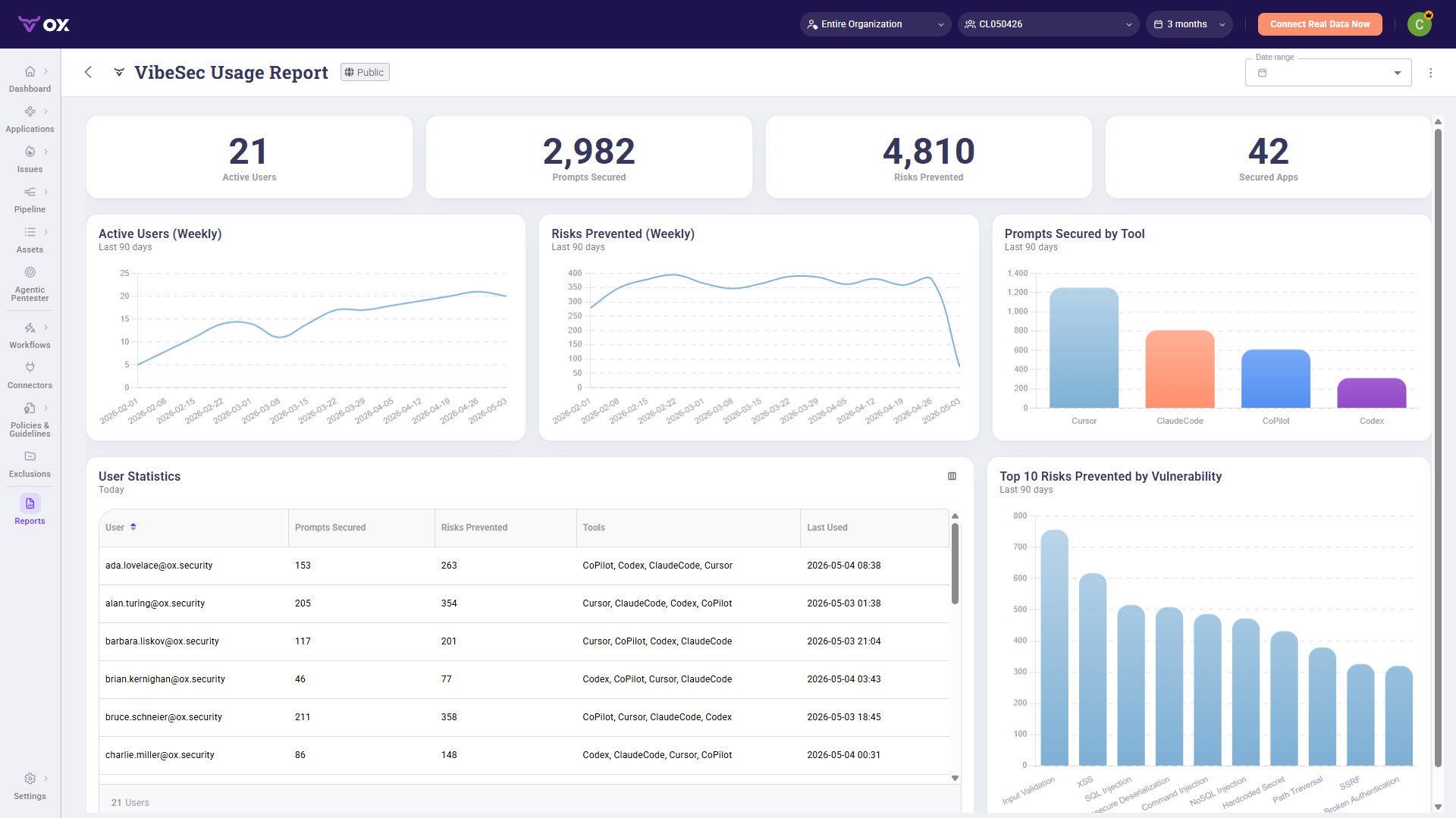
To defend against the chaotic output of AI-native programming, OX Security introduces OX VibeSec – a platform-wide capability engineered to neutralize vulnerabilities in AI-generated code at the exact moment of creation. OX VibeSec embeds automated, context-driven security guardrails directly into developer workflows via its Code Security Agent.
Instead of generating massive lists of static alerts, it evaluates the semantic intent of machine-generated code in real time, automatically stripping out hardcoded secrets and blocking risky outputs as code is built. It enforces Custom Coding Guidelines to deterministically apply organizational code security requirements, while the Secure Dependency Gate automatically disables automated deployments of malicious or hallucinated application components.
Beyond real-time prevention, OX VibeSec delivers total operational visibility through its AI Agent Bill of Materials (AI BOM), which automatically catalogues every component in your AI coding stack. This is paired with an Agent Activity Log that maintains a continuous, granular history of prompt interactions and tool usage, ensuring your AI development ecosystem is fully auditable.
Trace Exposure from AI Gen to Cloud Runtime
The core strength of the OX Security platform lies in its ability to eliminate the code-to-cloud visibility gap. OX continuously tracks application risk across its entire lifecycle, mapping the DNA of AI-generated artifacts directly to live cloud infrastructure.
By running automated, non-disruptive exploitability validations, OX can pinpoint exactly which AI-generated flaws are genuinely reachable by external threats at runtime. If a vulnerability poses a real-world business risk, OX doesn’t just alert the team to a broad cloud container; it traces the exploitable path all the way back to the exact code repository, file, and line of code responsible. This deep, multi-layered context enables AppSec leaders and development teams to ignore unroutable noise, prioritize true exposures, and fix critical flaws at the source before they ever hit production.
Secure the Future of AI-First Development
In summary, the reality of modern development is undeniable: you cannot secure machine-speed code generation using human-speed reactive workflows. Defending an enterprise accelerated by AI coding assistants requires an equally intelligent, AI-native security architecture.
Relying on disconnected scanners that run long after code is written only guarantees a mountain of false positives, mounting security debt, and critical visibility gaps that leave live applications exposed. To maintain velocity without sacrificing integrity, organizations must deploy real-time, context-aware guardrails that govern, validate, and secure code at the exact millisecond of inception. For those tasked with scaling software security without choking engineering pipelines, the next logical milestone is moving away from post-hoc, legacy scanning.
The OX Security Platform gives you the tools to securely embrace AI-driven velocity. It is the only platform that enables organizations to prevent new risks, secure development systems, and fix previously identified issues across the entire AI coding stack – reducing newly created production issues by as much as 90 percent. With OX VibeSec, you can automatically prevent vulnerabilities in AI-generated code by feeding live cloud, API, and policy context directly into your team’s preferred AI code editors (like Cursor or Claude Code) before the AI ever generates code. Rather than managing endless backlogs, OX VibeSec intercepts flaws at the initial prompt level, keeping developer workflows completely uninterrupted while ensuring every line of machine-assisted software is secure from inception.
Don’t let machine-speed generation outpace your defense. Schedule a personalized demo of OX VibeSec today to stop scanning and start preventing.
FAQs
OX VibeSec bypasses traditional “after-the-fact” scanning by intercepting the developer’s prompt and analyzing likely security risks in the background. It then sends context-specific security guidelines directly to the AI coding agent (like Cursor or GitHub Copilot) before generation, forcing the model to write clean, compliant code without interrupting the developer’s workflow.
Yes. Enterprise policy rules are configured directly in OX’s centralized dashboard as Policy-as-Code. These organizational priorities and compliance requirements are fed seamlessly into VibeSec’s active guidelines, which automatically govern agent parameters across various programming languages.
No. VibeSec works invisibly in the background, communicating parameters directly to the underlying AI models rather than blocking human pull requests. Because it forces the AI tool to write secure code from the first line, it prevents security backlogs and completely eliminates the classic “rework” bottleneck.
VibeSec is designed as a platform-agnostic layer that integrates across the entire enterprise AI ecosystem. It securely monitors and guides leading coding suites — including Cursor, Windsurf, GitHub Copilot, and Claude Code — while granting security teams the administrative power to allow or block specific external SaaS integrations and LLM extensions.