Even non-developers are using AI coding tools. How do you reduce risk?
TL;DR
- The vibe coding era has unlocked lasting productivity gains, but the frontier is moving faster than most organizations’ security practices can handle.
- AI coding tools aren’t just for developers. Product managers, QA analysts, and business analysts are building things too, sometimes with no awareness of your approved models, compliant dependencies, or security policies.
- Autonomous AI agents can delete databases, expose secrets, and publish repositories publicly, not maliciously, but because nobody defined the boundaries.
- Using multiple AI coding tools (Cursor, Claude Code, Copilot, Windsurf) means IDE-native security only covers its own environment. Policies don’t follow teams from one tool to the next.
- OX VibeSec embeds governance directly into the AI coding stack, finding vulnerabilities at the moment of creation, controlling who can use what, and providing full visibility across every model, agent, and tool in the pipeline, without reducing velocity.
There’s a version of this story where everything goes right. A developer opens Cursor, describes the feature they need, watches the code appear, reviews it briefly, and ships. Securely.
That’s it. The business moves forward.
This is genuinely happening. Across engineering organizations of every size, AI coding tools are delivering on their promise of velocity, acceleration, and quality output.
But there’s a parallel story unfolding in the same organizations. These stories don’t surface until something breaks.
A dependency slips in that nobody explicitly approved. A pattern gets replicated across dozens of files before anyone notices it’s insecure. A team outside of engineering, emboldened by how accessible AI tools have made software creation, triggers something catastrophic without realizing it was even possible.
What are you doing to head off this unprecedented risk?
The Frontier Has Always Needed Fences
The history of transformative technology follows a predictable arc. A new capability arrives, spreads faster than anyone anticipated, and creates extraordinary value. With that comes new categories of risk that the previous era’s rules weren’t designed to address.
The internet didn’t come with a security model. Cloud computing didn’t either. In both cases, governance had to be invented after the fact, often in response to something gone wrong.
AI coding is different only in speed. The tools are spreading so fast (and the productivity gains are so visible) that many organizations are again treating security as a problem to solve later. Or they’re falsely assuming native prevention. That instinct is understandable but it’s also how technical debt of the most perilous kind gets created.
We don’t have to repeat the pattern this time. The lesson of every previous frontier is not that speed is necessarily a bad thing. It’s more that organizations that built in governance early were the ones that most often scaled without catastrophic incident.
They didn’t move slower. They moved with intention. The teams winning the AI development race aren’t simply moving the fastest. They’re moving deliberately.
The Problem Hiding in Plain Sight: It’s Not Just Developers
Here’s a scenario playing out inside many organizations right now, largely below the radar of legacy security practices:
A product manager, comfortable with AI tools from their personal life, starts using Cursor or Claude to build out a quick internal prototype. A QA analyst, tired of waiting for engineering bandwidth, uses an AI assistant to write a test automation script. A business analyst generates a small data pipeline to answer a reporting question.
None of these people think of themselves as developers. None of them have been sufficiently briefed on their organization’s approved AI models, compliant dependencies, or secure development policies.
This is not a criticism of those workers, it’s a structural problem. AI coding tools have dramatically lowered the barrier to writing software with AI-generated code, which means the population of people writing software has expanded far beyond the group familiar with your AppSec practices.
The risk here isn’t theoretical. When non-engineering users operate AI coding tools without guardrails, they can inadvertently expose credentials, publish code containing PII, introduce dependencies with known vulnerabilities, or connect systems in ways that create an attack surface nobody intended. They don’t know they’re doing it. That’s the point.
At the same time, the answer is not to restrict access to AI tools, full stop. The productivity value is real and uniformly locking it down would be both impractical and counterproductive.
The answer is to apply governance at the layer where the risk actually originates: the AI coding environment itself.
The Scenario That Keeps Security Teams Up at Night
Beyond the non-developer problem, there is a category of AI-driven risk that deserves its own conversation: the catastrophic, unintentional action.
Imagine an AI coding agent, operating autonomously in a vibe workflow, that misinterprets an instruction and deletes a production database. Or surfaces and publishes secrets embedded in a repository. Or exposes infrastructure that was never meant to be public-facing.
These aren’t hypothetical edge cases. They are foreseeable outcomes of systems with significant operational capability but no awareness of organizational boundaries.
The challenge is that AI agents are, by design, action-oriented. They are built to execute. In autonomous or semi-autonomous workflows, the feedback loop between intention and consequence can be extraordinarily short.
A human developer who was about to delete a database would likely pause. An AI agent following an instruction that points in that direction may not.
This is why governance at the AI coding layer has to be about more than vulnerability detection. Defining, enforcing, and continuously monitoring the boundaries of what AI systems are permitted to do is critical, not as a philosophical position, but as an operational requirement.
The Multi-Tool Reality (And Why It Complicates Everything)
There is one more structural challenge that most AI coding security conversations gloss over: most engineering organizations are not using just one AI coding tool, especially when you consider the “non-developer” movement.
Cursor for some teams, Claude for others, GitHub Copilot for the developers who were already using it, and whatever the non-engineering teams have quietly adopted in the background. Each of these tools has its own model, its own interface, and its own set of MCP server integrations and AI supply chain dependencies. Each of them is also a potential vector for the risks described earlier.
This matters for a specific reason: IDE-native security capabilities (where they exist at all) can only secure their own environment. A guardrail built into Cursor doesn’t follow a developer into Claude. A policy enforced in one tool doesn’t automatically apply to the next one a team member opens.
What organizations actually need is not tool-specific security — it is a governance layer that sits above the tools, applies consistently regardless of which AI coding interface is in use, and provides a single view of risk across the entire AI development ecosystem.
Speed Without Friction: The False Tradeoff
At this point, the security-minded reader may be nodding. The developer-minded reader may be growing skeptical.
Every time security teams have tried to add governance to a development workflow, the result has been friction. Slower pipelines, interrupted flow states, security reviews that take longer than the features they’re reviewing — stop us if you’ve heard this before.
This is a legitimate historical grievance. It’s also a solvable problem, and addressing it is precisely what effective AI coding security should be designed to do.
The goal should be to embed security directly into the environment where code is being created so vulnerabilities are caught and remediated at the moment of inception, before they become something a downstream tool has to find, ticket, and assign — the root cause of security team alert fatigue.
The developer never leaves their IDE. Their velocity is unchanged. The security posture of what they’re building is fundamentally different.
This also has direct implications for token consumption and latency. These are two concerns that come up immediately in any honest conversation about AI coding security.
The right model is one that operates efficiently in the background: not re-processing everything the AI generates, but intercepting and addressing risk at precisely the moments that matter.
Security that introduces latency is security that gets turned off. That outcome helps nobody.
What Governing the AI Coding Stack Actually Looks Like
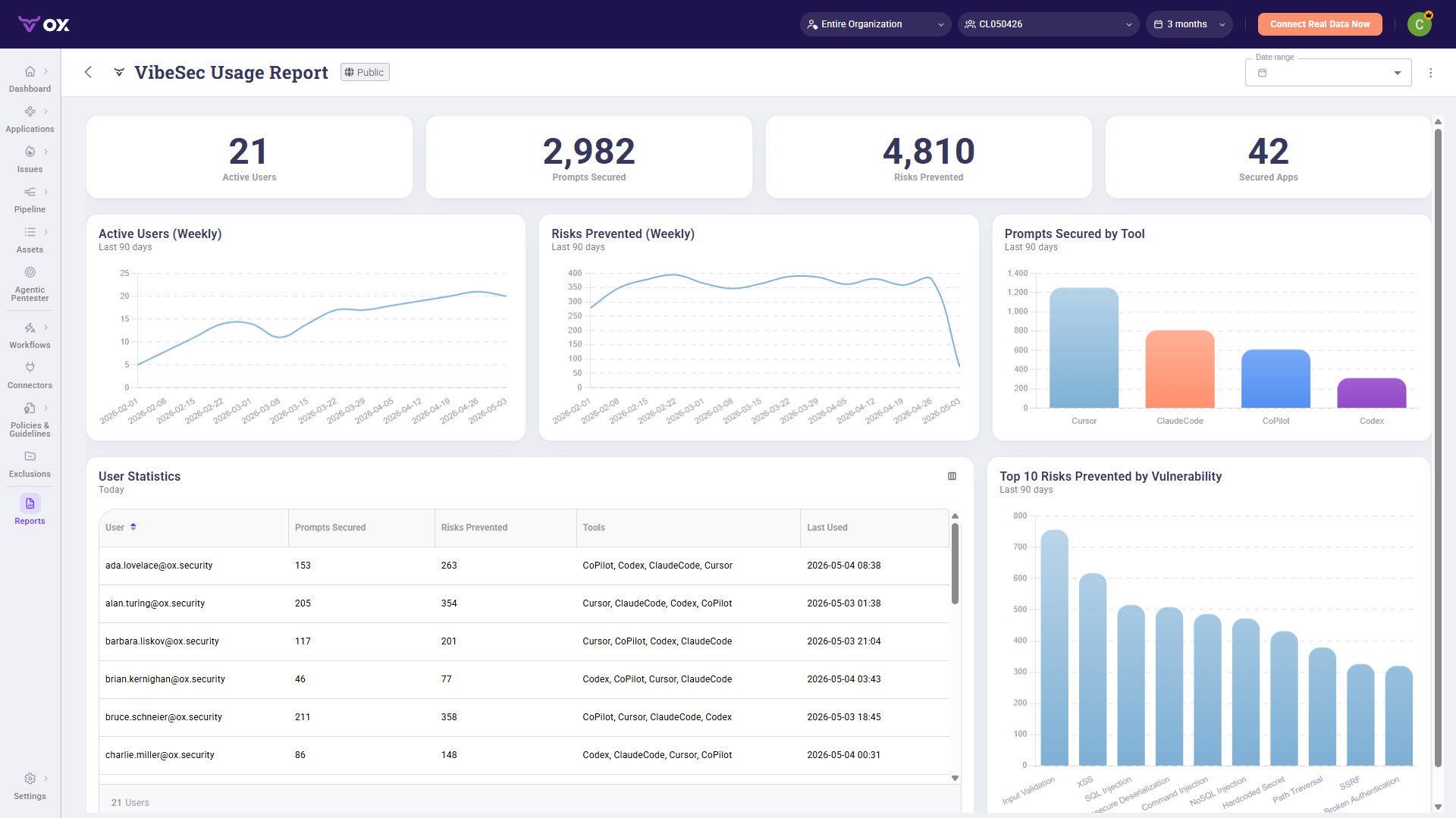
OX VibeSec was built to address this specific set of problems — not as an adjacent solution that has been retrofitted to the AI coding context, but as a platform designed from the ground up for the vibe coding era.
The starting point is the Code Security Agent: a capability that integrates directly into AI coding tools (across Cursor, Claude, and whatever else is in your stack) to automatically eliminate newly introduced vulnerabilities at the point of creation.
The developer gets immediate remediation guidance without leaving their environment. The security team gets fewer issues to triage downstream. The feedback loop between risk and resolution collapses from days to seconds.
But catching vulnerable code at the point of creation is only part of the picture. Governing the AI coding stack means understanding everything that’s operating inside it.
OX VibeSec’s AI Bill of Materials capability does exactly that: automatically identifying, cataloguing, and continuously monitoring every component across the AI coding ecosystem including MCP servers, models, skills, hooks, and agent behaviors.
In an environment where developers are pulling in external components faster than any manual review process can track, this kind of automated inventory isn’t a nice-to-have. It’s the foundation of any meaningful governance posture.
AI Usage Controls from OX address the non-developer problem directly. Organizations can apply fine-grained policies that govern which models, interfaces, and dependencies are approved for use and automatically block those that aren’t, at the user and team level.
Product managers, QA analysts, and business analysts can work in AI coding environments without security teams having to assume the worst. The boundaries are defined and enforced at the platform layer, not through training and hope.

For the catastrophic-action scenario, the Secure Dependency Gate prevents malicious, hallucinated, or non-compliant components from making it into code or production, disabling automated deployments of problematic packages before they can do damage.
Custom Coding Guidelines ensure that organizational security requirements are applied deterministically, regardless of which tool or team is doing the building.
Skill Scanning adds a layer of protection specific to autonomous AI workflows: automatically scanning, flagging, and quarantining risky agent skills before they can propagate through a pipeline.
The Agent Activity Log provides the continuous, exportable audit trail that security and compliance teams need: full visibility into what the system did, when, and why.

Taken together, these capabilities don’t just address individual risk vectors. They create a governance infrastructure for the entire AI development lifecycle, one that sits above the tools, connects to the broader AppSec and SecOps context of OX AI-native application protection platform, including OX Code, which continues the security analysis once AI-generated code lands in your repositories and feeds insights from runtime and production back into the development environment where they can actually prevent the next issue.
The Deliberate Organization Wins
The organizations that will define what secure AI development looks like — those already operating with AI-native application security in place —are not the ones waiting to see how this plays out. They are building the infrastructure now — the guardrails, the visibility, the governance layer that makes speed sustainable rather than reckless.
The vibe coding era is not going to slow down. The productivity gains are too real, and the competitive pressure to ship faster is too intense.
What will separate the organizations that thrive from the ones that spend years unwinding self-inflicted damage is whether they built the fences before they needed them.
The frontier always gets settled eventually. The question is whether you’re the one who built the process everyone else depends on, or the one who had to learn the hard way why it mattered.
OX is the only platform that enables organizations to prevent new risks, secure development systems and fix previously identified issues across their entire AI coding stack — reducing newly created production issues by as much as 90%.
If you’d like to see OX VibeSec in action, sign up for a demo or start for free today.