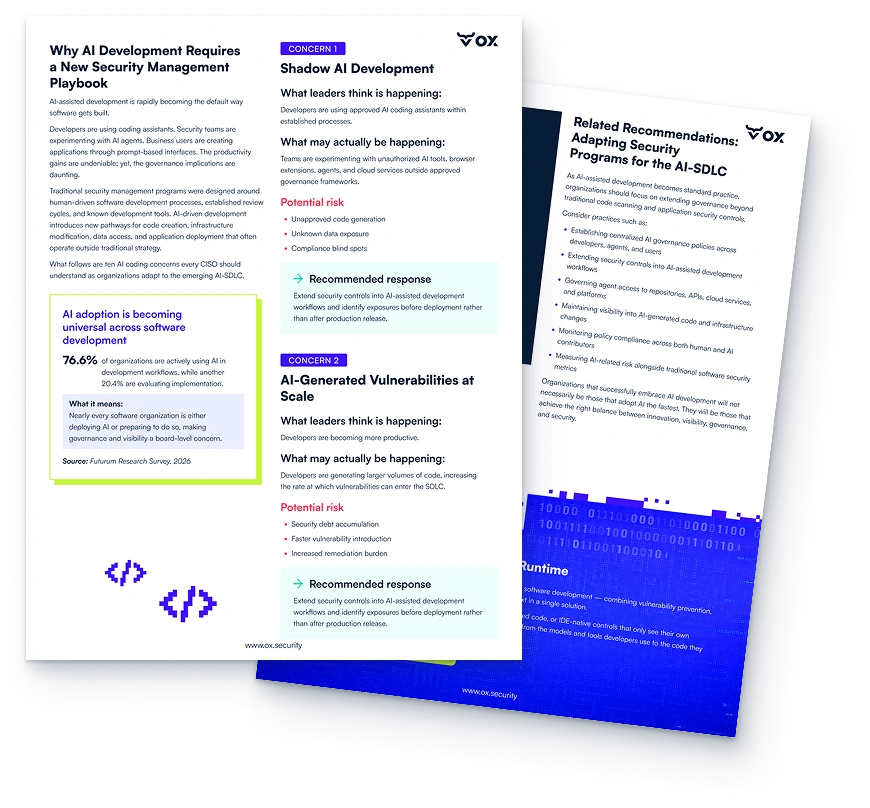

TL;DR
- AI code security is the practice of preventing, detecting and fixing vulnerabilities in code that AI assistants and coding agents generate, at the point the code is created rather than after it is committed. For enterprises, it is now a distinct discipline because AI writes a large share of committed code and roughly half of it fails security testing.
- AI is speeding up how code is written, but it is also increasing risk at the same pace. Veracode’s 2026 GenAI Code Security Report puts the pass rate for AI-generated code at 56%, barely changed from the previous year, and many of these issues reach production before security teams can review them. This creates a gap that traditional approaches are not built to handle.
- Traditional application security tools are overwhelmed with volume and lack context. They generate thousands of alerts, most of which are low priority, making it difficult for teams to identify and act on real risks. This leads to alert fatigue and delays in fixing critical vulnerabilities.
- OX VibeSec changes how security works by bringing it directly into the developer workflow. Instead of checking code after it is written, it identifies and corrects insecure patterns as the code is generated. This reduces delays and improves accuracy.
- The OX AI-native application protection platform (AINAPP) makes this approach practical at enterprise scale, carrying every finding from the prompt that produced it through to the runtime it threatens. It understands how code behaves in real conditions and surfaces only the vulnerabilities that are actually exploitable in your environment.
- Developers get clear, actionable fixes inside their existing tools, allowing them to resolve issues instantly. This keeps development fast while lowering security debt, helping teams scale without losing control over risk.
Your developers are shipping faster than ever. AI-assisted development tools like GitHub Copilot and Cursor have changed the pace at which code gets written, reviewed, Your developers are shipping faster than ever. AI-assisted development tools like GitHub Copilot and Cursor have changed the pace at which code gets written, reviewed, and pushed to production – and for teams adopting prompt-based workflows, vibe coding security represents the sharpest edge of that acceleration: entire applications built through natural language prompts and shipped with no code review, no threat model, and no security gate between the AI’s output and production. For Application Security (AppSec) teams, that speed creates a problem that is getting harder to ignore.
According to Veracode’s 2026 GenAI Code Security Report, AI-generated code passed security testing only 56% of the time across more than 100 tested models – a rate essentially flat against the year before. In other words, close to half of AI code generation tasks still introduce a security weakness, and the problem is not receding as the models improve. That is why AI code security has become a non-negotiable discipline for AppSec teams: when almost one task in two produces a flaw, and most of it reaches production before anyone reviews it, post-build scanning is already too late.
The tools most AppSec teams rely on were built for a different era. They were designed around human-speed development cycles, sitting outside the workflow and generating long lists of alerts that developers learn to tune out over time – which is precisely why AI security testing tools purpose-built for AI-generated code are not optional: they combine semantic understanding, runtime context, and in-workflow interception that legacy scanners were never architected to deliver. In an environment where code volume has grown dramatically and the attack surface expands with every AI-assisted commit, those tools are no longer keeping up, which is why AI security for AppSec demands a fundamentally different approach, one built around how AI-generated code is created and deployed, not how human-written code was reviewed in the past.
What AppSec teams need is security that works at the same speed developers do, understands the context of the codebase rather than flagging generic patterns, and gives developers fixes they can act on without pulling them out of their workflow.
We walk through why AI code security has become one of the most pressing challenges for AppSec teams – part of the broader AI application security challenge that extends beyond code generation to model behavior, agent workflows, and runtime exposure – where traditional tools fall short, and how OX gives enterprise teams a way to stay ahead of risk without slowing development down.
What Is AI Code Security?
AI code security is the discipline of preventing, detecting, and remediating security weaknesses in code produced by AI coding assistants and autonomous agents. It covers the prompt that generates the code, the dependencies the model suggests, the secrets and permissions it embeds, and the runtime behavior of what ships – applying controls at the moment of creation rather than after commit.
That definition matters because the failure mode is different from human-written code. A developer who introduces an injection flaw usually does it once. A model that has learned an insecure pattern reproduces it consistently, across every repository and every developer using the same assistant, at a rate no review process was sized for.
For a wider treatment of the threat categories and prevention patterns, see our guide to AI code security threats and best practices. This guide focuses on what enterprise AppSec teams specifically need to put in place: the risks that matter at scale, how to secure the pipeline end to end, and how to evaluate tooling.
What Are the Specific Risks in AI-Generated Code?
Four risk classes account for most of what AppSec teams find in AI-generated code. They are not new vulnerability types. What is new is the rate at which they appear and the fact that they arrive looking correct, because the model produces syntactically clean, plausibly structured code around them.
| Risk | What it looks like in AI-generated code | Why traditional tooling misses it |
|---|---|---|
| Hallucinated dependencies and slopsquatting | The model imports a package that does not exist. Attackers register the name and wait. Across 16 code-generating models, 19.6% of recommended packages did not exist – 205,474 unique fake names – and roughly 45% reappeared every time the same prompt was run, which is what makes them worth registering. | Composition analysis validates the packages you have. A hallucinated import that an attacker has since registered resolves as a real, low-profile package with no CVE history. |
| Hardcoded secrets and credentials | Models complete configuration blocks and connection strings with literal values because that is what the training data looks like. The secret is functional, so tests pass. | Secret scanners fire on pattern matches without knowing whether the credential is live, scoped to production, or a placeholder in a test fixture – so the finding lands in the same undifferentiated queue as everything else. |
| Injection through unvalidated input | Generated database queries and shell calls interpolate parameters directly. The code works for the case the developer described in the prompt and fails for the case they did not. | Static analysis flags the pattern but cannot tell whether a custom validator downstream sanitizes the input, which is what produces the false-positive volume teams learn to ignore. |
| Insecure API and agent permissions | Endpoints ship without authentication or rate limiting; agents are granted broad tokens because the prompt asked for something that works. | The flaw is in what the code is permitted to do at runtime, not in its syntax. Nothing in the source file is wrong. |

Why Can’t Traditional AppSec Tools Keep Up?
The security risks AppSec teams are dealing with right now go well beyond the technical. They are operational, and in many organizations, they have already reached a point where the current approach is no longer sustainable. The most immediate issue is alert fatigue. According to OX Security’s 2025 Application Security Benchmark, the average organization receives over 500,000 security alerts, with 95 to 98% being non-critical or false positives.
Refer to the graph below:

When the overwhelming majority of what your team reviews every day turns out to be irrelevant, the natural response is to become less responsive overall, including to the alerts that actually matter. In the 2025 SANS Detection and Response Survey, 73% of organizations named false positives their number one threat-detection challenge, and the share encountering them very frequently rose from 13% to 20% year over year. That is not an edge case. That is most security teams describing their current reality.
AI-generated code makes this problem worse in a specific way. When a developer uses GitHub Copilot or Cursor to write a function, the code looks clean, passes review, and ships. The vulnerability is not obvious and does not trigger a loud alarm. It sits quietly in the codebase until an attacker finds it. Traditional scanners are not built to distinguish between a high-risk pattern in AI-generated code and a routine false positive – which is exactly the gap an AI vulnerability scanner closes, using semantic reasoning and runtime reachability to separate exploitable threats from irrelevant noise before they hit the developer queue.
There is also a supply chain dimension that often gets missed. AI tools frequently suggest third-party dependencies as part of their code recommendations, and developers accept those suggestions without necessarily reviewing the security posture of each package. As AI-assisted development scales across dozens of repositories and hundreds of developers, the dependency chain quietly expands in ways that no traditional scanner was built to track in real time.
When your team is spending most of their time working through noise, there is very little capacity left to see the risks that genuinely need attention. Trying to solve this by adding more scanning tools or hiring more analysts only compounds the same underlying problem. The structure of how security works in relation to development needs to change.
How to Secure AI Code Across the SDLC
Securing AI-generated code is a pipeline problem, not a scanning problem. Each stage below closes a gap the previous one cannot reach.
- Govern which AI tools are in use: Inventory the assistants, agents, Model Context Protocol (MCP) servers, and extensions your developers have installed, and what permissions each holds. An AI Bill of Materials (AI-BOM) gives you that inventory in the same way an SBOM does for dependencies. You cannot apply policy to tooling you cannot see.
- Apply policy at the prompt: Encode your organization’s coding standards, banned patterns, and approved libraries as guidance the assistant receives before it generates. This is the only control point where a vulnerability can be prevented rather than found.
- Vet dependencies before they enter the branch: Check every model-suggested package against the registry for existence, age, maintainer history, and download profile. A package that appeared last week and matches a name your assistant has suggested before warrants a hard block, not a warning.
- Scan on generation, not only on commit: Run analysis as the code appears in the editor. A finding a developer sees while the context is still in their head costs minutes; the same finding in a ticket three sprints later costs a rebuild of that context.
- Prioritize on reachability, not severity score: Establish whether the flawed path is reachable from an entry point, loaded at runtime, and exposed to untrusted input. This is what separates the handful of findings that matter from the hundreds of thousands that do not.
- Validate that the controls hold: Test the running application adversarially and confirm that the patterns you prevented upstream never reached production, and that the permissions you granted agents cannot be chained into something worse.
Best AI Code Security Tools for Enterprises
The tools below approach AI code security from different starting points. The distinction that matters for enterprise buyers is whether a platform can prevent an insecure pattern before it is written or can only report it afterwards.
| Tool | Primary approach to AI-generated code | Best suited to |
|---|---|---|
| OX Security | Governs the AI tooling layer (agents, MCPs, extensions) through an AI-BOM, steers code as it is generated against organization-specific guidelines, then validates across code, cloud, and adversarial testing on one platform. | Enterprises that want prevention at the prompt plus consolidated validation, rather than another scanner feeding the same queue. |
| Snyk | Developer-first scanning across code, dependencies, containers and IaC, surfaced in the IDE as code is written. | Teams prioritizing broad developer adoption and dependency coverage. |
| Checkmarx | Enterprise AST suite – SAST, SCA, DAST, IaC and secrets – with an Assist agent family covering developer guidance and triage, plus an AI-BOM inventory and LLM scanning for AI components. | Large AppSec programs with established scan-and-remediate workflows. |
| GitHub Advanced Security | CodeQL analysis, secret scanning and Copilot Autofix, native to GitHub repositories and pull requests. | Organizations standardized on GitHub end to end. |
| SonarQube | Static analysis for code quality and security defects, run in CI and in the IDE. | Teams treating security findings as part of a wider code-quality gate. |
How Does OX Secure AI-Generated Code?
In most organizations, security still operates as a separate layer. Code is written first, often with the help of AI tools, and security checks come later through scans, reviews, or pipeline gates. That delay creates a gap. By the time a vulnerability is found, the developer has already moved on, and fixing it becomes slower and more troublesome.
The OX AINAPP governs agents, code, and cloud as one platform from prompt to runtime, leveraging a set of components that draw on a shared context. OX VibeSec closes the initial gap by embedding security into the workflow where the code is generated. It governs which agents, MCP servers, skills, and packages are allowed to run and with what permissions, enforces your own coding guidelines as the assistant writes, and vets dependencies before they enter the build. OX Code then validates what shipped, OX Cloud enforces the boundaries that code and agents cannot cross, and OX Agentic Pentester tests on demand whether those controls hold under adversarial pressure.
What the Platform Shows an AppSec Engineer
The first thing you notice in OX is that it does not overwhelm you with raw alerts. Rather, it starts by organizing risk.

On the dashboard, you can see how thousands of alerts get reduced into a much smaller, prioritized set. For example, tens of thousands of original alerts are aggregated and narrowed down to a few hundred that actually need attention. This is critical in AI-driven environments where code volume is high and traditional tools generate excessive noise.
Below that, the PBOM (Pipeline Bill of Materials) connects everything. By integrating OX Code and OX Cloud, the platform maps source control and pipelines to cloud environments. Source control, pipelines, open source dependencies, infrastructure as code, and cloud environments are all mapped together. This is where OX becomes useful for AI-generated code. When AI suggests a dependency or generates logic that touches multiple layers, OX does not treat it as isolated code. It understands how that code connects across the system.
Understanding Risk at the Application Level
Once you move from the dashboard into applications, the view becomes more actionable. Each application is listed with business priority, severity of issues, and exposure. You can immediately see which services are carrying the highest risk and which ones are relatively stable.

This matters for AI-generated code because a developer can generate a feature, merge it and move on within an hour. OX connects that code to the application it belongs to and to how exposed that application actually is, so prioritization is tied to business impact rather than to severity labels.
Drilling Down Into Actual Vulnerabilities

Each vulnerability is not just a line item. It includes severity, category, affected application, owner, when it was first seen, and how long it has been open. You can see examples like:
- SQL injection in an API endpoint.
- Exposed secrets in a public repository.
- Vulnerable open source packages with known CVEs (Common Vulnerabilities and Exposures).
- Misconfigured cloud storage with public access.
Where OX Helps Specifically with AI-generated Code
When developers use AI tools, they tend to trust the output because it works functionally. Three things close that gap. OX identifies vulnerabilities as code moves through repositories and pipelines, before they are deeply embedded. OX Cloud evaluates how that code interacts with infrastructure and runtime exposure, so a finding is judged on what it can actually reach. And because only exploitable findings surface, the queue stays small enough to act on.
From Post-Commit Scanning to Prevention at the Point of Creation
AI-assisted development has changed how software is written, but security practices have not kept pace. Teams are dealing with a growing volume of code, expanding attack surfaces, and an overwhelming number of alerts, most of which do not require action. As a result, real vulnerabilities often remain hidden in noise and reach production before they are properly addressed.
Finding more flaws faster does not solve that, because volume was never the constraint. The constraint is knowing which findings can actually be reached, and stopping the rest from being written at all. That is what prevention at the point of creation means in practice: policy applied to the agent before it generates, dependencies vetted before they enter the branch, and validation that proves the controls held instead of opening another queue.
The OX AINAPP does this as one platform rather than four tools. OX VibeSec governs the AI user ecosystem – agents, MCP servers, skills and packages – and prevents unsafe patterns at the prompt. OX Code validates what prevention achieved across source and supply chain. OX Cloud enforces the boundaries agents cannot cross at runtime. OX Agentic Pentester runs on demand to prove those controls hold under real attack conditions. Because all four work from the same context, a finding arrives with the evidence needed to act on it rather than as one more alert to triage.
See how the OX AINAPP governs your agents, code, and cloud from prompt to runtime, or book a demo to see it run against your own pipeline.
FAQs
AI code security focuses on identifying and fixing vulnerabilities introduced by AI-generated code. This has become important because AI tools can generate large volumes of code quickly, and Veracode’s 2026 testing found that only 56% of AI-generated code passes security tests, so a significant portion reaches production with weaknesses if it is not addressed early.
Traditional tools rely on pattern-based scanning and operate after code is written. They do not understand how code behaves in a real environment, which leads to large volumes of false positives and missed risks. In AI-driven development, this approach cannot keep up with the speed and scale of code generation.
OX VibeSec is a product rather than a methodology. It embeds security inside the tools where code is now written, including IDEs and AI coding assistants, and governs which agents, MCP servers, skills, and packages are allowed to run and with what permissions. DevSecOps integrates security into the pipeline, but those checks still run after the code exists. VibeSec moves the control point earlier, to the prompt, before the code is generated.
The OX AI-native application protection platform (AINAPP) uses OX VibeSec, OX Code and OX Cloud to follow code from the prompt that generated it through to what runs in production. By tracking that journey in a Pipeline Bill of Materials (PBOM), OX identifies vulnerabilities that legacy scanners miss because they only see one layer.
OX filters out low-priority and non-exploitable findings and highlights the small percentage of issues that actually matter. This allows teams to focus on real risks instead of reviewing thousands of irrelevant alerts, improving both efficiency and response time.
Look for prevention rather than detection alone: whether the tool can enforce your coding standards at the point of generation, whether it inventories the AI assistants and agents your developers actually use, and whether it prioritizes runtime reachability rather than severity score. A tool that only adds findings to an existing queue does not change the outcome.
No. VibeSec works invisibly in the background, communicating parameters directly to the underlying AI models rather than blocking human pull requests. Because it forces the AI tool to write secure code from the first line, it prevents security backlogs and completely eliminates the classic “rework” bottleneck.
VibeSec is designed as a platform-agnostic layer that integrates across the entire enterprise AI ecosystem. It securely monitors and guides leading coding suites – including Cursor, Windsurf, GitHub Copilot, and Claude Code – while granting security teams the administrative power to allow or block specific external SaaS integrations and LLM extensions.
Yes. Enterprise policy rules are configured directly in OX’s centralized dashboard as Policy-as-Code. These organizational priorities and compliance requirements are fed seamlessly into VibeSec’s active guidelines, which automatically govern agent parameters across various programming languages.